Menu
Store
Blog
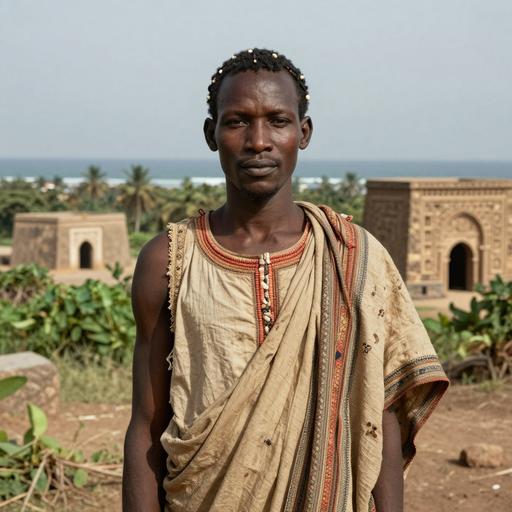
Portrait reconstruction of I8816
Ancient Individual

A man buried in Tanzania in the Medieval era

I8816
1300 CE - 1600 CE
Male
Swahili Culture of Kilwa
Tanzania
Scroll to begin
Chapter I

Identity

The biological and cultural markers that define this ancient individual

Sample ID

I8816

Date Range

1300 CE - 1600 CE

Biological Sex

Male

mtDNA Haplogroup

L2a1h

Y-DNA Haplogroup

J-Y25795

Cultural Period

Swahili Culture of Kilwa

Chapter II

Place

Where this individual was discovered

Country Tanzania
Locality Kilwa (Kilwa District)
Coordinates -8.5750, 39.3105
Chapter III

Time

When this individual lived in the broader context of human history

I8816 1300 CE - 1600 CE
Chapter IV

Story

The narrative of this ancient life

The Swahili culture of Kilwa Kisiwani, an island off the coast of modern-day Tanzania, is a fascinating blend of African, Arab, Persian, Indian, and later European influences that emerged from the 9th century onwards. This culture reached its zenith between the 13th and 15th centuries, establishing itself as a significant player in the Indian Ocean trade network. The Swahili culture is characterized by its linguistic, architectural, economic, social, and spiritual distinctiveness, reflecting the multifaceted interactions within the region.

Geographic and Historical Context

Kilwa Kisiwani is part of the Swahili Coast, which stretches from southern Somalia to northern Mozambique, including several coastal islands. This strategic location on the Indian Ocean made Kilwa one of the most prosperous city-states in the region. Kilwa's significance peaked during the 13th and 14th centuries under the rule of the Mahdali dynasty, who claimed descent from Persian royalty.

Economic Prosperity

The prosperity of Kilwa was primarily due to its role in the trade routes that connected Africa to the Middle East, India, and beyond. The Swahili people were master navigators and traders, dealing in gold, ivory, tortoiseshell, and slaves from the African interior, which they exchanged for cloth, spices, ceramics, and other luxury goods from Asia. The Kilwa Sultanate controlled the trade of gold from the kingdom of Great Zimbabwe, which was shipped via the port of Sofala, further enhancing its wealth and influence.

Linguistic and Cultural Synthesis

Swahili, the language spoken by the people of Kilwa, is a Bantu language heavily influenced by Arabic, due to centuries of interaction and intermarriage with Arab traders. This synthesis is evident in Swahili culture, where African and Islamic traditions blended seamlessly. Islamic practices, while prevalent, were adapted to fit local contexts, resulting in unique cultural expressions.

Architectural Achievements

Kilwa is renowned for its impressive architecture, which includes coral stone structures and grand edifices like the Great Mosque of Kilwa and the Husuni Kubwa palace. The Great Mosque, one of the oldest standing mosques on the East African coast, exemplified Islamic architectural elegance combined with local building techniques. Husuni Kubwa, a significant palatial complex, reflected the wealth and sophistication of the Swahili elite, featuring numerous rooms, courtyards, and even a swimming pool, showcasing advanced engineering skills.

Social and Political Structure

The society in Kilwa was cosmopolitan, with a social structure that included diverse groups such as Africans, Arabs, Persians, and later Portuguese settlers. The sultanate was the central political authority, with the Sultan at the top, supported by a class of wealthy merchants. The matrilineal system in some Swahili communities allowed women a degree of influence and property rights, which was unusual in many other Islamic societies of the time.

Religious Life

Islam played a central role in the cultural and social life of Kilwa, influencing law, education, and daily practices. The spread of Islam was facilitated by trade; however, traditional beliefs and practices were often interwoven with Islamic ones. The presence of mosques, Quranic schools, and Islamic scholars underscored the importance of religion in Kilwa.

European Contact and Decline

In the late 15th century, Kilwa came into contact with the Portuguese, who sought to control the Indian Ocean trade routes. In 1505, the Portuguese, led by Francisco de Almeida, captured Kilwa and other key Swahili ports, initiating a period of decline for the once-prosperous city-state. Subsequent conflicts, coupled with the shifting trade routes, eventually led to the diminishing influence of Kilwa.

Legacy

Today, Kilwa Kisiwani is a UNESCO World Heritage Site, recognized for its historical and cultural significance. The remnants of its architectural marvels and the rich cultural history continue to intrigue researchers and tourists alike. The Swahili culture of Kilwa represents a remarkable example of cultural and economic exchange in the pre-modern world, showcasing the dynamism and adaptability of East African societies in response to global interactions.

In summary, the Swahili culture of Kilwa was a vibrant and sophisticated maritime society that played a pivotal role in the regional and transoceanic trade networks. Its legacy persists in the Swahili language, culture, and the enduring remains of its architectural achievements.

Chapter V

Context

Other ancient individuals connected to this sample

Sources

References

Scientific publications and genetic data

Scientific Publication

Entwined African and Asian genetic roots of medieval peoples of the Swahili coast

Authors Brielle ES, Fleisher J, Wynne-Jones S
Abstract

The urban peoples of the Swahili coast traded across eastern Africa and the Indian Ocean and were among the first practitioners of Islam among sub-Saharan people1,2. The extent to which these early interactions between Africans and non-Africans were accompanied by genetic exchange remains unknown. Here we report ancient DNA data for 80 individuals from 6 medieval and early modern (AD 1250-1800) coastal towns and an inland town after AD 1650. More than half of the DNA of many of the individuals from coastal towns originates from primarily female ancestors from Africa, with a large proportion-and occasionally more than half-of the DNA coming from Asian ancestors. The Asian ancestry includes components associated with Persia and India, with 80-90% of the Asian DNA originating from Persian men. Peoples of African and Asian origins began to mix by about AD 1000, coinciding with the large-scale adoption of Islam. Before about AD 1500, the Southwest Asian ancestry was mainly Persian-related, consistent with the narrative of the Kilwa Chronicle, the oldest history told by people of the Swahili coast3. After this time, the sources of DNA became increasingly Arabian, consistent with evidence of growing interactions with southern Arabia4. Subsequent interactions with Asian and African people further changed the ancestry of present-day people of the Swahili coast in relation to the medieval individuals whose DNA we sequenced.

Use code for 40% off Expires Feb 27