Menu
Store
Blog
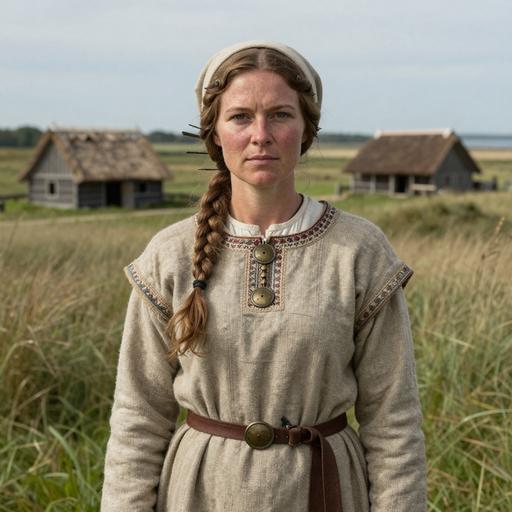
Portrait reconstruction of MDM004
Ancient Individual

A woman buried in Netherlands in the Medieval era

MDM004
500 CE - 700 CE
Female
Medieval Frisian Saxons
Netherlands
Scroll to begin
Chapter I

Identity

The biological and cultural markers that define this ancient individual

Sample ID

MDM004

Date Range

500 CE - 700 CE

Biological Sex

Female

mtDNA Haplogroup

K2a6

Cultural Period

Medieval Frisian Saxons

Chapter II

Place

Where this individual was discovered

Country Netherlands
Locality Midlum (Friesland)
Coordinates 53.1843, 5.4443
Chapter III

Time

When this individual lived in the broader context of human history

MDM004 500 CE - 700 CE
Chapter IV

Story

The narrative of this ancient life

The Medieval Frisian Saxons, primarily known as the Saxons, were a prominent Germanic people inhabiting parts of what is now Germany and the Netherlands during the Early to High Middle Ages. Understanding their culture and society requires delving into their socio-political structures, religious practices, economic life, and interactions with neighboring groups.

Geographic and Historical Context

The term \Frisian Saxons" is somewhat of a conflation, as the Frisians and Saxons were distinct groups with overlapping territories and cultural exchanges. The Saxons primarily settled in what is now Lower Saxony, Saxony-Anhalt, and parts of North Rhine-Westphalia in Germany, while the Frisians inhabited coastal regions of what is now the Netherlands and Germany. Despite their distinct identities, these groups shared various cultural and linguistic similarities due to geographical proximity and historical interactions.

Socio-Political Structure

The Saxons were organized into tribal systems, with a loose confederation of chieftains and tribes rather than a centralized monarchy. The idea of kingship was relatively foreign to them until later periods when external pressures necessitated more organized defense mechanisms. Their society was comprised of free men, but also included classes of serfs and slaves, much like other medieval European societies.

Law and Justice

Saxon law was guided by a set of customary laws rather than written codes until the later Middle Ages. These customs were transmitted orally and were adjudicated by elders and chiefs in communal gatherings known as "things." The system was heavily based on compensation and reparation, a common feature of Germanic legal systems, rather than corporal punishment.

Religion and Beliefs

Before their Christianization, the Saxons practiced a form of Germanic paganism. They worshipped a pantheon of gods similar to the Norse, with deities like Woden (Odin) and Thunor (Thor). Trees, particularly oak trees, and certain animals were considered sacred, and they held large communal ceremonies, particularly during seasonal festivals such as Yule.

The conversion to Christianity began in earnest in the 8th century, spurred largely by the Frankish campaigns led by Charlemagne. The Christianization process included the destruction of pagan shrines and the establishment of churches, a gradual and often resistant process marked by repeated Saxon revolts against Frankish rule.

Economy and Daily Life

The economy of the Saxons was primarily agrarian, with agriculture forming the backbone. They cultivated crops like barley, oats, and wheat and raised livestock, including cattle, pigs, and sheep. Craftsmen produced goods ranging from textiles to metalwork, which were often traded locally and occasionally long-distance via emerging trade networks.

Settlements varied from small villages to larger fortified areas known as "burghs," which provided protection and helped foster trade. The Frisian coast's strategic location along the North Sea allowed for seafaring and trade across the northern European seas, connecting them with other cultures and economic systems.

Art and Culture

Saxon artistic expressions were heavily influenced by their Norse kin and the broader Germanic world. Their art often featured intricate metalwork, carvings, and embroidery, with motifs drawn from nature, myths, and daily life. Storytelling and oral tradition were crucial, with skalds and bards preserving history and myth through their songs and poems.

Language

The Old Saxon language, a West Germanic language, was spoken by the Saxons. It was closely related to Old English and Old Frisian. The language saw a decline in use with the spread of Latin and the rise of Middle Low German due to economic and political shifts in the region.

Legacy

The legacy of the Frisian Saxons is seen in varied cultural landscapes: from linguistic contributions to regional traditions that echo through time. The adoption of Christianity and integration into the Carolingian Empire marked a significant transition, with remnants of their pagan past persisting in folklore and customs. Today, the history of the Saxons is an integral part of the cultural tapestry in Northern Germany and parts of the Netherlands, contributing to regional identities and historical narratives."

Chapter V

Context

Other ancient individuals connected to this sample

Sources

References

Scientific publications and genetic data

Scientific Publication

The Anglo-Saxon migration and the formation of the early English gene pool

Authors Gretzinger J, Sayer D, Justeau P
Abstract

The history of the British Isles and Ireland is characterized by multiple periods of major cultural change, including the influential transformation after the end of Roman rule, which precipitated shifts in language, settlement patterns and material culture1. The extent to which migration from continental Europe mediated these transitions is a matter of long-standing debate2-4. Here we study genome-wide ancient DNA from 460 medieval northwestern Europeans-including 278 individuals from England-alongside archaeological data, to infer contemporary population dynamics. We identify a substantial increase of continental northern European ancestry in early medieval England, which is closely related to the early medieval and present-day inhabitants of Germany and Denmark, implying large-scale substantial migration across the North Sea into Britain during the Early Middle Ages. As a result, the individuals who we analysed from eastern England derived up to 76% of their ancestry from the continental North Sea zone, albeit with substantial regional variation and heterogeneity within sites. We show that women with immigrant ancestry were more often furnished with grave goods than women with local ancestry, whereas men with weapons were as likely not to be of immigrant ancestry. A comparison with present-day Britain indicates that subsequent demographic events reduced the fraction of continental northern European ancestry while introducing further ancestry components into the English gene pool, including substantial southwestern European ancestry most closely related to that seen in Iron Age France5,6.

Use code for 40% off Expires Feb 27