Menu
Store
Blog
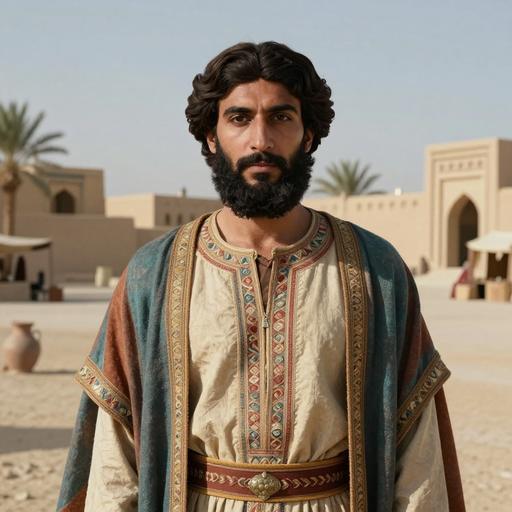
Portrait reconstruction of MH1_LT
Ancient Individual

A man buried in Bahrain in the Sasanian era

MH1_LT
432 CE - 561 CE
Male
Late Tylos Period Sasanian Bahrain
Bahrain
Scroll to begin
Chapter I

Identity

The biological and cultural markers that define this ancient individual

Sample ID

MH1_LT

Date Range

432 CE - 561 CE

Biological Sex

Male

mtDNA Haplogroup

R2

Y-DNA Haplogroup

Not available

Cultural Period

Late Tylos Period Sasanian Bahrain

Chapter II

Place

Where this individual was discovered

Country Bahrain
Locality Madinat Hamad (Northern Governorate)
Coordinates 26.1190, 50.4990
Chapter III

Time

When this individual lived in the broader context of human history

MH1_LT 432 CE - 561 CE
Chapter IV

Story

The narrative of this ancient life

The Late Tylos Period, particularly in the context of Sasanian Bahrain, represents a fascinating era that reflects a confluence of influences and transitions in the Persian Gulf region. The Tylos period, named after the Hellenistic name for Bahrain, is notable for its strategic importance and cultural richness. By the time of the Late Tylos Period, Bahrain was under Sasanian influence, which uniquely shaped its social, economic, and cultural landscape.

Historical Context

The Late Tylos Period encompasses the late pre-Islamic era, during which Bahrain (known as Tylos to the Greeks and Dilmun in earlier times) was under the control of the Sasanian Empire, which ruled from 224 to 651 CE. The Sasanians, known for their advanced civilization centered in Persia (modern-day Iran), exerted considerable influence over the Arabian Peninsula, including areas like Bahrain, which was known for its strategic location and economic prosperity.

Political Influence

Under the Sasanians, Bahrain was part of a broader administrative system that linked it to the powerful empire. The island served as a key naval base and a center for trade, acting as an intermediary in the trade routes that connected the Indian subcontinent, the Roman Empire, and the east coast of Africa. This strategic position made Bahrain a valuable asset for the Sasanians, allowing them to project power across the Gulf region.

Economic Activity

Economically, the Late Tylos Period in Bahrain was characterized by thriving trade, agriculture, and pearling. The island's location made it a maritime hub, facilitating exchanges of goods such as textiles, spices, and pearls. Pearling was especially significant, with Bahrain reputed for its high-quality pearls, which were highly sought after in both local and international markets.

Agriculture also played a critical role, thanks to the fertile lands and the innovative water management techniques inherited from earlier Dilmunian practices. Date cultivation was particularly prominent, providing both sustenance and trade goods.

Cultural Interactions

Culturally, the era was marked by a rich tapestry of influences due to Bahrain's position as a crossroads of civilizations. This melting pot included Persian, Arab, Hellenistic, and Indian influences, each contributing to the local culture. The Sasanians themselves brought elements of Zoroastrianism, their state religion, though there was also a presence of other religious practices, including Christianity and local Arabian polytheistic traditions.

Art and architecture from the period often reflected Sasanian styles, with intricate designs and motifs that showcased the empire's artistic sophistication. Architectural remains from the era, such as forts and temples, reveal a blend of local and Persian techniques.

Social Structure

The social structure of Late Tylos was influenced by both local traditions and Sasanian bureaucracy. There was a distinct hierarchy, with Sasanian military and administrative officials often holding significant power. Local chieftains and tribal leaders likely played intermediary roles, balancing local autonomy with the directives from the Sasanian central authority. The society was quite diverse, comprising various ethnic and religious communities that coexisted and interacted through trade and social exchanges.

Legacy and Transition

The end of the Sasanian influence in Bahrain coincided with the broader decline of the Sasanian Empire, culminating in the Islamic conquests of the mid-7th century. This transition brought about significant changes as Islam became the dominant cultural and religious force. However, the Late Tylos Period's legacy persisted in many aspects, influencing future generations in terms of trade practices, cultural interactions, and local governance.

In summary, the Late Tylos Period in Sasanian Bahrain was characterized by a complex and dynamic synthesis of cultural influences, political significance, and economic prosperity. The interactions between the local Arabian traditions and the broader Sasanian influence created a unique and vibrant cultural milieu that would leave its mark on the region's history.

Chapter V

Context

Other ancient individuals connected to this sample

Sources

References

Scientific publications and genetic data

Scientific Publication

Ancient genomes illuminate Eastern Arabian population history and adaptation against malaria

Authors Martiniano R, Haber M, Almarri MA
Abstract

The harsh climate of Arabia has posed challenges in generating ancient DNA from the region, hindering the direct examination of ancient genomes for understanding the demographic processes that shaped Arabian populations. In this study, we report whole-genome sequence data obtained from four Tylos-period individuals from Bahrain. Their genetic ancestry can be modeled as a mixture of sources from ancient Anatolia, Levant, and Iran/Caucasus, with variation between individuals suggesting population heterogeneity in Bahrain before the onset of Islam. We identify the G6PD Mediterranean mutation associated with malaria resistance in three out of four ancient Bahraini samples and estimate that it rose in frequency in Eastern Arabia from 5 to 6 kya onward, around the time agriculture appeared in the region. Our study characterizes the genetic composition of ancient Arabians, shedding light on the population history of Bahrain and demonstrating the feasibility of studies of ancient DNA in the region.

Use code for 40% off Expires Feb 27