Menu
Store
Blog
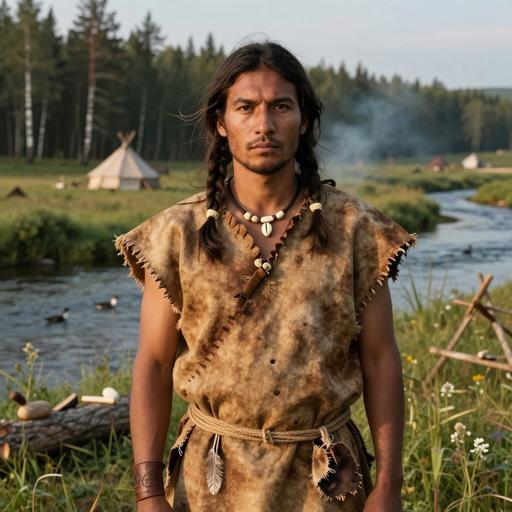
Portrait reconstruction of NEO100
Ancient Individual

A man buried in Russia in the Mesolithic era

NEO100
8342 BCE - 8236 BCE
Male
Mesolithic Ural Culture
Russia
Scroll to begin
Chapter I

Identity

The biological and cultural markers that define this ancient individual

Sample ID

NEO100

Date Range

8342 BCE - 8236 BCE

Biological Sex

Male

mtDNA Haplogroup

H2a2a1

Y-DNA Haplogroup

Q-L56

Cultural Period

Mesolithic Ural Culture

Chapter II

Place

Where this individual was discovered

Country Russia
Locality Ural-River (Orenburg Oblast, Ileksky District)
Coordinates 51.5660, 53.6830
Chapter III

Time

When this individual lived in the broader context of human history

NEO100 8342 BCE - 8236 BCE
Chapter IV

Story

The narrative of this ancient life

The Mesolithic Ural Culture, often associated with the broader Early Uralic people, refers to the societies that existed in the region surrounding the Ural Mountains during the Mesolithic period, roughly spanning from about 10,000 to 5,000 BCE. This era marks a significant transition in human history, characterized by the shift from predominantly nomadic lifestyles of hunter-gatherers to more settled communities as they adapted to changing climatic conditions following the last Ice Age. The Mesolithic Ural Culture represents a critical period in the development of human societies in Northern Eurasia.

Geography and Environment

The Ural Mountains, stretching from the Arctic tundra in the north to the steppes in the south, create a natural boundary between Europe and Asia. This unique geographical position played a crucial role in the development of the Mesolithic Ural Culture. The region is rich in diverse landscapes, including dense forests, rivers, lakes, and mineral resources, which provided abundant opportunities for human settlement and resource exploitation.

Subsistence and Economy

The Mesolithic Uralic peoples were primarily hunter-gatherers, relying on the rich biodiversity of the region for sustenance. The lush forested areas were home to numerous game species such as elk, deer, wild boar, and smaller mammals, which were crucial for food, clothing, and tools. The extensive river systems supported a wealth of aquatic resources, including fish and mussels, which became central to their diet. The seasonal migrations of animals often influenced settlement patterns, with groups moving to follow herds or access fishing grounds.

Plant gathering was also an essential aspect of their subsistence strategy, with nuts, berries, and other edible plant species forming a significant part of their diet. This combination of hunting, fishing, and gathering ensured a relatively stable food supply, allowing for the growth and development of more permanent settlement sites.

Tools and Technology

The Mesolithic period is distinguished by advanced microlithic tools, characterized by small, finely crafted flint blades mounted onto wood or bone to create composite tools. The people of the Ural culture were adept at flint knapping, producing a range of tools for hunting and processing food, including knives, scrapers, and arrowheads. Bone and antler were also used to create tools and weapons, reflecting the ingenuity and adaptability of these early communities.

In addition to hunting tools, the Mesolithic Uralic people developed implements for fishing, such as spears, harpoons, and fishhooks, which were carefully crafted to exploit the aquatic resources of the region.

Social Structure and Settlement

The Mesolithic Ural communities were likely organized into small, kin-based groups or bands, each comprising several families. These groups were highly mobile, moving as necessary to exploit seasonal resources effectively. However, certain favorable locations may have supported more permanent or semi-permanent settlements, especially along rivers or lakeshores, where resources were abundant year-round.

As with many Mesolithic societies, it is believed that social structures were relatively egalitarian, although some evidence suggests that certain individuals or families may have held higher status, possibly due to their skills, age, or success in hunting and gathering.

Art and Symbolism

Art played a significant role in the Mesolithic Ural Culture, as evidenced by petroglyphs and carvings discovered in various sites across the region. These artworks often depict animals, hunting scenes, and abstract patterns, demonstrating a deep connection to their environment and a rich symbolic life. The use of body ornamentation, such as beads and pendants made from bone, teeth, and stone, indicates a cultural emphasis on personal adornment and social identity.

Spiritual Beliefs

While direct evidence of Mesolithic spiritual beliefs is limited, the art and burial practices provide some insights into their worldview. The careful placement of grave goods and the orientation of burials suggest a belief in an afterlife or spiritual continuity. Additionally, the depictions of animals in art may indicate a form of animism, where animals were believed to hold spiritual significance or be connected to human ancestors.

Conclusion

The Mesolithic Ural Culture was a dynamic and adaptable society that thrived in the challenging landscapes of the Ural Mountains. Through their ingenuity in tool-making, resource exploitation, and social organization, these early Uralic peoples laid the foundations for subsequent cultural developments in the region. The rich archaeological record left behind by these communities offers valuable insights into the lifeways and beliefs of a pivotal era in human history.

Chapter V

Context

Other ancient individuals connected to this sample

Sources

References

Scientific publications and genetic data

Scientific Publication

Population genomics of post-glacial western Eurasia

Authors Allentoft ME, Sikora M, Refoyo-Martínez A
Abstract

Western Eurasia witnessed several large-scale human migrations during the Holocene1-5. Here, to investigate the cross-continental effects of these migrations, we shotgun-sequenced 317 genomes-mainly from the Mesolithic and Neolithic periods-from across northern and western Eurasia. These were imputed alongside published data to obtain diploid genotypes from more than 1,600 ancient humans. Our analyses revealed a 'great divide' genomic boundary extending from the Black Sea to the Baltic. Mesolithic hunter-gatherers were highly genetically differentiated east and west of this zone, and the effect of the neolithization was equally disparate. Large-scale ancestry shifts occurred in the west as farming was introduced, including near-total replacement of hunter-gatherers in many areas, whereas no substantial ancestry shifts happened east of the zone during the same period. Similarly, relatedness decreased in the west from the Neolithic transition onwards, whereas, east of the Urals, relatedness remained high until around 4,000 BP, consistent with the persistence of localized groups of hunter-gatherers. The boundary dissolved when Yamnaya-related ancestry spread across western Eurasia around 5,000 BP, resulting in a second major turnover that reached most parts of Europe within a 1,000-year span. The genetic origin and fate of the Yamnaya have remained elusive, but we show that hunter-gatherers from the Middle Don region contributed ancestry to them. Yamnaya groups later admixed with individuals associated with the Globular Amphora culture before expanding into Europe. Similar turnovers occurred in western Siberia, where we report new genomic data from a 'Neolithic steppe' cline spanning the Siberian forest steppe to Lake Baikal. These prehistoric migrations had profound and lasting effects on the genetic diversity of Eurasian populations.

Use code for 40% off Expires Feb 26