Menu
Store
Blog
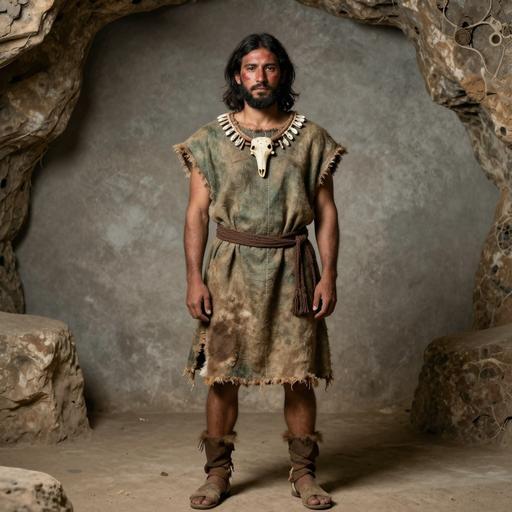
Portrait reconstruction of NEO175
Ancient Individual

A man buried in Russia in the Bronze Age era

NEO175
2843 BCE - 2471 BCE
Male
Don Catacomb Culture
Russia
Scroll to begin
Chapter I

Identity

The biological and cultural markers that define this ancient individual

Sample ID

NEO175

Date Range

2843 BCE - 2471 BCE

Biological Sex

Male

mtDNA Haplogroup

U2e1'2'3

Y-DNA Haplogroup

I-Y20885

Cultural Period

Don Catacomb Culture

Chapter II

Place

Where this individual was discovered

Country Russia
Locality Ksizovo-6 (Lipetsk Oblast, Zadonsky District)
Coordinates 52.2780, 38.9550
Chapter III

Time

When this individual lived in the broader context of human history

NEO175 2843 BCE - 2471 BCE
Chapter IV

Story

The narrative of this ancient life

The \Don Catacomb Culture," also recognized as a part of the broader Indo-European cultural and archaeological framework, flourished approximately between 2800 BCE and 2200 BCE in the steppes of Eastern Europe, specifically around the lower Don River Basin in modern-day Russia and Ukraine. It was part of the larger Catacomb culture group, which covered the steppes of Southern Russia and extended into Eastern Europe. Known for their distinct burial practices, this culture provides valuable insights into the socio-economic practices, spiritual beliefs, and lifestyle of early Indo-European societies.

Geographic and Environmental Context

The region inhabited by the Don Catacomb Culture was primarily composed of steppe landscapes, characterized by vast grasslands that were conducive to both agriculture and pastoralism. These open spaces allowed for the development of a semi-nomadic lifestyle, with communities engaging in both farming and animal husbandry. The river systems, particularly the Don River, provided fertile lands and were crucial for transport and trade.

Sociopolitical Organization

The Don Catacomb Culture likely consisted of loosely organized tribal units that engaged in both cooperative and competitive interactions. The hierarchical social structures evident from the archaeological sites suggest the existence of leadership roles, possibly held by chieftains or elders. Power dynamics were often reinforced by religious and ritualistic activities, with leaders playing prominent roles in ceremonies and funerals.

Burial Practices and Religion

Denoting their name, the Catacomb culture is particularly known for its distinct burial rites. The people of this culture practiced inhumation, burying their dead in pits dug into the earth and lined with stone slabs or wooden constructs to form a “catacomb.” These graves often contained personal belongings, suggesting a belief in an afterlife. Grave goods typically included pottery, weapons, ornaments, and sometimes the remains of sacrificed animals, indicative of ritualistic practices and status differentiation within the society.

Interestingly, burial practices showcased an evolution over time, with early graves presenting simpler constructions, and later ones becoming more elaborate. The presence of ochre on skeletal remains suggests ritualistic significance and the symbolic representation of life and death cycles.

Economy and Subsistence

The economy of the Don Catacomb Culture primarily depended on agriculture and animal husbandry. Evidence points to the cultivation of wheat and barley, alongside the domestication of cattle, sheep, and goats. The presence of horse remains also indicates their use in transport and possibly early chariotry, marking significant advancements in mobility and trade.

Trade networks extended across regions, connecting the Don Catacomb Culture with neighboring cultures. Artifacts such as metal implements, beads, and pottery found in grave sites signify the presence of skilled artisans and suggest interactions with cultures as far as the Caucasus and Central Europe.

Art and Symbolism

Material culture, including pottery and metalwork, indicates a society that valued artistry and symbolism. Pottery was often decorated with incised patterns and occasionally painted, featuring motifs that may have held symbolic or communicative significance. While primarily utilitarian, some pottery and metalwork pieces appear to have been used in rituals or as markers of status.

Language and Legacy

As part of the broader Indo-European tapestry, the Don Catacomb Culture likely contributed to the linguistic development of Proto-Indo-European languages. While direct linguistic traces are challenging to identify, cultural diffusion through migration and trade would have facilitated linguistic exchanges that formed a basis for later Indo-European languages, further entrenching their legacy in the historical and cultural developments of Europe and Asia.

Decline and Transition

The decline of the Don Catacomb Culture around 2200 BCE was likely due to a combination of climatic changes, resource depletion, and migrations, leading to cultural transformations and the eventual emergence of new cultural entities. Its integration into succeeding Bronze Age cultures exemplifies the region's dynamic nature and the continuity of Indo-European cultural practices.

In summary, the Don Catacomb Culture represents a critical period in the development of early Indo-European societies, characterized by its distinctive burial practices, socioeconomic versatility, and inter-regional interactions. Its contributions to the cultural and genetic landscape of Europe continue to be recognized as foundational in understanding the complexities of prehistoric human development."

Chapter V

Context

Other ancient individuals connected to this sample

Sources

References

Scientific publications and genetic data

Scientific Publication

Population genomics of post-glacial western Eurasia

Authors Allentoft ME, Sikora M, Refoyo-Martínez A
Abstract

Western Eurasia witnessed several large-scale human migrations during the Holocene1-5. Here, to investigate the cross-continental effects of these migrations, we shotgun-sequenced 317 genomes-mainly from the Mesolithic and Neolithic periods-from across northern and western Eurasia. These were imputed alongside published data to obtain diploid genotypes from more than 1,600 ancient humans. Our analyses revealed a 'great divide' genomic boundary extending from the Black Sea to the Baltic. Mesolithic hunter-gatherers were highly genetically differentiated east and west of this zone, and the effect of the neolithization was equally disparate. Large-scale ancestry shifts occurred in the west as farming was introduced, including near-total replacement of hunter-gatherers in many areas, whereas no substantial ancestry shifts happened east of the zone during the same period. Similarly, relatedness decreased in the west from the Neolithic transition onwards, whereas, east of the Urals, relatedness remained high until around 4,000 BP, consistent with the persistence of localized groups of hunter-gatherers. The boundary dissolved when Yamnaya-related ancestry spread across western Eurasia around 5,000 BP, resulting in a second major turnover that reached most parts of Europe within a 1,000-year span. The genetic origin and fate of the Yamnaya have remained elusive, but we show that hunter-gatherers from the Middle Don region contributed ancestry to them. Yamnaya groups later admixed with individuals associated with the Globular Amphora culture before expanding into Europe. Similar turnovers occurred in western Siberia, where we report new genomic data from a 'Neolithic steppe' cline spanning the Siberian forest steppe to Lake Baikal. These prehistoric migrations had profound and lasting effects on the genetic diversity of Eurasian populations.

Use code for 40% off Expires Feb 26