Menu
Store
Blog
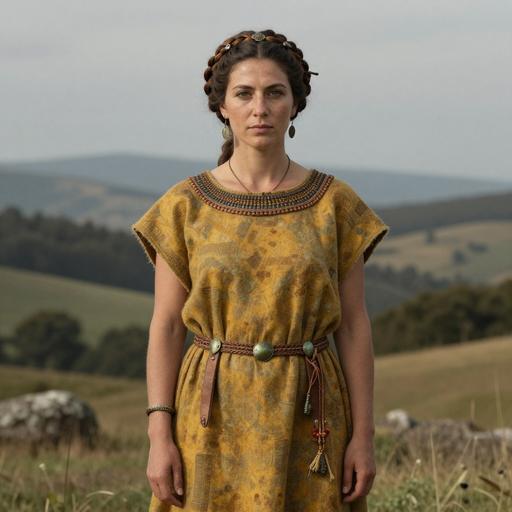
Portrait reconstruction of NEO653
Ancient Individual

A woman buried in Spain in the Bronze Age era

NEO653
1601 BCE - 1425 BCE
Female
Bronze Age Asturian Culture
Spain
Scroll to begin
Chapter I

Identity

The biological and cultural markers that define this ancient individual

Sample ID

NEO653

Date Range

1601 BCE - 1425 BCE

Biological Sex

Female

mtDNA Haplogroup

HV0d

Cultural Period

Bronze Age Asturian Culture

Chapter II

Place

Where this individual was discovered

Country Spain
Locality El Toral-3 (Principado de Asturias, Asturias, Llanes)
Coordinates 43.4020, -4.7070
Chapter III

Time

When this individual lived in the broader context of human history

NEO653 1601 BCE - 1425 BCE
Chapter IV

Story

The narrative of this ancient life

The Bronze Age Asturian culture, situated in the region of modern-day Asturias in northern Spain, represents a fascinating chapter in the broader context of the Celtic-Iberian cultural evolution. This culture is characterized by its unique blend of indigenous Iberian elements and influences from the Celtic migrations across Europe.

Geographic and Environmental Context

Asturias is located in the northwestern Iberian Peninsula, bounded by the Cantabrian Sea to the north, and the Cantabrian Mountains to the south. This geographical setting significantly influenced the lifestyle, economy, and cultural practices of its Bronze Age inhabitants. The region's rugged terrain, dense forests, and plentiful rivers provided a natural defense and sustained a variety of flora and fauna that supported hunting, gathering, and later agricultural developments.

Society and Social Structure

Bronze Age Asturian society was likely organized into tribal units or clans, similar to other Celtic groups. These clans were probably led by chieftains or a council of elders who wielded significant authority over their respective territories. There is evidence to suggest a hierarchical social structure, with warriors and skilled craftsmen occupying higher social strata, supported by agricultural workers and possibly bonded labor.

Economy and Subsistence

The economy of the Asturian Bronze Age culture was diverse and adapted to its environment. Subsistence practices included agriculture, hunting, fishing, and gathering. The fertile valleys and river plains were suitable for the cultivation of cereals, while animal husbandry played a crucial role, with sheep, goats, and cattle being the primary domesticated species.

Trade and exchange networks were integral to the economy, facilitating access to bronze—a vital material for tools, weapons, and ornaments. The acquisition of tin and copper, essential components of bronze, suggests trade links extending beyond the Iberian Peninsula.

Material Culture and Technology

Asturian material culture is distinguished by its pottery, metalwork, and construction techniques. Pottery from this period often features geometric designs and was likely produced using coil-building techniques before being fired in simple kilns.

The metallurgical skills of the Asturian peoples evolved significantly during this era, with bronze objects such as axes, swords, and jewelry being commonly produced. These tools and ornaments demonstrate both functional and artistic craftsmanship, indicative of the cultural significance of metalwork.

Housing and Settlements

Settlements in Bronze Age Asturias varied from small, family-based homesteads to larger fortified villages. These communities were typically located on elevated ground or near water sources for strategic defense and resource access. The use of stone and wood in construction was prevalent, with dwellings often featuring circular or oval layouts and thatched roofs.

Religion and Spiritual Beliefs

Asturian religious practices during the Bronze Age likely involved a pantheon of deities characteristic of proto-Celtic traditions. Evidence of ritual practices includes the presence of burial mounds (tumuli) and stone structures that might have served ceremonial purposes. These sites suggest a belief in an afterlife and the veneration of ancestors, with offerings placed in graves alongside the deceased.

Art and Symbolism

Artistic expression in Asturian culture often manifested in the form of engravings on metal objects, rock carvings, and pottery decoration. The symbolism in Asturian art reflects common Celtic motifs, such as spirals and interlaced patterns, which may have held spiritual significance or conveyed social status.

Cultural Interactions

During the Bronze Age, Asturia was a cultural crossroads where indigenous Iberian traditions merged with those of migrating Celtic peoples. This interaction facilitated the adoption of new technologies and ideas, enriching the local culture and fostering innovation.

Conclusion

The Bronze Age Asturian culture represents a distinctive Celtic-Iberian society marked by its adaptability to a challenging landscape, its skilled craftsmanship in metallurgy and pottery, and its complex social structures. Despite their relatively isolated geographic position, the Asturians were active participants in the broader cultural and economic networks of prehistoric Europe, leaving a lasting legacy on the region's historical and cultural development.

Chapter V

Context

Other ancient individuals connected to this sample

Sources

References

Scientific publications and genetic data

Scientific Publication

Population genomics of post-glacial western Eurasia

Authors Allentoft ME, Sikora M, Refoyo-Martínez A
Abstract

Western Eurasia witnessed several large-scale human migrations during the Holocene1-5. Here, to investigate the cross-continental effects of these migrations, we shotgun-sequenced 317 genomes-mainly from the Mesolithic and Neolithic periods-from across northern and western Eurasia. These were imputed alongside published data to obtain diploid genotypes from more than 1,600 ancient humans. Our analyses revealed a 'great divide' genomic boundary extending from the Black Sea to the Baltic. Mesolithic hunter-gatherers were highly genetically differentiated east and west of this zone, and the effect of the neolithization was equally disparate. Large-scale ancestry shifts occurred in the west as farming was introduced, including near-total replacement of hunter-gatherers in many areas, whereas no substantial ancestry shifts happened east of the zone during the same period. Similarly, relatedness decreased in the west from the Neolithic transition onwards, whereas, east of the Urals, relatedness remained high until around 4,000 BP, consistent with the persistence of localized groups of hunter-gatherers. The boundary dissolved when Yamnaya-related ancestry spread across western Eurasia around 5,000 BP, resulting in a second major turnover that reached most parts of Europe within a 1,000-year span. The genetic origin and fate of the Yamnaya have remained elusive, but we show that hunter-gatherers from the Middle Don region contributed ancestry to them. Yamnaya groups later admixed with individuals associated with the Globular Amphora culture before expanding into Europe. Similar turnovers occurred in western Siberia, where we report new genomic data from a 'Neolithic steppe' cline spanning the Siberian forest steppe to Lake Baikal. These prehistoric migrations had profound and lasting effects on the genetic diversity of Eurasian populations.

Use code for 40% off Expires Feb 26