Menu
Store
Blog
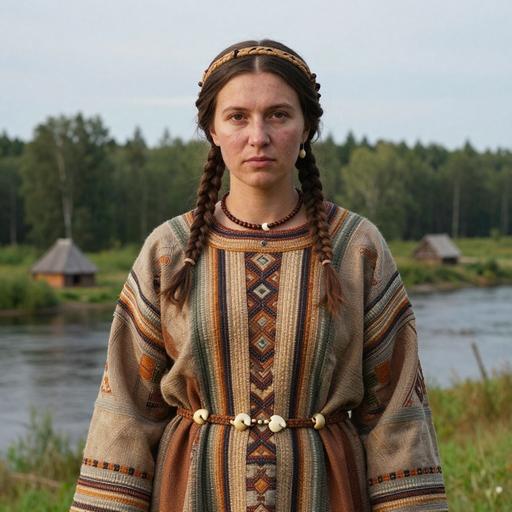
Portrait reconstruction of NEO87
Ancient Individual

A woman buried in Russia in the Neolithic era

NEO87
6594 BCE - 6434 BCE
Female
Volga-Oka Culture
Russia
Scroll to begin
Chapter I

Identity

The biological and cultural markers that define this ancient individual

Sample ID

NEO87

Date Range

6594 BCE - 6434 BCE

Biological Sex

Female

mtDNA Haplogroup

U5a1

Cultural Period

Volga-Oka Culture

Chapter II

Place

Where this individual was discovered

Country Russia
Locality Zamostye-2 (Moscow Oblast, Sergiyevo-Posadsky District)
Coordinates 56.6660, 38.0160
Chapter III

Time

When this individual lived in the broader context of human history

NEO87 6594 BCE - 6434 BCE
Chapter IV

Story

The narrative of this ancient life

The Volga-Oka Culture of the Forest Neolithic era represents a fascinatingly complex and rich prehistoric culture that existed approximately between 6000 and 2000 BCE in the region situated around the confluence of the Volga and Oka Rivers in what is now modern-day Russia. This culture emerges as part of the broader Neolithic era, characterized by significant transitions in human societies, particularly the shift from nomadic hunter-gatherer lifestyles to more settled agricultural and semi-agricultural communities.

Geographic and Environmental Context

The Volga-Oka region is characterized by a vast landscape of dense forests interspersed with rivers, lakes, and wetlands, which provided a diverse ecosystem that was rich in resources. The temperate climate, with cold winters and mild summers, supported a variety of flora and fauna, offering abundant opportunities for hunting, fishing, and foraging. The rivers facilitated not only sustenance through fishing but also transportation and trade routes that were crucial for cultural exchange and interaction.

Subsistence and Economy

The subsistence strategies of the Volga-Oka Culture were primarily based on a mixed economy of hunting, gathering, fishing, and rudimentary agriculture. Archaeological evidence suggests that the inhabitants hunted a range of game such as elk, deer, and wild boar, as well as smaller mammals and birds. The forests provided an abundance of plant resources, including nuts, berries, and roots that supplemented their diet.

Fishing played a critical role in their subsistence, supported by the numerous water bodies in the region. Fishing tools and remains of fish bones found in archaeological sites indicate that freshwater fish was a staple in their diet, with techniques likely involving nets, traps, and possibly early forms of fish weirs.

Agriculture was in its nascent stages during this period, with evidence of small-scale cultivation of cereals such as barley and wheat. The development of pottery, which characterizes the Neolithic period, facilitated food storage and cooking, marking a significant advancement in their domestic economy.

Settlement Patterns

Settlements of the Volga-Oka Culture were traditionally small, consisting of modestly sized, semi-permanent dwellings constructed primarily from wood and other locally available materials. These structures indicate a degree of permanence, suggesting a shift from the highly mobile lifestyles of previous Mesolithic populations.

The residential sites were often strategically located near water sources, combining the benefits of access to resources with defensibility. The social structure within these communities likely evolved, with evidence pointing towards extended family groups as the primary social units.

Material Culture and Artifacts

The material culture of the Volga-Oka Culture encompasses a range of artifacts, with pottery being one of the most distinguishing features. The ceramics found are typically made from clay tempered with crushed shells or sand, often decorated with geometric patterns, incisions, and impressions.

Stone and bone tools, including axes, arrowheads, and fishing implements, were common. These tools demonstrate significant skill in crafting and utility, suggesting an advanced understanding of available materials and their properties.

Artistic expressions, albeit limited in surviving evidence, include personal ornaments such as pendants and beads made from bone, stone, and occasionally copper, illustrating an appreciation for adornment and possible symbolic meaning.

Sociocultural Aspects

Little is known about the specific social organization and religious beliefs of the Volga-Oka Culture due to limited evidence. However, the Neolithic era generally saw the emergence of more defined social hierarchies, possibly influenced by the development of agriculture and accumulation of surplus resources.

Burial practices vary, with some sites indicating care in the internment of the dead, potentially hinting at emerging religious or spiritual beliefs. These may have included respect for ancestors, nature worship, or animistic elements tied closely to their environmental context.

Interaction and Legacy

The Volga-Oka Culture did not develop in isolation but interacted with neighboring cultures, facilitating exchanges that brought about innovations in tool-making, pottery styles, and other technological advancements. These interactions are crucial for understanding the complex web of cultural developments that occurred throughout the Neolithic period.

The legacy of the Volga-Oka Culture, like many prehistoric cultures, lies in its contributions to the foundation of more complex societies that emerged in the millennia to follow. Their adaptive strategies, tools, and early agricultural practices laid the groundwork for subsequent cultural advancements in ancient Eastern Europe.

Chapter V

Context

Other ancient individuals connected to this sample

Sources

References

Scientific publications and genetic data

Scientific Publication

Population genomics of post-glacial western Eurasia

Authors Allentoft ME, Sikora M, Refoyo-Martínez A
Abstract

Western Eurasia witnessed several large-scale human migrations during the Holocene1-5. Here, to investigate the cross-continental effects of these migrations, we shotgun-sequenced 317 genomes-mainly from the Mesolithic and Neolithic periods-from across northern and western Eurasia. These were imputed alongside published data to obtain diploid genotypes from more than 1,600 ancient humans. Our analyses revealed a 'great divide' genomic boundary extending from the Black Sea to the Baltic. Mesolithic hunter-gatherers were highly genetically differentiated east and west of this zone, and the effect of the neolithization was equally disparate. Large-scale ancestry shifts occurred in the west as farming was introduced, including near-total replacement of hunter-gatherers in many areas, whereas no substantial ancestry shifts happened east of the zone during the same period. Similarly, relatedness decreased in the west from the Neolithic transition onwards, whereas, east of the Urals, relatedness remained high until around 4,000 BP, consistent with the persistence of localized groups of hunter-gatherers. The boundary dissolved when Yamnaya-related ancestry spread across western Eurasia around 5,000 BP, resulting in a second major turnover that reached most parts of Europe within a 1,000-year span. The genetic origin and fate of the Yamnaya have remained elusive, but we show that hunter-gatherers from the Middle Don region contributed ancestry to them. Yamnaya groups later admixed with individuals associated with the Globular Amphora culture before expanding into Europe. Similar turnovers occurred in western Siberia, where we report new genomic data from a 'Neolithic steppe' cline spanning the Siberian forest steppe to Lake Baikal. These prehistoric migrations had profound and lasting effects on the genetic diversity of Eurasian populations.

Use code for 40% off Expires Feb 26