Menu
Store
Blog
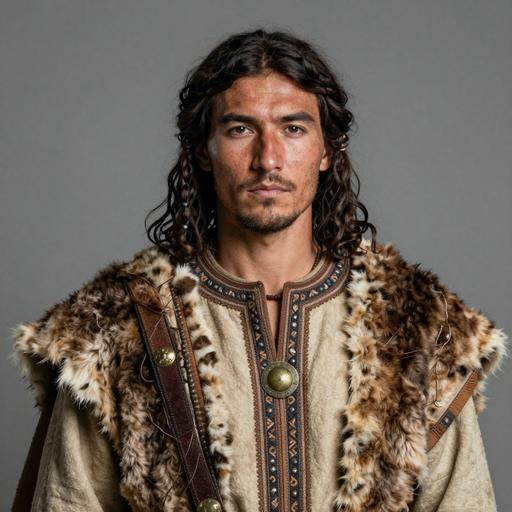
Portrait reconstruction of NEO902
Ancient Individual

A man buried in Kazakhstan in the Iron Age era

NEO902
411 BCE - 386 BCE
Male
Early Iron Age Kazakhstan
Kazakhstan
Scroll to begin
Chapter I

Identity

The biological and cultural markers that define this ancient individual

Sample ID

NEO902

Date Range

411 BCE - 386 BCE

Biological Sex

Male

mtDNA Haplogroup

J1b1a1

Y-DNA Haplogroup

Q-L56

Cultural Period

Early Iron Age Kazakhstan

Chapter II

Place

Where this individual was discovered

Country Kazakhstan
Locality Sjauke-1 (Pavlodar Region, Pavlodar municipality)
Coordinates 52.4310, 76.8380
Chapter III

Time

When this individual lived in the broader context of human history

NEO902 411 BCE - 386 BCE
Chapter IV

Story

The narrative of this ancient life

The Early Iron Age in Kazakhstan, particularly during the era of the Scythians (roughly between the 9th and 2nd centuries BCE), is a period and culture marked by significant developments in terms of social, technological, and artistic revolutions. The region, part of the vast Eurasian steppe, was inhabited by several nomadic tribes, the most prominent of which were the Scythians or Saka in Persian sources. This era was characterized by the maturation of iron metallurgy, advancements in horsemanship, and distinctive artistic styles, all of which had profound impacts on the cultural and socio-political fabric of the region.

Geographical Context

Kazakhstan’s diverse landscapes, including vast steppes, rugged mountains, and forested valleys, provided a dynamic environment for the development of early nomadic cultures. The region served as a crucial junction for trade and cultural exchanges between the East and West, linking the civilizations of Europe, Persia, China, and India. This centrality facilitated the diffusion of technologies and ideas, thus contributing to the unique cultural landscape of the Early Iron Age.

Social and Political Organization

The Scythians were predominantly a nomadic warrior society organized into tribal confederations. Society was structured hierarchically with a tribal leader or king at the top, often seen as a semi-divine figure endowed with both temporal and spiritual authority. Wealth and social status were closely tied to the number of livestock owned, reflecting the pastoral nature of their subsistence economy.

Tribal elites were distinguished by their lavish burial mounds, known as kurgans, which were often accompanied by rich grave goods, including weapons, jewelry, and horses, indicating beliefs in an afterlife where such items would be needed. The Scythian culture is noted for its matrilineal aspects as well, with women often occupying prominent roles, as evidenced by their inclusion in warfare and leadership roles in some tribes.

Economy and Subsistence

The economy of Early Iron Age Kazakhstan was primarily based on pastoralism, with horses, sheep, cattle, and camels being essential to the nomadic lifestyle. Seasonal migrations were an essential aspect of living, as tribes moved their herds between summer and winter pastures. In addition to animal husbandry, there is evidence of some agriculture, although it often played a secondary role to pastoralism.

Trade was integral to the economy, with the Scythians acting as intermediaries. They traded furs, livestock, and other goods native to the steppes for luxury items such as textiles, wine, and metal goods from more settled civilizations. This trade was facilitated by the flourishing network of routes that would later become known as part of the Silk Road.

Technological Advancedments

The use of iron significantly impacted Scythian society. Iron tools and weapons were superior to their Bronze Age predecessors, allowing for more efficient agriculture, construction, and warfare. The Scythians were also excellent horsemen and are credited with innovations such as the recurve bow, which became a powerful tool of war and hunting. Their mastery of mounted warfare and use of cavalry tactics became a template for other nomadic groups that followed.

Art and Culture

Scythian art, known for its distinct \animal style," was characterized by motifs depicting dynamic, fluid forms often involving animals in combat or intricate intertwining. This style permeated various artifacts, from everyday items to elaborate metalwork found in burial sites. Artiste practices served not only an aesthetic purpose but also communicated social, spiritual, and political messages.

Religion and mythology, deeply intertwined with nature and the natural cycles, were reflected in their art and burial customs. The reverence for ancestors and the spiritual significance of animals were key elements of their belief system. Shamanistic practices were likely, with shamans serving as mediators between the physical and spiritual worlds.

Archaeological Significance

The Scythian sites in Kazakhstan, such as the Issyk kurgan, have provided archaeologists with invaluable insights into Scythian life. The discovery of the 'Golden Man,' an intricately adorned figure buried in a kurgan near Almaty, is one of the most significant archaeological finds, reflecting the wealth, craftsmanship, and cultural sophistication of the era.

Influence and Legacy

The Scythians had a significant impact on the cultural landscapes across Eurasia. Their interactions with other cultures resulted in exchanges that enriched both nomadic and sedentary societies. The Scythian influence is visible in the diffusion of their particular style of warfare, artistic motifs, and metallurgical practices across a wide area, from the Black Sea to China.

In sum, Early Iron Age Kazakhstan during the Scythian era was a vibrant and dynamic period characterized by a rich tapestry of cultural practices, technological advancements, and extensive cross-cultural interactions. This era laid critical foundations for the cultural developments that would follow in the region’s history."

Chapter V

Context

Other ancient individuals connected to this sample

Sources

References

Scientific publications and genetic data

Scientific Publication

Population genomics of post-glacial western Eurasia

Authors Allentoft ME, Sikora M, Refoyo-Martínez A
Abstract

Western Eurasia witnessed several large-scale human migrations during the Holocene1-5. Here, to investigate the cross-continental effects of these migrations, we shotgun-sequenced 317 genomes-mainly from the Mesolithic and Neolithic periods-from across northern and western Eurasia. These were imputed alongside published data to obtain diploid genotypes from more than 1,600 ancient humans. Our analyses revealed a 'great divide' genomic boundary extending from the Black Sea to the Baltic. Mesolithic hunter-gatherers were highly genetically differentiated east and west of this zone, and the effect of the neolithization was equally disparate. Large-scale ancestry shifts occurred in the west as farming was introduced, including near-total replacement of hunter-gatherers in many areas, whereas no substantial ancestry shifts happened east of the zone during the same period. Similarly, relatedness decreased in the west from the Neolithic transition onwards, whereas, east of the Urals, relatedness remained high until around 4,000 BP, consistent with the persistence of localized groups of hunter-gatherers. The boundary dissolved when Yamnaya-related ancestry spread across western Eurasia around 5,000 BP, resulting in a second major turnover that reached most parts of Europe within a 1,000-year span. The genetic origin and fate of the Yamnaya have remained elusive, but we show that hunter-gatherers from the Middle Don region contributed ancestry to them. Yamnaya groups later admixed with individuals associated with the Globular Amphora culture before expanding into Europe. Similar turnovers occurred in western Siberia, where we report new genomic data from a 'Neolithic steppe' cline spanning the Siberian forest steppe to Lake Baikal. These prehistoric migrations had profound and lasting effects on the genetic diversity of Eurasian populations.

Use code for 40% off Expires Feb 26