Menu
Store
Blog
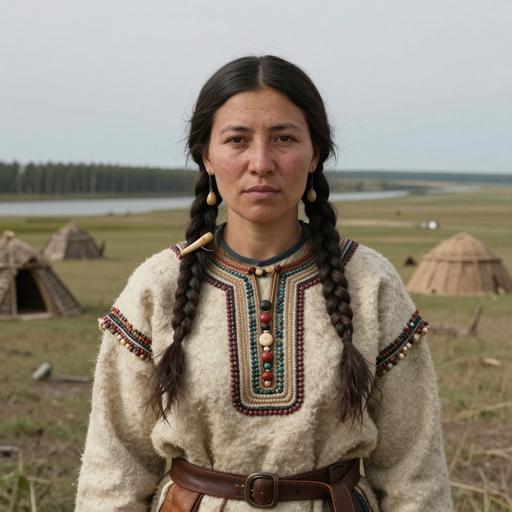
Portrait reconstruction of NEO910
Ancient Individual

A woman buried in Russia in the Bronze Age era

NEO910
2464 BCE - 2213 BCE
Female
Ob River Bronze Age Culture
Russia
Scroll to begin
Chapter I

Identity

The biological and cultural markers that define this ancient individual

Sample ID

NEO910

Date Range

2464 BCE - 2213 BCE

Biological Sex

Female

mtDNA Haplogroup

C4+152

Cultural Period

Ob River Bronze Age Culture

Chapter II

Place

Where this individual was discovered

Country Russia
Locality Vengerovo-2 (Novosibirsk Oblast, Vengerovsky District)
Coordinates 55.7070, 76.7830
Chapter III

Time

When this individual lived in the broader context of human history

NEO910 2464 BCE - 2213 BCE
Chapter IV

Story

The narrative of this ancient life

The Ob River Bronze Age Culture, often associated with the Proto-Ugric peoples, marks a significant period in the Eurasian Steppe's prehistoric timeline, showcasing the interplay of migratory patterns, technological advancements, and cultural evolutions. This culture thrived during the Late Bronze Age, approximately between 1900 BCE and 900 BCE, in the region surrounding the Ob River, which flows through what is now western Siberia in Russia.

Geographical Context

The Ob River, one of the major river systems in Siberia, provided a unique ecological niche that enabled the development of the Bronze Age culture. This region's rich resources, including game, fish, and fertile floodplains, supported both agriculture and pastoralism. The extensive waterways facilitated trade and interaction across sprawling territories, linking this culture with far-flung regions of Eurasia.

Technological and Material Culture

The Ob River culture is distinguished by its advancements in metallurgy, particularly the use of bronze, a critical technological leap from stone tools. Artisans in this region developed sophisticated techniques for bronze casting, which they used to create a variety of artifacts, including weapons, tools, and ornamental items. These metal objects not only served practical purposes but also held significant social and ceremonial value.

Pottery from this era was often decorated with intricate designs, displaying a high level of craftsmanship. These designs offer insights into the aesthetic sensibilities and symbolic language of the Proto-Ugric people. Additionally, evidence suggests the use of textiles, although such materials rarely survive in the archaeological record.

Economy and Subsistence

The economy of the Ob River Bronze Age culture was a hybrid of agriculture, fishing, hunting, and pastoralism. The fertile lands along the riverbanks were well-suited for growing grains, while the surrounding forests and steppes provided ample hunting grounds for animals such as deer and elk. The Ob River itself was a vital source of fish, a staple in the local diet.

The domestication of animals, including horses, cattle, and sheep, played a pivotal role in daily life. Horses, in particular, were likely used for transportation and possibly in warfare, indicating the beginnings of the iconic horse culture that later characterized the Eurasian steppes.

Social Structure and Organization

The Proto-Ugric society of the Ob River characterized by tribal communities likely organized into kinship networks. While detailed understandings of their social hierarchy remain speculative, archaeological evidence points to the existence of social stratification, likely based on wealth, craftsmanship, or leadership capabilities.

Burial practices provide further insight into their social dynamics. Notably, grave goods, such as weapons and jewelry, varied in quantity and quality, suggesting differing social statuses. The presence of elaborate burial mounds (kurgans) indicates that certain individuals held significant power or religious authority.

Cultural and Religious Beliefs

The spiritual life of the Proto-Ugric people is predominantly inferred from archaeological findings and ethnographic parallels with later Ugric and Finno-Ugric cultures. They likely practiced animism, with a belief system centered around nature worship and the veneration of ancestral spirits. Rituals may have been held to honor these spirits or deities, possibly involving sacrifices—evidenced by the discovery of animal bones and particular offerings in ritual contexts.

Shamanistic practices were likely a cornerstone of their religious rites, with shamans acting as intermediaries between the spiritual and terrestrial worlds. Rock carvings and other symbolic artifacts from the era often depict scenes possibly related to mythological narratives or spiritual symbolism.

Interaction and Legacy

The Ob River Bronze Age culture was not isolated; it engaged in persistent interaction with neighboring cultures through trade, conflict, and migration. This region served as a cultural crossroads, contributing to the diffusion of technological innovations, such as metalwork and horsemanship, across Eurasia.

The legacy of the Ob River Bronze Age culture can be traced in the linguistic and cultural characteristics of the Ugric and Finno-Ugric peoples, including the Khanty and Mansi, who inhabit parts of Siberia today. Their traditions and languages hint at the continuity and transformation of cultural elements first incubated in the Bronze Age.

In summary, the Ob River Bronze Age culture represents a pivotal chapter in the prehistory of Siberia, marked by significant technological, social, and cultural developments. As the Proto-Ugric people navigated the challenges and opportunities of their environment, they laid foundational elements for future cultural identities that would continue to evolve long after the demise of the Bronze Age societies.

Chapter V

Context

Other ancient individuals connected to this sample

Sources

References

Scientific publications and genetic data

Scientific Publication

Population genomics of post-glacial western Eurasia

Authors Allentoft ME, Sikora M, Refoyo-Martínez A
Abstract

Western Eurasia witnessed several large-scale human migrations during the Holocene1-5. Here, to investigate the cross-continental effects of these migrations, we shotgun-sequenced 317 genomes-mainly from the Mesolithic and Neolithic periods-from across northern and western Eurasia. These were imputed alongside published data to obtain diploid genotypes from more than 1,600 ancient humans. Our analyses revealed a 'great divide' genomic boundary extending from the Black Sea to the Baltic. Mesolithic hunter-gatherers were highly genetically differentiated east and west of this zone, and the effect of the neolithization was equally disparate. Large-scale ancestry shifts occurred in the west as farming was introduced, including near-total replacement of hunter-gatherers in many areas, whereas no substantial ancestry shifts happened east of the zone during the same period. Similarly, relatedness decreased in the west from the Neolithic transition onwards, whereas, east of the Urals, relatedness remained high until around 4,000 BP, consistent with the persistence of localized groups of hunter-gatherers. The boundary dissolved when Yamnaya-related ancestry spread across western Eurasia around 5,000 BP, resulting in a second major turnover that reached most parts of Europe within a 1,000-year span. The genetic origin and fate of the Yamnaya have remained elusive, but we show that hunter-gatherers from the Middle Don region contributed ancestry to them. Yamnaya groups later admixed with individuals associated with the Globular Amphora culture before expanding into Europe. Similar turnovers occurred in western Siberia, where we report new genomic data from a 'Neolithic steppe' cline spanning the Siberian forest steppe to Lake Baikal. These prehistoric migrations had profound and lasting effects on the genetic diversity of Eurasian populations.

Use code for 40% off Expires Feb 26