Menu
Store
Blog
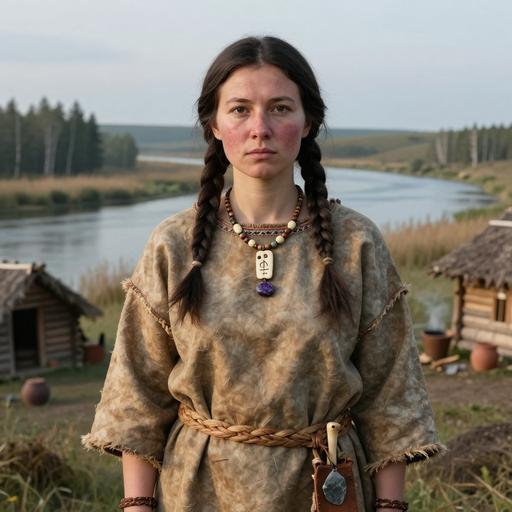
Portrait reconstruction of NEO921
Ancient Individual

A woman buried in Russia in the Eneolithic era

NEO921
2906 BCE - 2677 BCE
Female
Ob River Eneolithic Culture
Russia
Scroll to begin
Chapter I

Identity

The biological and cultural markers that define this ancient individual

Sample ID

NEO921

Date Range

2906 BCE - 2677 BCE

Biological Sex

Female

mtDNA Haplogroup

R1b1

Cultural Period

Ob River Eneolithic Culture

Chapter II

Place

Where this individual was discovered

Country Russia
Locality Vengerovo-2 (Novosibirsk Oblast, Vengerovsky District)
Coordinates 55.7070, 76.7830
Chapter III

Time

When this individual lived in the broader context of human history

NEO921 2906 BCE - 2677 BCE
Chapter IV

Story

The narrative of this ancient life

The Ob River Eneolithic Culture, associated with Proto-Ugric peoples, represents a fascinating intersection of archaeological and linguistic heritage in northern Eurasia. This culture, which thrived during the Eneolithic (or Copper Age) period, is predominantly situated around the Ob River basin in Western Siberia, a significant waterway that courses through a vast expanse of diverse landscapes, from boreal forests to tundra.

Geography and Environment

The Ob River is one of the longest rivers in the world, weaving through the heart of Siberia. During the Eneolithic period, the region's environment was challenging yet resource-rich, offering dense forests, fertile riverbanks, and abundant wildlife. The climate was colder and more volatile compared to today, requiring adaptations from its inhabitants. Seasonal changes would dictate the movement and lifestyle of the people, influencing their agricultural practices, hunting, and fishing activities.

Subsistence and Economy

The economy of the Ob River Eneolithic Culture was likely a balanced mix of hunting, fishing, and rudimentary agriculture. The river itself, teeming with fish, provided a stable food resource, while the surrounding forests were home to various game animals such as elk, deer, and boar. Evidence suggests that the people engaged in early forms of agriculture, cultivating hardy, resilient crops that could withstand the shorter growing seasons.

Settlement Patterns

Settlements in this culture were predominantly seminomadic, adapting to the harsh environmental conditions. Archaeological findings, including remains of dwellings, suggest modest, temporary structures that could be easily dismantled and relocated. This mobility was crucial for following game migrations and seasonal fish runs. However, some sites indicate more permanent villages, characterized by pit houses and communal spaces, hinting at a complex social structure.

Material Culture

The material culture of the Ob River Eneolithic people displays a unique blend of innovation and tradition. They were skilled in the crafting of tools and ornaments from locally available materials such as stone, bone, and wood. The introduction of metallurgy is a hallmark of the Eneolithic period, and evidence of early copper working has been discovered, although it was not as prevalent as in other contemporaneous cultures.

Pottery from this era shows a transition in styles and techniques, with decorations that could carry symbolic meanings or clan identifiers. These ceramics were practical for cooking and storage, but also possibly played roles in ceremonial contexts.

Social Structure and Organization

The social structure of this culture was likely based on kinship and clan systems, with the river and its resources forming the backbone of the social and economic organization. Leadership within these communities might have been fluid, dependent on skill and experience, especially in navigating the challenging environment. With the onset of more sedentary life in certain areas, social hierarchies could have become more pronounced, as suggested by variance in burial practices.

Beliefs and Rituals

Spiritual life in the Proto-Ugric culture was deeply intertwined with nature and its cycles. The river undoubtedly held significant spiritual value, possibly seen as a life-giving force. Shamanic practices were likely prevalent, possibly involving rituals to ensure successful hunts or bountiful harvests. Artifacts such as figurines, found in burial sites, might represent deities or spirits, indicating a belief system focused on natural elements and ancestral reverence.

Linguistic Heritage

The Proto-Ugric language, a precursor to modern Ugric languages such as Hungarian, Khanty, and Mansi, offers crucial insights into the cultural and social dynamics of the time. Linguistic studies suggest that during the Eneolithic period, this early Ugric speech community was forming and diversifying, laying the foundation for future developments in Uralic language families.

Legacy and Influence

The cultural artifacts and ecological adaptations of the Ob River Eneolithic Culture have left a lasting imprint on subsequent cultures in the region. The integration of copper metallurgy, the development of semi-sedentary communities, and the complex spiritual beliefs have all influenced the emergent societies that followed.

In summary, the Ob River Eneolithic Culture of Proto-Ugric peoples is a testament to human resilience and adaptability in a challenging environment. Through a combination of archaeological evidence and linguistic research, we've gained a richer understanding of how these early peoples lived, their cultural practices, and their lasting impact on the history of the Uralic-speaking world.

Chapter V

Context

Other ancient individuals connected to this sample

Sources

References

Scientific publications and genetic data

Scientific Publication

Population genomics of post-glacial western Eurasia

Authors Allentoft ME, Sikora M, Refoyo-Martínez A
Abstract

Western Eurasia witnessed several large-scale human migrations during the Holocene1-5. Here, to investigate the cross-continental effects of these migrations, we shotgun-sequenced 317 genomes-mainly from the Mesolithic and Neolithic periods-from across northern and western Eurasia. These were imputed alongside published data to obtain diploid genotypes from more than 1,600 ancient humans. Our analyses revealed a 'great divide' genomic boundary extending from the Black Sea to the Baltic. Mesolithic hunter-gatherers were highly genetically differentiated east and west of this zone, and the effect of the neolithization was equally disparate. Large-scale ancestry shifts occurred in the west as farming was introduced, including near-total replacement of hunter-gatherers in many areas, whereas no substantial ancestry shifts happened east of the zone during the same period. Similarly, relatedness decreased in the west from the Neolithic transition onwards, whereas, east of the Urals, relatedness remained high until around 4,000 BP, consistent with the persistence of localized groups of hunter-gatherers. The boundary dissolved when Yamnaya-related ancestry spread across western Eurasia around 5,000 BP, resulting in a second major turnover that reached most parts of Europe within a 1,000-year span. The genetic origin and fate of the Yamnaya have remained elusive, but we show that hunter-gatherers from the Middle Don region contributed ancestry to them. Yamnaya groups later admixed with individuals associated with the Globular Amphora culture before expanding into Europe. Similar turnovers occurred in western Siberia, where we report new genomic data from a 'Neolithic steppe' cline spanning the Siberian forest steppe to Lake Baikal. These prehistoric migrations had profound and lasting effects on the genetic diversity of Eurasian populations.

Use code for 40% off Expires Feb 26