Menu
Store
Blog
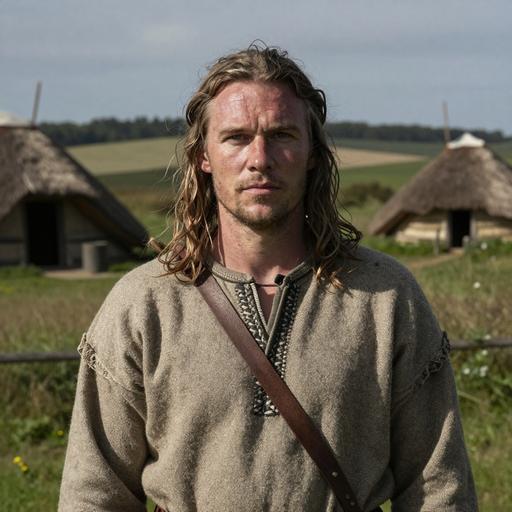
Portrait reconstruction of NEO946
Ancient Individual

A man buried in Denmark in the Bronze Age era

NEO946
1383 BCE - 1052 BCE
Male
Danish Bronze Age
Denmark
Scroll to begin
Chapter I

Identity

The biological and cultural markers that define this ancient individual

Sample ID

NEO946

Date Range

1383 BCE - 1052 BCE

Biological Sex

Male

mtDNA Haplogroup

U4a1a

Y-DNA Haplogroup

R-L151

Cultural Period

Danish Bronze Age

Chapter II

Place

Where this individual was discovered

Country Denmark
Locality Hove A (Zealand region)
Coordinates 55.7080, 12.2500
Chapter III

Time

When this individual lived in the broader context of human history

NEO946 1383 BCE - 1052 BCE
Chapter IV

Story

The narrative of this ancient life

The Danish Bronze Age, spanning approximately from 1700 BCE to 500 BCE, was a vibrant and transformative era characterized by significant developments in technology, art, social structure, and trade. This period, following the Neolithic Age, marked a profound evolution in the prehistoric societies of what is today Denmark. It was a time of notable advancements and cultural richness, shaped by the introduction of bronze – an alloy primarily composed of copper and tin – which replaced stone as the primary material for tools and weapons.

Technological and Artistic Developments

  1. Bronze Metallurgy: The introduction of bronze technology is a hallmark of this era. While Denmark itself lacked natural deposits of copper and tin, the society became adept at importing these resources from other European regions, developing intricate networks of trade. The craft of bronze smithing led to the production of a diverse array of items including weapons (such as swords, daggers, and axes), tools (like sickles and chisels), and various personal ornaments (such as pins, bracelets, and rings).

  2. Artistic Expression: The Danish Bronze Age is noted for its remarkable artifacts, which reveal a highly developed sense of aesthetics and symbolism. Spiral motifs, suns, and ship engravings were commonly used, indicating their possible religious or cultural significance. One of the most iconic artifacts from this period is the Trundholm Sun Chariot, a bronze and gold leaf-covered sculpture that portrays a horse-drawn solar disk, symbolizing the sun's journey across the sky – a central theme in Nordic mythology.

Social Structure and Settlements

  1. Community and Social Hierarchy: The era saw the emergence of increasingly complex societal structures. Evidence suggests the presence of hierarchical leadership, possibly chieftain-based, indicated by the wealth and quality of grave goods found in burial sites. Such burials were often located in barrows (large mounds) that signify the status and importance of the individual, showcasing the growing social stratification.

  2. Settlements: Communities were primarily agrarian, engaged in farming and animal husbandry. Settlements consisted of longhouses that served as domestic and communal spaces. These structures were typically built with wooden frames and thatched roofs, reflective of the environmental adaptation and available resources. Some findings indicate the presence of larger community centers, possibly serving as regional hubs of trade, culture, and governance.

Religious Beliefs and Practices

  1. Sun Worship: Sun worship played a central role in the spiritual life of the Danish Bronze Age people. The sun was regarded as a vital life force, essential for agriculture and survival. Artifacts such as the Sun Chariot underscore the significance of solar deities or myths.

  2. Burial Rites: The burial practices of the Danish Bronze Age were complex and varied, often involving large mounds or barrows to indicate high status. These graves often contained an array of goods, suggesting beliefs in an afterlife or that the dead required certain items in the next world. Ritualistic deposits or offerings in bogs across Denmark further highlight a ritualistic dimension, possibly connected to fertility or nature deities.

Trade and Interaction

  1. Long-Distance Trade: Despite its geographic position, Denmark was far from isolated during the Bronze Age. Long-distance trade networks were an integral component of the era, evidenced by the movement of metals, amber, and other luxury goods across Europe. Danish amber, in particular, was highly prized and widely traded, reaching as far as the Mediterranean.

  2. Cultural Exchange: Interaction with other cultures, particularly in Central Europe and the British Isles, facilitated a fusion of artistic styles and technologies. This exchange enriched the Danish Bronze Age culture, contributing to its diversity and complexity.

Legacy

The Danish Bronze Age laid fundamental cultural and technological foundations for subsequent periods. The era’s advances in metallurgy and artwork, combined with its rich social and spiritual life, significantly influenced the succeeding Iron Age and later historical societies in Scandinavia. Today, the meticulously preserved artifacts, burial sites, and settlement remains continue to offer invaluable insights into the everyday lives, beliefs, and aspirations of the Danish Bronze Age people, marking it as a pivotal chapter in Northern European prehistory.

Chapter V

Context

Other ancient individuals connected to this sample

Sources

References

Scientific publications and genetic data

Scientific Publication

Population genomics of post-glacial western Eurasia

Authors Allentoft ME, Sikora M, Refoyo-Martínez A
Abstract

Western Eurasia witnessed several large-scale human migrations during the Holocene1-5. Here, to investigate the cross-continental effects of these migrations, we shotgun-sequenced 317 genomes-mainly from the Mesolithic and Neolithic periods-from across northern and western Eurasia. These were imputed alongside published data to obtain diploid genotypes from more than 1,600 ancient humans. Our analyses revealed a 'great divide' genomic boundary extending from the Black Sea to the Baltic. Mesolithic hunter-gatherers were highly genetically differentiated east and west of this zone, and the effect of the neolithization was equally disparate. Large-scale ancestry shifts occurred in the west as farming was introduced, including near-total replacement of hunter-gatherers in many areas, whereas no substantial ancestry shifts happened east of the zone during the same period. Similarly, relatedness decreased in the west from the Neolithic transition onwards, whereas, east of the Urals, relatedness remained high until around 4,000 BP, consistent with the persistence of localized groups of hunter-gatherers. The boundary dissolved when Yamnaya-related ancestry spread across western Eurasia around 5,000 BP, resulting in a second major turnover that reached most parts of Europe within a 1,000-year span. The genetic origin and fate of the Yamnaya have remained elusive, but we show that hunter-gatherers from the Middle Don region contributed ancestry to them. Yamnaya groups later admixed with individuals associated with the Globular Amphora culture before expanding into Europe. Similar turnovers occurred in western Siberia, where we report new genomic data from a 'Neolithic steppe' cline spanning the Siberian forest steppe to Lake Baikal. These prehistoric migrations had profound and lasting effects on the genetic diversity of Eurasian populations.

Use code for 40% off Expires Feb 26