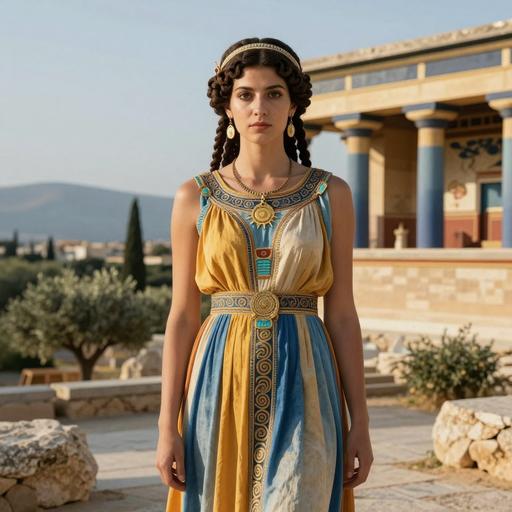
The Minoan civilization, thriving from approximately 3000 to 1100 BCE, was a significant pre-Greek society located on the island of Crete and neighboring Aegean islands. This period is divided into several phases, each illustrating the remarkable development and cultural achievements of the Minoans, reflecting their sophisticated society and influence over the Aegean region.
Geographic Setting
The Minoans were based primarily on Crete, the largest of the Greek islands, which offers a diverse landscape of mountains, fertile plains, and coastline. This strategic location facilitated maritime trade and cultural exchanges with other parts of the Aegean, Near East, and Egypt, positioning Crete as a crucial hub of ancient commerce and culture.
Political Structure
Initially, the Minoans did not have a centralized state. Instead, their political organization was likely characterized by a series of palatial centers, such as Knossos, Phaistos, Malia, and Zakros. These palaces were not only administrative and political centers but also served as hubs for economic, religious, and cultural activities. The nature of Minoan governance is still not entirely understood, but it is believed to have been less hierarchical than contemporary civilizations, possibly displaying some form of collective leadership or a bureaucracy associated with polycentric governance.
Economy
The Minoan economy was largely based on agriculture, trade, and crafting. Their agricultural practices included the cultivation of grains, olives, and grapes, while livestock farming was focused on sheep, goats, and cattle. The Minoans also engaged in extensive trade networks, exporting goods such as olive oil, wine, ceramics, and textiles in exchange for metals, ivory, and other luxury items. The artifacts found on Crete and traded throughout the Aegean world underscore their broad commercial connections.
Culture and Society
Minoan culture is renowned for its contributions to art and architecture. The palatial complexes were elaborately decorated with frescoes depicting religious rituals, nature, and sports. These frescoes are notable for their vibrant colors and dynamic forms. The Minoans also excelled in pottery, creating intricately designed vessels and the famed Kamares ware, which is characterized by its delicate forms and abstract, multi-colored patterns.
Society was likely matrilineal, with some interpretations suggesting prominent roles for women, which is inferred from iconographic representations in art. The presence of goddess figures in their religious practices also supports theories of a female-centered spiritual hierarchy.
Religion
Minoan religion was centered around nature worship and the veneration of deities associated with fertility and the earth, often represented by goddesses. Religious symbols include the bull, associated with the bull-leaping sport depicted in frescoes, and the double axe, or \labrys," which played a significant role in religious ceremonies. The practice of ritual sacrifice and offerings, particularly in peak sanctuaries and cave shrines, was common.
Language and Writing
The Minoans developed a writing system known as Linear A, which remains undeciphered, reflecting a language that predates the Greek language. Linear A is primarily found on clay tablets and religious objects, providing limited insight into the bureaucracy, trade, and religious practices of the time.
Art and Architecture
Minoan architectural innovation is evident in their palatial complexes, which featured advanced construction techniques, such as ashlar masonry, multi-story buildings with complex layouts, light wells, and sophisticated plumbing systems. The absence of fortification walls around Minoan sites suggests a society that prioritized trade and maintained peaceful relations with neighboring cultures during much of its existence.
Decline
The decline of the Minoan civilization is attributed to a combination of natural disasters, such as earthquakes and the catastrophic volcanic eruption on the nearby island of Thera (modern-day Santorini), along with external invasions, notably by the Mycenaeans from mainland Greece. By 1100 BCE, Minoan society had been largely assimilated or replaced by Mycenaean culture, marking the end of this influential period in Aegean history.
In summary, the Minoan civilization of the Aegean from 3000-1100 BCE represents a culture rich in artistic and architectural achievements, possessing a complex society with extensive trade networks, a unique religion, and a political structure embedded in palatial centers. Their legacy is an integral part of Greek cultural heritage, laying foundational aspects for the development of classical Greek culture."