Menu
Store
Blog
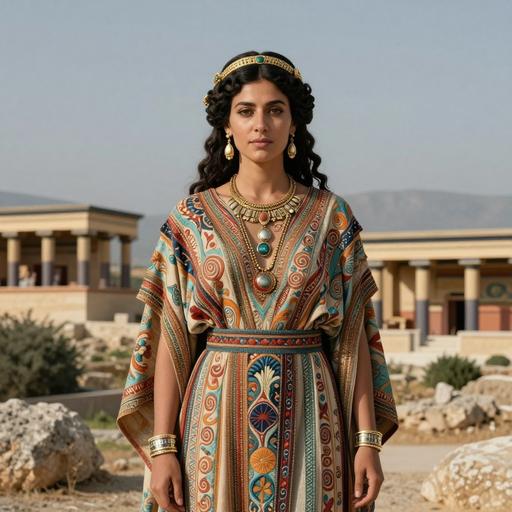
Portrait reconstruction of I9123
Ancient Individual

A woman buried in Greece in the Bronze Age era

I9123
1370 BCE - 1340 BCE
Female
Armenoi Site, Crete, Greece
Greece
Scroll to begin
Chapter I

Identity

The biological and cultural markers that define this ancient individual

Sample ID

I9123

Date Range

1370 BCE - 1340 BCE

Biological Sex

Female

mtDNA Haplogroup

U5a1

Cultural Period

Armenoi Site, Crete, Greece

Chapter II

Place

Where this individual was discovered

Country Greece
Locality Armenoi. Crete
Coordinates 35.4500, 24.1667
Chapter III

Time

When this individual lived in the broader context of human history

I9123 1370 BCE - 1340 BCE
Chapter IV

Story

The narrative of this ancient life

The Armenoi site, located near the village of Armeni on the island of Crete, is one of the most significant archaeological sites associated with the Minoan civilization, which flourished during the Bronze Age, approximately from 2600 to 1100 BCE. This site provides invaluable insight into the funerary practices and societal structure of the Minoans, particularly during the late Minoan period.

Geographic and Historical Context

Crete, situated in the southern Aegean Sea, was the cradle of the Minoan civilization, widely regarded as Europe's earliest advanced civilization. The Armenoi site is positioned around 11 kilometers south of the city of Rethymno, in a landscape characterized by olive groves and gentle hills. The area is significant due to its proximity to the fertile lands and its strategic location between major Minoan centers like Knossos and Phaistos.

Discovery and Excavation

The Armenoi site was excavated systematically beginning in the late 1960s and early 1970s by the archaeologist Yannis Tzedakis. It consists of a large Late Minoan cemetery which dates roughly from the 14th to the 12th centuries BCE. Dozens of rock-cut chamber tombs have been discovered, providing a wealth of information about the Minoans' funerary customs and their conception of the afterlife.

Tomb Architecture and Funerary Practices

The primary feature of the Armenoi site is its collection of over 200 chamber tombs carved directly into the soft limestone. These tombs vary in size, indicating a hierarchical society with social stratification. Some tombs are modest, containing a single chamber, while others are more elaborate, with multiple chambers and elaborate entrances.

Each tomb typically consists of three parts: the dromos (a long entranceway), the stomion (the entrance), and the chamber itself. The entrances were often sealed with slabs of stone after burial. Many of the chambers contained multiple burials, suggesting they were used over several generations. The bodies were typically placed on the floor in a contracted position, surrounded by grave goods that included pottery, bronze tools, weapons, jewelry, and seals. The presence of personal items and offerings indicates a belief in an afterlife where the deceased required the same belongings they used in life.

Grave Goods and Social Insights

The grave goods found at Armenoi offer a glimpse into the socioeconomic status of those interred within the tombs. High-quality pottery, such as the distinctive stirrup jars and painted vessels, suggests that Armenoi was part of a well-developed trade network, exchanging goods with other Minoan settlements and possibly with regions beyond Crete.

Tools and weapons made of bronze found in the tombs indicate advanced metallurgical skills and hint at the possible roles the deceased held in life, such as warriors or artisans. Jewelry made of gold, semi-precious stones, and intricate craftsmanship reflects the Minoans' artistic achievements and social complexity.

Religious and Cultural Aspects

The Minoan religion, as suggested by the artifacts and architectural remains in places like Armenoi, was polytheistic and heavily centered around nature worship, with an emphasis on female deities. The placement of objects within the graves may reflect ritualistic practices, and the repetitive use of tombs underscores the importance of ancestor worship or reverence for familial ties.

In addition, the presence of frescoes or painted pottery in some of the tombs reveals the Minoans’ sophisticated artistry and possible narratives or mythologies that were important to their cultural identity.

Conclusion

The Armenoi site on Crete provides a critical lens through which we can examine the late phase of the Minoan civilization. It highlights the complexity of their societal structure, their technological proficiency, and their cultural and religious practices. The cemetery at Armenoi stands as a testament to a civilization that, while ancient, laid the groundwork for future cultures in the Aegean and beyond. The ongoing study of this site continues to enrich our understanding of the Minoans, offering tangible links to understanding their world, their lives, and their beliefs about death and the afterlife.

Chapter V

Genetics

The genetic ancestry of this ancient individual

Ancient Genetic Admixture

This analysis compares the DNA profile of I9123 with ancient reference populations, showing the genetic composition in terms of prehistoric ancestral groups.

Neolithic Farmers 49.7%
European Hunter-Gatherers 25.7%
Western Steppe Pastoralists 22.2%
Ancient Asians 2.4%

Modern Genetic Admixture

This analysis compares the DNA profile with present-day reference populations, showing what percentage of genetic makeup resembles modern populations from different regions.

Europe 79.7%
Southern European 73.7%
Italian 59.5%
Sardinian 14.1%
Northwestern European 6.1%
Asia 18.5%
Northern West Asian 13.0%
Cypriot 9.2%
Mesopotamian 3.8%
Arab, Egyptian & Levantine 5.5%
Levantine 5.5%
Oceania 1.8%
Melanesian 1.8%
Papuan 1.8%

Closest Modern Populations

These are the modern populations showing the closest statistical alignment to A woman buried in Greece in the Bronze Age era, ranked by genetic distance. Lower distance values indicate closer statistical similarity.

1
Sicilian West
2.9512
2
Belmonte Jew
3.3785
3
Italian Umbria
3.6197
4
Ukrainian Zhytomyr O
3.6893
5
Italian Marche
3.7084
6
Maltese
3.7357
7
Italian Lazio
3.7816
8
Italian Tuscany
3.8268
9
Italian Abruzzo
3.9328
10
Ashkenazi Ukraine
3.9599
Chapter VI

Context

Other ancient individuals connected to this sample

Sources

References

Scientific publications and genetic data

Scientific Publication

Genetic origins of the Minoans and Mycenaeans

Authors Lazaridis I, Mittnik A, Patterson N
Abstract

The origins of the Bronze Age Minoan and Mycenaean cultures have puzzled archaeologists for more than a century. We have assembled genome-wide data from 19 ancient individuals, including Minoans from Crete, Mycenaeans from mainland Greece, and their eastern neighbours from southwestern Anatolia. Here we show that Minoans and Mycenaeans were genetically similar, having at least three-quarters of their ancestry from the first Neolithic farmers of western Anatolia and the Aegean, and most of the remainder from ancient populations related to those of the Caucasus and Iran. However, the Mycenaeans differed from Minoans in deriving additional ancestry from an ultimate source related to the hunter-gatherers of eastern Europe and Siberia, introduced via a proximal source related to the inhabitants of either the Eurasian steppe or Armenia. Modern Greeks resemble the Mycenaeans, but with some additional dilution of the Early Neolithic ancestry. Our results support the idea of continuity but not isolation in the history of populations of the Aegean, before and after the time of its earliest civilizations.

G25 Coordinates

The G25 coordinates for sample I9123 can be used for detailed admixture analysis in our G25 Studio tool.

I9123,0.09327818,0.13422146,0.01183998,-0.02787164,0.02760396,-0.00930016,-0.00167224,0.0051191,0.01456556,0.02593056,-0.0018867,0.00390256,-0.00801408,-0.00129494,-0.00285418,-0.00327912,0.00591814,-0.00271428,-0.0052312,0.00586278,-0.00025296,-0.00267728,0.000606,-0.01062818,0.00098386
Analyze in G25 Studio
Use code for 40% off Expires Feb 27