Menu
Store
Blog
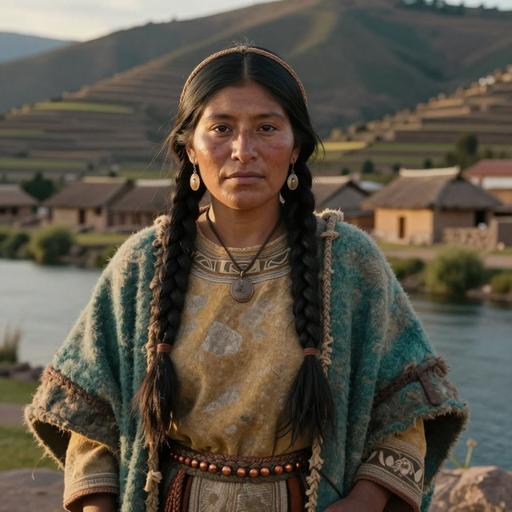
Portrait reconstruction of K1
Ancient Individual

A woman buried in Peru in the Ancient South America era

K1
6000 BCE - 2000 CE
Female
Unknown Period Kaillachuro, Peru
Peru
Scroll to begin
Chapter I

Identity

The biological and cultural markers that define this ancient individual

Sample ID

K1

Date Range

6000 BCE - 2000 CE

Biological Sex

Female

mtDNA Haplogroup

H5a1

Cultural Period

Unknown Period Kaillachuro, Peru

Chapter II

Place

Where this individual was discovered

Country Peru
Locality Rio Ilave Basin. Kaillachuro
Chapter III

Time

When this individual lived in the broader context of human history

K1 6000 BCE - 2000 CE
Chapter IV

Story

The narrative of this ancient life

The Kaillachuro culture is not a widely recognized period or group within the extensively studied Andean civilizations. If it has been referred to in some niche academic quarters or recent discoveries, it's relatively obscure compared to more established Andean cultures such as the Inca, Wari, Nazca, or Moche. However, we can explore the common characteristics and historical context of an unspecified or \unknown" Andean civilization period or culture based in what could potentially be part of the vast Andean cultural tapestry that characterized pre-Columbian Peru.

Geographical Context

The Andes mountain range has played a significant role in shaping the civilizations within its vicinity. Kaillachuro, if it indeed refers to a specific region or archaeological site within Peru, would be located within the Andes and could encompass highland valleys and plateaus. This geography influences climate, agriculture, and social organization.

Possible Cultural Characteristics

  1. Material Culture and Architecture:

    • Like other Andean cultures, it is likely that Kaillachuro utilized stone extensively in their building practices, given the abundant natural resources.
    • Architectural styles might include terraced fields, which are a hallmark of Andean agricultural adaptation, necessary for maximizing arable land in steep mountainous regions.
    • Structures may include communal buildings or religious temples, possibly aligning with astronomical events, a feature common in Andean architecture.
  2. Socioeconomic Organization:

    • Societies in the Andes often had a hierarchical structure, with a centralized authority such as a chief or ruling elite overseeing local population groups.
    • Economies would be a mix of agriculture, particularly the cultivation of crops like potatoes and quinoa, and pastoralism focusing on camelids like llamas and alpacas.
  3. Art and Symbolism:

    • Andean civilizations are known for their intricate textiles and ceramics, both of which are often imbued with religious and social symbolism.
    • Artifacts may include iconography that blends elements of native wildlife, deities, and abstract patterns, potentially serving as conduits for mythological storytelling or communication of status.
  4. Religion and Cosmology:

    • Religion in the Andes was often polytheistic and animistic, with a reverence for natural elements such as mountains (apus), water sources, and celestial bodies.
    • Rituals and ceremonies probably involved offerings and sacrifices, embodied through complex ceremonies and festivities tied to the agricultural calendar.
  5. Technological Proficiencies:

    • Agricultural innovations might include advanced irrigation techniques or crop rotation, which were crucial for thriving in the often-challenging Andean environment.
    • Textile technology would also be highly developed, with techniques for weaving and dyeing that produce vibrant and durable garments and ceremonial cloths.

Interaction with Other Cultures

  • If the Kaillachuro existed in proximity to other known cultures, trade and cultural exchanges would likely have been prominent. This would manifest in shared motifs and technologies.
  • There might have been periods of conflict or cooperation with neighboring groups, influencing political and cultural evolution.

Archaeological Evidence

The archeological footprint would include:

  • Pottery shards with distinctive styles.
  • Ruins of structures possibly aligned for astronomical observations.
  • Burial sites with grave goods reflecting the social status and belief systems.

Challenges and Opportunities

  1. Preservation and Research:

    • As an "unknown" culture, significant archaeological efforts would be required to uncover and interpret the remnants of Kaillachuro's existence, emphasizing non-invasive techniques.
  2. Adaptive Strategies:

    • Responses to climatic changes and external pressures, such as covert trading networks or warfare adaptations, could be vital exploration areas.

In summary, while it is challenging to provide a detailed description of the Kaillachuro culture without specific scholarly references or archaeological findings, contextual speculation based on Andean patterns offers a framework for imagining such a society. Further excavation and research could eventually shed light on its distinct characteristics and contributions to the rich tapestry of Andean history."

Chapter V

Context

Other ancient individuals connected to this sample

Sources

References

Scientific publications and genetic data

Scientific Publication

The genetic prehistory of the Andean highlands 7000 years BP though European contact

Authors Lindo J, Haas R, Hofman C
Abstract

The peopling of the Andean highlands above 2500 m in elevation was a complex process that included cultural, biological, and genetic adaptations. Here, we present a time series of ancient whole genomes from the Andes of Peru, dating back to 7000 calendar years before the present (BP), and compare them to 42 new genome-wide genetic variation datasets from both highland and lowland populations. We infer three significant features: a split between low- and high-elevation populations that occurred between 9200 and 8200 BP; a population collapse after European contact that is significantly more severe in South American lowlanders than in highland populations; and evidence for positive selection at genetic loci related to starch digestion and plausibly pathogen resistance after European contact. We do not find selective sweep signals related to known components of the human hypoxia response, which may suggest more complex modes of genetic adaptation to high altitude.

Use code for 40% off Expires Feb 27