Introduction
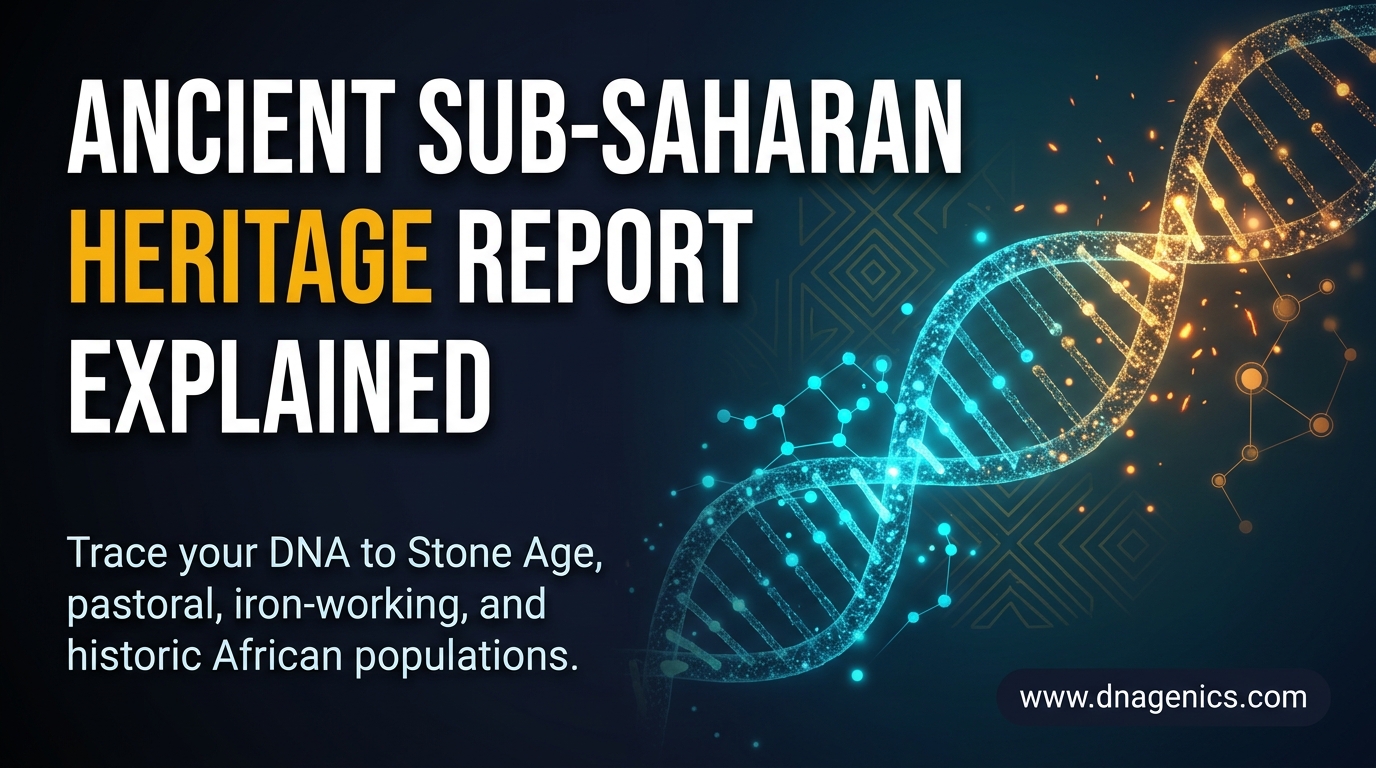
For many people, a DNA ancestry result that simply says “Sub-Saharan African” is only the beginning of the story. An Ancient Sub-Saharan Africa Heritage Report goes deeper, linking your DNA to ancient populations across the region and placing those connections into historical context. Instead of focusing only on broad modern ancestry categories, it helps show how your genetic profile relates to older population histories from Stone Age foragers to historic kingdoms.
This matters because African ancestry is both ancient and extraordinarily diverse. The continent holds some of the deepest human population history available in ancestry testing, and a report like this can help users see connections across time, geography, and culture. For people in the African diaspora, as well as anyone with heritage from West, East, Central, Southern Africa, or the Sahel, this kind of deep-ancestry analysis can offer a more detailed and meaningful view of family origins.
Key Takeaways
- The Ancient Sub-Saharan Africa Heritage Report estimates your genetic similarity to ancient populations across multiple historical periods, not just one modern region.
- The report combines several comparison methods into an overall score, then breaks results down by era, closest ancient match, and maternal or paternal lineage markers.
- Each period is labeled with clear evidence types, including Shares DNA, Shared lineage branch, Best-fit model, and Reference sample, so users can tell similarity from direct segment sharing.
- The report spans major African historical contexts, including Stone Age, Pastoral Neolithic, Bronze Age, Iron Age, Swahili Coast, Great Kingdoms, Protohistoric, and Historic periods.
- This product is especially useful for users who want deeper pre-colonial African ancestry context, including people researching connections to Mali, Ghana, Zimbabwe, Kongo, and other historic African societies.
How the Ancient Sub-Saharan Africa Heritage Report Works
The Ancient Sub-Saharan Africa Heritage Report is designed to measure how closely your DNA connects to ancient populations across Sub-Saharan Africa. It does this by comparing your genetic data with ancient reference individuals and population groups from different eras. The result is not a single yes-or-no answer, but a layered picture of affinity, similarity, and shared lineage signals.
At the center of the report is an overall Ancient Sub-Saharan Africa score. This score summarizes your genetic affinity to the region’s population history using four complementary comparison methods. Rather than treating all evidence as the same, the report keeps the different signal types visible so users can understand what is driving each result. That makes the report useful for beginners who want a simple summary and for advanced users who want more detail.
The report also includes a closest ancient individual match, which highlights the single ancient sample you are most genetically similar to. This does not mean you descend from that person directly. It means your DNA profile appears most similar to that ancient individual within the available reference set. The report also shows matched ancient samples grouped by historical era, which helps users see whether their strongest connections cluster in one period or appear across several time spans.
The Historical Periods Covered in the Report
One of the most valuable features of this report is its period-by-period structure. Instead of giving a broad regional label, it organizes the ancestry story across eight eras of Sub-Saharan African history. This allows users to see how their DNA may connect to different layers of population history over time.
The report covers Stone Age populations, including early and later hunter-gatherer foragers. These groups represent some of the deepest ancestral layers in the dataset and are especially important for users interested in long-term population continuity. It also includes the Pastoral Neolithic, when early cattle-herding communities expanded across parts of Africa and new lifeways spread through the landscape.
The Bronze Age section reflects early metalworking cultures, while the Iron Age includes Bantu expansion and iron-working societies. These periods are important because they capture major demographic and cultural changes that shaped much of Sub-Saharan Africa. Later periods include the Swahili Coast, linked to East African coastal trading civilizations, and the Great Kingdoms, which bring in contexts such as Mali, Ghana, Zimbabwe, and Kongo.
The report also includes Protohistoric and Historic periods. Protohistoric generally refers to the transition toward written records and early colonial contact, while Historic covers documented populations and kingdoms. Together, these categories create a timeline that is broad enough to be informative, but specific enough to be useful for people seeking more than a generic ancestry percentage.
Evidence Labels and What They Mean
A key part of this report is that every ancient individual is labeled by the type of evidence linking them to your results. This is important because not every match means the same thing. Keeping the evidence types separate helps prevent overinterpretation and gives readers a more accurate picture of the analysis.
The label Shares DNA means the ancient individual shares DNA segments with you. This is the strongest kind of connection described in the report, because it indicates segment-level sharing rather than only population-level similarity. The label Shared lineage branch means you and the ancient individual share the same maternal or paternal haplogroup branch. This can be informative for lineage history, but it does not identify a specific ancestor by itself.
The label Best-fit model means the individual is part of the population mix that best fits your DNA, but this is a statistical similarity signal rather than direct shared DNA. Finally, Reference sample means the individual is shown for context and comparison, not as a match. A “Show” filter lets you view just one kind of evidence, which is especially helpful if you want to focus on direct DNA sharing or lineage markers separately from broader similarity.
Regional Coverage and Historical Context
The report is especially valuable because it brings together multiple parts of Sub-Saharan Africa in one framework. Users can see connections that span West Africa, East Africa, Southern Africa, Central Africa, and the Sahel without having to interpret each region separately. This broader structure reflects the complexity of African population history and avoids reducing ancestry to a single place or time period.
In West Africa, the report may include contexts such as the Nok culture and the Ghana and Mali empires. In East Africa, it reaches the Swahili Coast and Great Rift Valley pastoralists. Southern Africa can include San foragers, Bantu-speaking agriculturalists, and Great Zimbabwe, while Central Africa may connect to rainforest hunter-gatherers and the Kongo Kingdom. The Sahel adds trans-Saharan trade routes and Sahelian kingdoms, showing how movement, exchange, and state formation shaped the region’s genetic history.
This regional breadth matters because it gives users concrete historical touchpoints. For many people, seeing a named kingdom or cultural tradition creates a stronger sense of place than a broad ancestry category ever could. At the same time, the report remains neutral and careful, since every result is an estimate of genetic similarity, not proof of descent from a specific ruler, dynasty, or historical figure.
What the Report Can and Cannot Tell You
This report can help you understand how your DNA relates to ancient Sub-Saharan African population history, but it has important limits. A strong connection to a period such as the Great Kingdoms does not mean you descend from a specific royal lineage. It means your genetic data show estimated similarity to populations associated with that historical era or region.
It can also help users look deeper than typical recent-ancestry results. For people in the African diaspora, this is especially meaningful because it can point toward pre-colonial African population connections rather than only recent centuries. For history enthusiasts, the report offers a structured way to explore human migration, cultural change, and long-term genetic continuity across Africa.
At the same time, users should remember that ancient DNA reference panels are incomplete by nature. The report reflects the ancient samples currently available for comparison, not an exhaustive record of every African population or every historical community. That means the results are best understood as an informed, evidence-based estimate, not as the final word on your ancestry.
Practical Implications
If you are considering this report, the most useful approach is to read it as a historical and genetic map, not as a literal family tree. Look first at the overall score, then compare it with the period-by-period breakdown and the closest ancient sample. If your strongest signals cluster in one era or region, that can give you a useful starting point for further research into African history, migration, and regional identity.
It can also help to pay close attention to the evidence labels. A result based on shared DNA segments carries a different meaning from one based on a best-fit model or a shared lineage branch. By separating those categories, the report helps you avoid common misunderstandings and supports a more responsible interpretation of ancient ancestry data. If you are using the report as part of family history research, it may be helpful to combine it with documentary genealogy, oral history, and broader reading on the historical periods listed in your results.
Conclusion
The Ancient Sub-Saharan Africa Heritage Report offers a detailed, balanced way to explore deep African ancestry through ancient population history. By combining an overall similarity score, period-by-period analysis, closest ancient matches, and lineage markers, it gives users a richer view of their genetic ties to the past. For anyone interested in Sub-Saharan African heritage, especially across the African diaspora, it provides a meaningful and carefully framed path into deeper ancestry research.
References / Further Reading
- DNAGENICS, Ancient Sub-Saharan Africa Heritage Report (product description and report framework)
- General background on Sub-Saharan African population history, ancient DNA, and African kingdoms and trade networks