Introduction
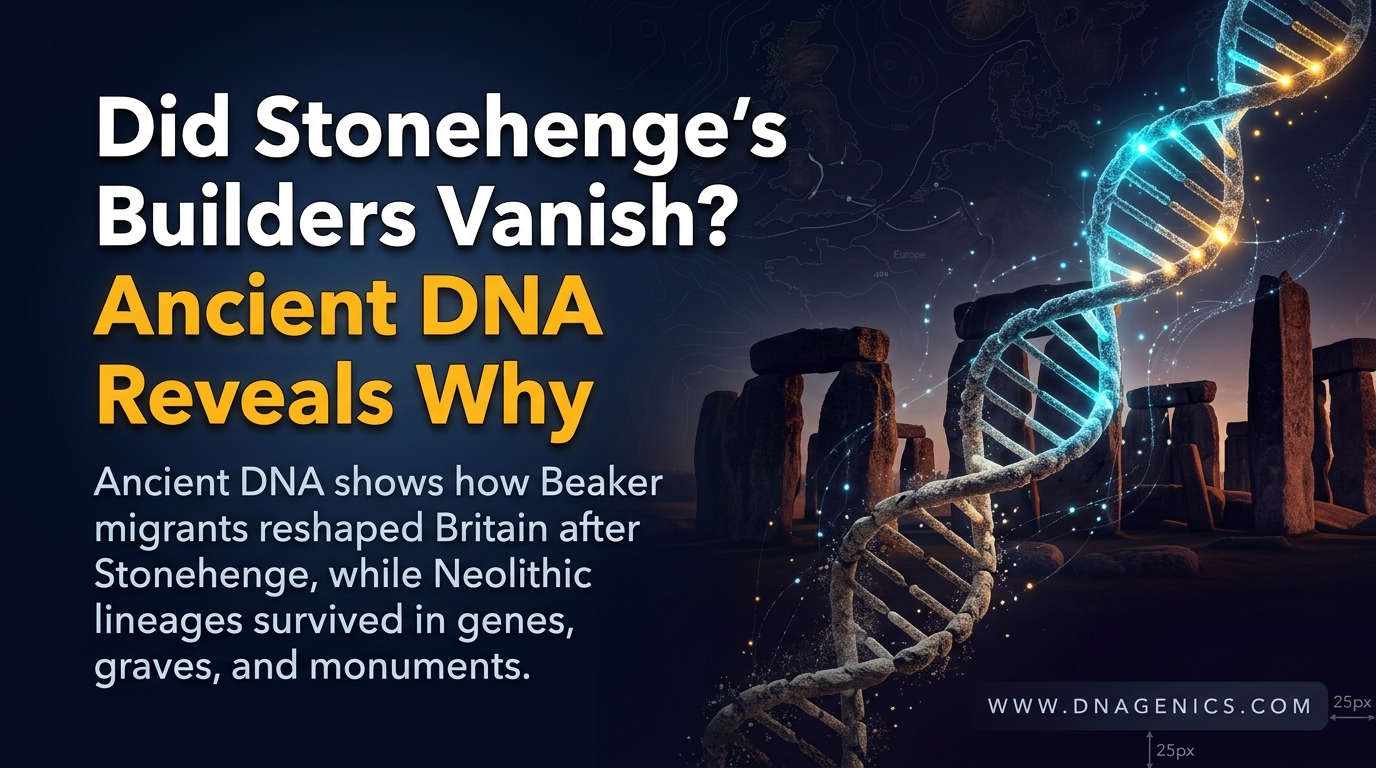
Stonehenge is one of the most famous monuments in the world, but the people who built it are often treated as if they vanished overnight. Ancient DNA tells a more complicated story. A major genetic transition did occur in Britain after the arrival of Beaker pottery around 2450 BC, yet the change was not an instant disappearance of the older population. Instead, it was a long process of migration, intermarriage, cultural change, and demographic replacement.
This matters because DNA can sometimes make dramatic historical events sound simpler than they were. When researchers compare ancient DNA, burial practices, and archaeological dates, they can see that the builders of Stonehenge were not erased in a single moment. Their descendants lived on for generations, mixed with newcomers, and left traces in later genomes, in the male line, and even in the monument itself.
Key Discoveries / Main Points
- Beaker-associated migrants arriving after 2450 BC replaced roughly 90% of Britain’s gene pool within a few centuries, according to ancient DNA studies.
- The first Stonehenge builders were Neolithic farmers, and the great sarsen circle and trilithons were already in place before the main Beaker arrival.
- The genetic shift was slow rather than sudden, likely unfolding over 10 to 16 generations, with some local people persisting in the landscape.
- Local Neolithic ancestry did survive in later Bronze Age Britain, although usually at low levels in the genome and unevenly across individuals and regions.
- The Y chromosome and mitochondrial DNA suggest that both men and women moved, but local male lineages survived in some places, including Orkney.
What This Means for Your DNA
For anyone interested in ancestry DNA testing, this story is a useful reminder that population history is usually about statistical patterns, not simple labels. When geneticists say that a later group replaced most of an earlier one, they mean that the overall frequency of ancestry components changed dramatically across many people. That does not mean every family line ended, and it does not mean that identity can be read directly from one genetic marker.
In practical terms, a modern DNA test cannot tell you that you are a direct descendant of Stonehenge’s builders or of the Beaker newcomers. What it can do is place your results within broad patterns of population genetics, showing whether your ancestry most closely matches later populations shaped by Bronze Age migration, earlier farming communities, or other ancient sources. The Stonehenge case shows why these comparisons are powerful, but also why they must be interpreted carefully.
For beginners, the key point is that ancestry is layered. A person can carry segments that reflect many periods of movement, from Neolithic farming expansion to Bronze Age migration and later historic events. For advanced users, this is a classic example of how admixture, drift, and changing burial practices can make one population appear to “replace” another even when continuity persists in smaller, less visible ways.
Historical and Archaeological Context
Britain’s first farmers arrived from the continent around 4000 BC and largely replaced the earlier hunter-gatherer population. These early farming groups were ultimately connected to broader Neolithic movements that spread from the Aegean through western Europe. They built long barrows, causewayed enclosures, Avebury, Silbury Hill, and the earliest phases of Stonehenge. In other words, the monument belongs to the world of Britain’s Neolithic farmers, not to the later Beaker migrants who became dominant centuries afterward.
Stonehenge itself changed over time. It began as a henge enclosure around 3000 BC, and the famous sarsen circle and inner trilithons were raised between about 2620 and 2480 BC. By the time the first Beaker newcomers arrived, the core monument was already complete or nearly complete. Later groups did not just inherit the site, they reshaped it, including rearranging the bluestones and adding later features. That makes Stonehenge a rare example of a monument that bridges major population shifts.
The wider archaeological picture fits the genetics. Beaker pottery appears in Britain soon after 2450 BC, followed by new burial customs, new genetic signatures, and major changes in material culture. Yet the local story did not end immediately. For some time, incoming and local groups lived side by side, with different mortuary practices and only limited mixing at first. This is exactly the kind of situation where archaeology and DNA together give a fuller view than either could alone.
The Science Behind It
The genetic results discussed here come from comparisons between ancient British genomes and two reference groups: continental Beaker-related people from the Lower Rhine and Meuse region, and earlier British Neolithic farmers. Researchers model ancestry as proportions drawn from those source populations, then test how well the model fits individual genomes and group averages. This kind of ancient DNA analysis can identify broad ancestry shifts, but it depends heavily on choosing the right reference populations and on understanding the limits of the data.
One important technical point is that the continental source matters. The Beaker people who arrived in Britain were not identical to the earlier farmers who had lived on the island. They already carried a mixed ancestry profile from the Lower Rhine-Meuse region, with both farmer-related and hunter-gatherer-related components. That means some of the “farmer ancestry” found in Bronze Age Britain may actually have come from continental Beaker groups, not directly from the builders of Stonehenge. This is a good example of how migration history can be hidden inside genetic averages.
In Simple Terms: Ancient DNA can show whether later people were genetically similar to earlier people, but it cannot always tell you exactly where each piece of ancestry came from. Think of it like mixing paints, some colors may have entered Britain directly, while others arrived already blended in continental populations.
The data also show why burial practice matters. If one community mainly cremated their dead and another buried them intact, the cremating group will be underrepresented in the genetic record. That means absence from the DNA record does not always mean absence from the population. In this case, the surviving Neolithic signal in Bronze Age Britain may partly reflect real demographic continuity and partly reflect which individuals happened to be preserved for study.
Why It Matters
This research changes the way we talk about cultural change in prehistoric Britain. The old idea that the people who built Stonehenge simply vanished is too blunt. A better reading is that a major migration and population turnover occurred, but the transition happened over generations and left behind pockets of continuity. Some local ancestry remained visible in later Bronze Age groups, and at least one Neolithic male lineage persisted for about a thousand years in Orkney.
The broader significance is that migration, population replacement, and continuity can all be true at once. Ancient DNA has made it possible to measure those changes more precisely, but the results work best when combined with archaeology, burial evidence, and regional history. For the future of ancestry research, this is a reminder that every population story is a process, not a single event.
References / Further Reading
- Published ancient DNA studies on Beaker Britain, including work led by Olalde and colleagues
- Studies on Stonehenge archaeology and construction phases
- Research on Bronze Age population genetics in Britain and Orkney
- Ancient DNA work on Late Neolithic and Bronze Age plague in Britain