Introduction
For many French Canadians, Franco-Americans, Acadians, and Cajuns, family history often includes a familiar story: somewhere in the tree, there may have been an Indigenous ancestor. These stories are deeply meaningful, and in some families they are supported by old records, local memory, or visible connections to colonial-era communities. But when we move from oral history to genetics, the picture becomes more complicated.
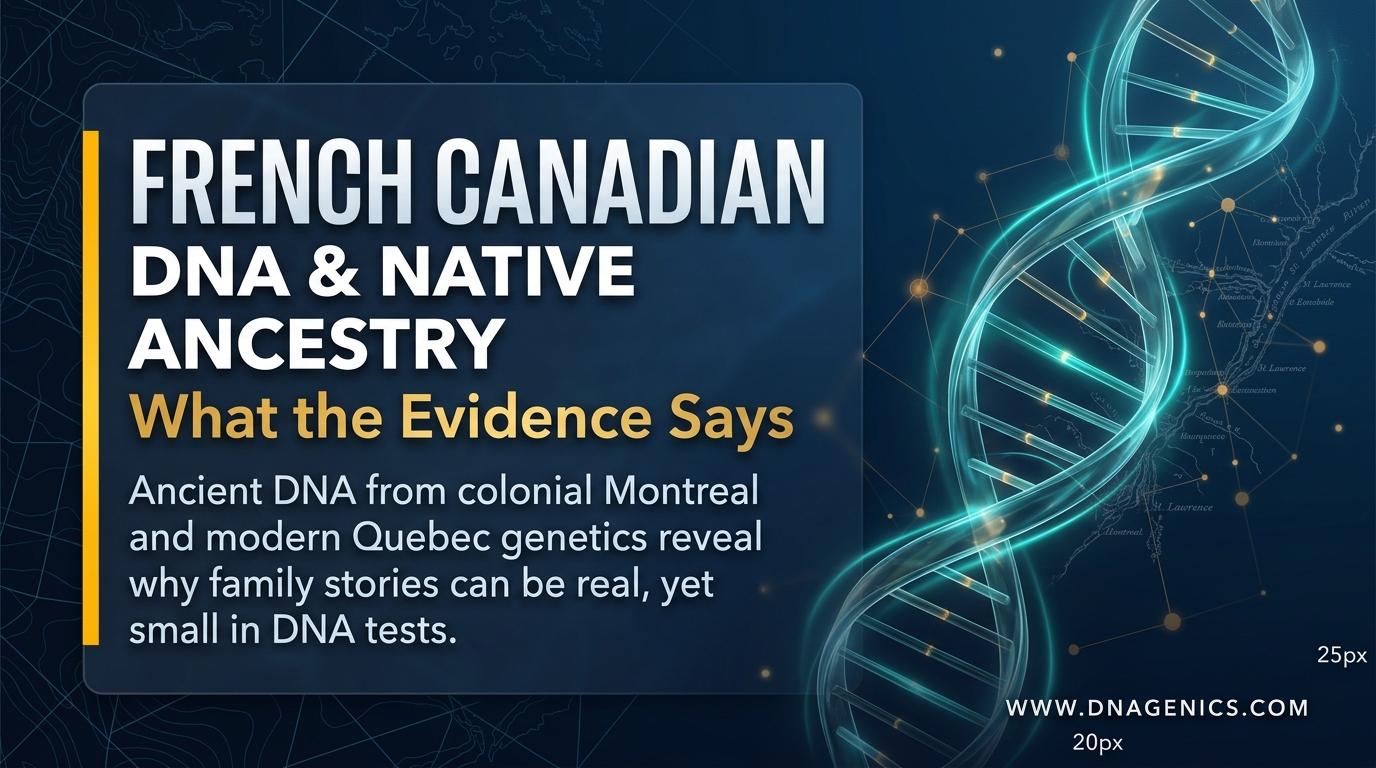
A new ancient DNA study from colonial Montreal helps explain why. By analyzing 45 people buried in the old Notre-Dame cemetery, researchers found that every sampled individual had European ancestry, with no clear evidence of recent Indigenous or African admixture. At the same time, modern population genetics shows that many Quebecers do carry small amounts of Native American ancestry, usually at levels that are easy to miss unless you use the right methods. The result is a useful reminder that DNA ancestry testing can confirm broad patterns of population history, but it cannot always validate every family story in a simple yes-or-no way.
This topic matters because it sits at the intersection of genetics, genealogy, and colonial history. It also highlights a core principle of population genetics: a small number of ancestors, repeated across many family trees, can leave a widespread but very faint signal in today’s genomes. In other words, a story can be historically plausible, yet still be difficult to detect in a modern DNA test.
Key Discoveries / Main Points
- Ancient DNA from colonial Montreal showed that all 45 sampled burials from the Notre-Dame cemetery had European ancestry, with no clear sign of recent Indigenous or African admixture.
- Modern Quebec genetics suggests that average Indigenous ancestry among many French Canadian groups is low, often below 1%, and rarely above 5% in the published data.
- Family stories can still be real: a documented Indigenous ancestor in the 1600s can appear in many family trees today, but the DNA contribution may be extremely small after many generations.
- Skeleton shape is not the same as ancestry: earlier studies using bone measurements suggested more mixed ancestry than the ancient DNA study confirmed, showing that morphology alone can mislead.
- Regional variation matters: eastern Quebec, especially Gaspesie and the North Shore, tends to show higher average Indigenous ancestry than Montreal or Quebec City in published studies.
What This Means for Your DNA
If your family has long said there was an Indigenous ancestor, this study does not automatically prove or disprove that story. What it does show is that the genetic signal from a distant ancestor can become very small over time. If that ancestor lived 10, 12, or 15 generations ago, the inherited DNA may now be fragmented, diluted, or absent from the segments that consumer ancestry tests can detect.
This is especially important for people using autosomal DNA tests. These tests are good at identifying recent ancestry and broad regional similarity, but they are less reliable for very old, low-level admixture. A result showing little or no Indigenous ancestry does not necessarily mean the family story is false. It may mean the signal is below the test’s detection threshold, or that the ancestor is farther back than the model can confidently resolve.
The study also helps explain why many French Canadian lines show a shared ancestry pattern. Because colonial Quebec descended from a relatively small founder population, even a limited number of mixed unions could spread across many descendants. That means a person can honestly descend from a documented Indigenous ancestor and still show only a tiny percentage in DNA testing, or none at all if the inheritance was not passed down in the sampled segments.
Historical and Archaeological Context
Montreal began as Ville-Marie in 1642, and the old Notre-Dame parish cemetery served the colony from 1683 to 1796. This was a formative period in the history of New France, when French settlers, Indigenous communities, and people of African descent all lived within the wider colonial world, though not on equal terms. The cemetery itself reflects that social order, since it primarily contained ordinary Catholic colonists, not the full diversity of colonial Montreal.
Historians know that marriages between French settlers and Indigenous women did happen, especially in the early colonial period and in the wider fur trade network. Some unions are well documented in parish records, and their descendants remained important in parts of Quebec and beyond. But these marriages were relatively rare in the St Lawrence valley itself, and many mixed families formed farther west or north, especially in the Great Lakes region. That is one reason why the history of French-Indigenous contact does not translate into a large, uniform Indigenous ancestry signal across all Quebec families.
Archaeology and archival history also help explain the cemetery results. Indigenous people often had burial places tied to their own communities, while enslaved people were frequently buried elsewhere, including on private property or in cemeteries for the poor. So the absence of Indigenous or African ancestry in this Montreal cemetery is not a statement about the absence of contact in colonial society. Instead, it reflects how burial practices, social status, and segregation shaped who ended up in which ground.
The Science Behind It
Ancient DNA studies recover genetic material from long-dead individuals and compare it with reference panels from modern and ancient populations. In this case, researchers used genome-wide data to test whether the burials from Montreal clustered with European, Indigenous American, or African reference groups. The result was clear: the sampled individuals fit within a European ancestry profile, with no meaningful evidence of recent admixture from the other groups in the study.
This is different from older skeletal approaches, which often infer ancestry from bone shape or cranial measurements. Those methods can be informative in broad population studies, but they are not precise enough to identify ancestry on their own. Human skeletal traits vary within every population, and overlapping features can lead to misclassification. That is why DNA provides a sharper tool for testing population history, especially when researchers want to detect admixture or kinship.
In Simple Terms: Bones can suggest patterns, but DNA is much better at showing where a person’s ancestors came from. Even then, very old ancestry can be so small that a modern test may not detect it clearly.
For advanced readers, the key issue is detection threshold. When ancestry from a source population becomes very small, different algorithms may disagree, especially if the sample is limited or the reference panel is imperfect. That is why studies of French Canadian ancestry often report different percentages depending on whether they use genealogy, haplotype-based methods, or admixture models. The broad conclusion is consistent, though: Indigenous ancestry exists in the population, but it is usually modest on average and highly uneven between regions and families.
Why It Matters
This research is important because it pushes ancestry analysis toward a more careful, evidence-based interpretation. It shows that oral tradition, parish records, archaeology, and DNA can all be true at the same time, but they may describe different parts of the same historical process. A family story may preserve a real ancestor, while the genome shows only a faint statistical trace of that person today.
It also matters for the future of genetics and historical research. As more ancient DNA becomes available from colonial sites, researchers can better distinguish between myth, memory, and measurable ancestry patterns. For anyone exploring French Canadian, Acadian, or Cajun roots, the message is not that family stories should be dismissed. It is that those stories work best when paired with records, local history, and a realistic understanding of how DNA inheritance fades across generations.
References / Further Reading
- Ancient DNA study of colonial Montreal burials, published in PNAS in 2026
- Quebec population genetics studies using CARTaGENE and regional French Canadian samples
- Historical records and parish registers from New France, including colonial Montreal and the St Lawrence valley
- Studies on French Canadian founder effects, migration, and Indigenous admixture in Quebec populations