Introduction
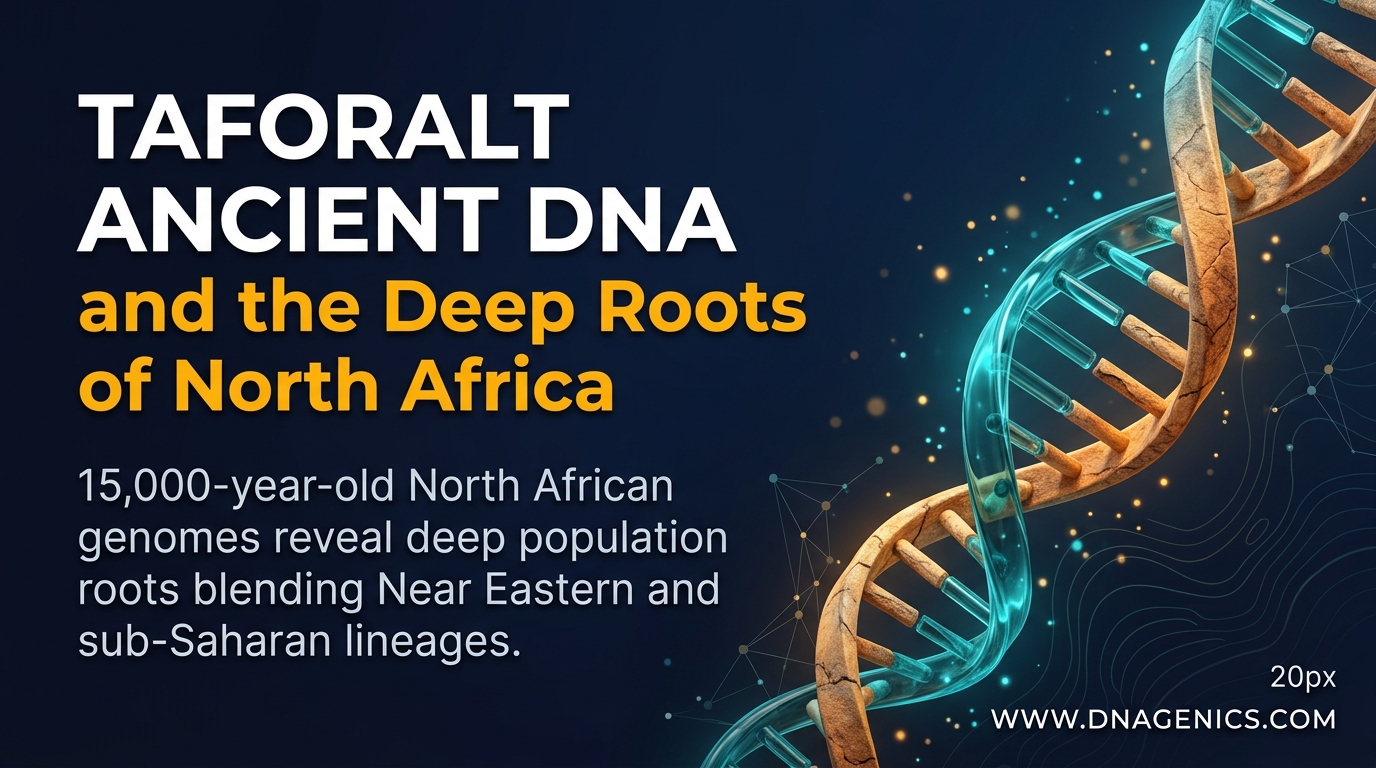
Ancient DNA can reveal surprising chapters of human history, especially in regions where archaeology and genetics tell a story that is older and more complex than modern borders suggest. One of the most striking examples comes from Taforalt, a cave site in eastern Morocco where hunter-gatherers buried their dead about 15,000 years ago, long before farming reached North Africa.
What makes this site so important is not only its age, but the genetic pattern recovered from the burials. The DNA from these ancient North Africans shows a population with strong ties to the Near East and also a substantial sub-Saharan African component. For people interested in DNA ancestry, migration, and population genetics, Taforalt offers a rare look at how deep and interconnected African prehistory really is.
This matters because it changes how we think about the origins of North African ancestry. Rather than a simple story of one population replacing another, Taforalt suggests that long before agriculture, people in North Africa were already part of a wider network of ancient populations stretching between Africa and the Levant.
Key Discoveries / Main Points
- Taforalt hunter-gatherers from Morocco, dated to about 15,000 years ago, are among the oldest well-sequenced ancient North Africans.
- Their genomes are best described as roughly two thirds Natufian-related and one third sub-Saharan African, showing deep mixture during the Ice Age.
- The Taforalt people carried no detectable Ice Age European ancestry, which suggests the main connection between North Africa and the Near East did not come through Europe.
- Their Y-chromosomes belonged to haplogroup E-M78, while their mitochondrial lineages included U6 and M1, both important for understanding ancient North African genetic history.
- Taforalt-like ancestry persisted in Morocco for about 7,000 years, and later Neolithic movements added European and Levantine ancestry to the regional gene pool.
What This Means for Your DNA
If you have ancestry from North Africa, the Mediterranean, or parts of southern Europe, Taforalt helps explain why your genetic results may include signals that look both African and Near Eastern. In consumer DNA testing, this kind of signal often appears as a broad regional component, not a direct statement that a specific person descends from a single ancient group. Instead, it reflects shared ancestry across many generations and many migrations.
For people with Moroccan, Algerian, Tunisian, Saharan, or broader Maghrebi ancestry, the Taforalt story shows that North African DNA has very deep roots in the region itself. Some present-day groups, especially more isolated Berber and Saharan populations, still carry substantial ancestry that is statistically similar to Taforalt. That does not mean a modern test can identify a one-to-one match, but it does mean your results may preserve echoes of this ancient population structure.
This also matters for people with Iberian or Canary Island ancestry. Small amounts of North African ancestry in those regions can partly reflect ancient movement across the western Mediterranean. In other words, if your DNA test reports a small North African component, part of that signal may trace back to very old ancestry connected to populations like Taforalt, not just to recent historical migration.
Historical and Archaeological Context
Taforalt, also known as the Grotte des Pigeons, is one of the most important prehistoric sites in Africa. The cave has produced evidence of symbolic behavior and burial practices, including shell beads that are among the oldest known personal ornaments in the world. Around 15,000 years ago, the site was used by Iberomaurusian hunter-gatherers, a Later Stone Age culture in the Maghreb.
The genetic results fit into a larger timeline of North African prehistory. After the Taforalt burials, the same ancestry seems to have remained present in Morocco for thousands of years. Even the last known hunter-gatherer from this regional sequence, from Ifri Ouberrid about 7,600 years ago, still looks very similar genetically to Taforalt. That long continuity suggests that some North African populations stayed local and stable through major environmental and cultural changes.
Later, farming spread into Morocco in more than one way. Some groups appear to have adopted agriculture while keeping much of their older ancestry, while other newcomers brought different genetic inputs from European Neolithic farmers and Levantine farmers. Over time, those layers mixed together to form much of the ancestry seen in later North African populations. Archaeology and genetics together show that North Africa was not a passive edge of history, but a center of long-term population continuity and contact.
The Science Behind It
The Taforalt study used ancient DNA sequencing and population genetic modeling to compare the genomes of seven individuals with a wide set of ancient and present-day reference populations. One of the main tools used in this kind of work is admixture modeling, which estimates whether a genome can be explained as a mixture of ancestry components related to known reference groups. In Taforalt, the best statistical fit placed the people close to Natufians from the Levant, plus a second source related to sub-Saharan African populations.
Importantly, this does not mean the Taforalt individuals were literally a recent mixture of the exact groups used in the model. In population genetics, the best-fitting reference populations are often proxies for deeper ancestral lineages. The large fit distances reported in the analysis indicate that the true ancestral sources were probably related to, but not identical with, the ancient and modern populations used for comparison. This is a standard and careful way to interpret ancient DNA: models describe genetic similarity, not direct identity.
In Simple Terms: Scientists compared the DNA from ancient Moroccan burials with DNA from other ancient and modern groups. The best match showed that the Taforalt people had ancestry related to both the Near East and sub-Saharan Africa, even though they lived in North Africa long before farming.
Another important detail is what the genomes did not show. There was no detectable Ice Age European ancestry in Taforalt, despite the relatively short distance across the Strait of Gibraltar. That tells us the deep genetic link between North Africa and the Near East was not simply the result of movement through Europe. Instead, ancient populations in Africa and the Levant were already connected in ways that are still being uncovered.
Why It Matters
Taforalt is significant because it challenges overly simple ideas about where populations came from and how they moved. North Africa had its own deep prehistoric ancestry, and that ancestry persisted through dramatic shifts in climate, technology, and subsistence. For DNA ancestry interpretation, this means North African signals should be understood as part of a long, complex regional history, not as a recent or secondary layer added from elsewhere.
The findings also point to a much bigger scientific future. As more ancient DNA from the Sahara, the Maghreb, and adjacent regions becomes available, researchers will be able to map how many distinct populations lived in North Africa and how they interacted over time. Taforalt is an early anchor point in that story, and it shows why ancient DNA, archaeology, and population genetics must be studied together to understand human migration.
References / Further Reading
- Published ancient DNA study of Taforalt hunter-gatherers from Morocco, 2018
- Follow-up population genetic analyses of ancient and present-day North Africans
- Archaeological context from the Grotte des Pigeons, Taforalt, eastern Morocco