Preparando el informe

Cargando la información y las referencias disponibles

Consultando el registro arqueológico...

Recopilando registros antiguos

Saltar al contenido principal
Abusanteer: Iron Age Yili Frontier
Cultura destacada

Abusanteer: Iron Age Yili Frontier

A small Iron Age community on the Yili (Ili) corridor linking steppe and oasis worlds.

789 CE - 202 BCE
Xinjiang (Yili/Ili Region), China
Desplázate para empezar
Capítulo I

La historia

Comprender la cultura Abusanteer: Iron Age Yili Frontier

Iron Age human remains from Abusanteer (Xinjiang, China; 789–202 BCE; n=6) hint at a frontier population with mixed maternal and paternal lineages. Archaeological context and genetic signals suggest connections across Eurasia, but conclusions remain preliminary.

Time Period

789–202 BCE

Region

Xinjiang (Yili/Ili Region), China

Common Y-DNA

Q (2), L~ (1)

Common mtDNA

C4 (3), T (2), H2b (1)

Capítulo II

Cronología

Momentos clave de la historia de esta cultura

789 BCE

Earliest dated burials at Abusanteer

Human remains from Abusanteer are dated beginning ca. 789 BCE, placing the site in the Iron Age landscape of the Yili (Ili) basin.

Capítulo III

Origins & Emergence

On the windswept threshold between steppe and mountain, Abusanteer in Chabuchaer (Qapqal) County occupies a strategic notch in the Yili (Ili) basin. Archaeological data indicates human remains dated to 789–202 BCE were recovered from Abusanteer; these belong to what is catalogued as the Iron Age Abusanteer group. The site sits along routes that would later feed into Silk Road networks, and its geographic position suggests a history of mobility and exchange.

Limited evidence suggests that the Abusanteer population emerged amid wider regional transformations in northwestern China during the first millennium BCE: the increasing importance of mounted pastoralism, the spread of iron technology, and expanding contacts between Eastern and Western Eurasian cultural spheres. Material culture for this specific site remains sparsely published, so broader inferences rely on regional parallels from the Yili basin and adjacent steppe. Geographically and temporally, Abusanteer aligns with other Iron Age communities that blended local traditions with influences carried by migrating groups and long-distance trade.

Because the archaeological record at Abusanteer is limited, narratives about origin must remain cautious. Nonetheless, the convergence of location, chronology, and preliminary genetic signals paints an image of a frontier community formed by movement, interaction, and adaptation.

  • Located in Abusanteer, Chabuchaer (Qapqal) County, Yili (Ili) Region, Xinjiang
  • Dated human remains: 789–202 BCE, Iron Age context
  • Positioned on corridors linking steppe, mountain, and oasis routes
Capítulo IV

Daily Life & Society

Archaeological data for daily practices at Abusanteer are limited, but the site's placement in the fertile Yili valley and along east–west corridors hints at a mixed lifeway. The surrounding landscape supports both pastoralism and small-scale agriculture; in the Iron Age Yili region, communities often combined herding (sheep, goats, possibly horses) with cultivation in riverine oases. This ecological balance would have produced a seasonal rhythm of movement, exchange, and settlement.

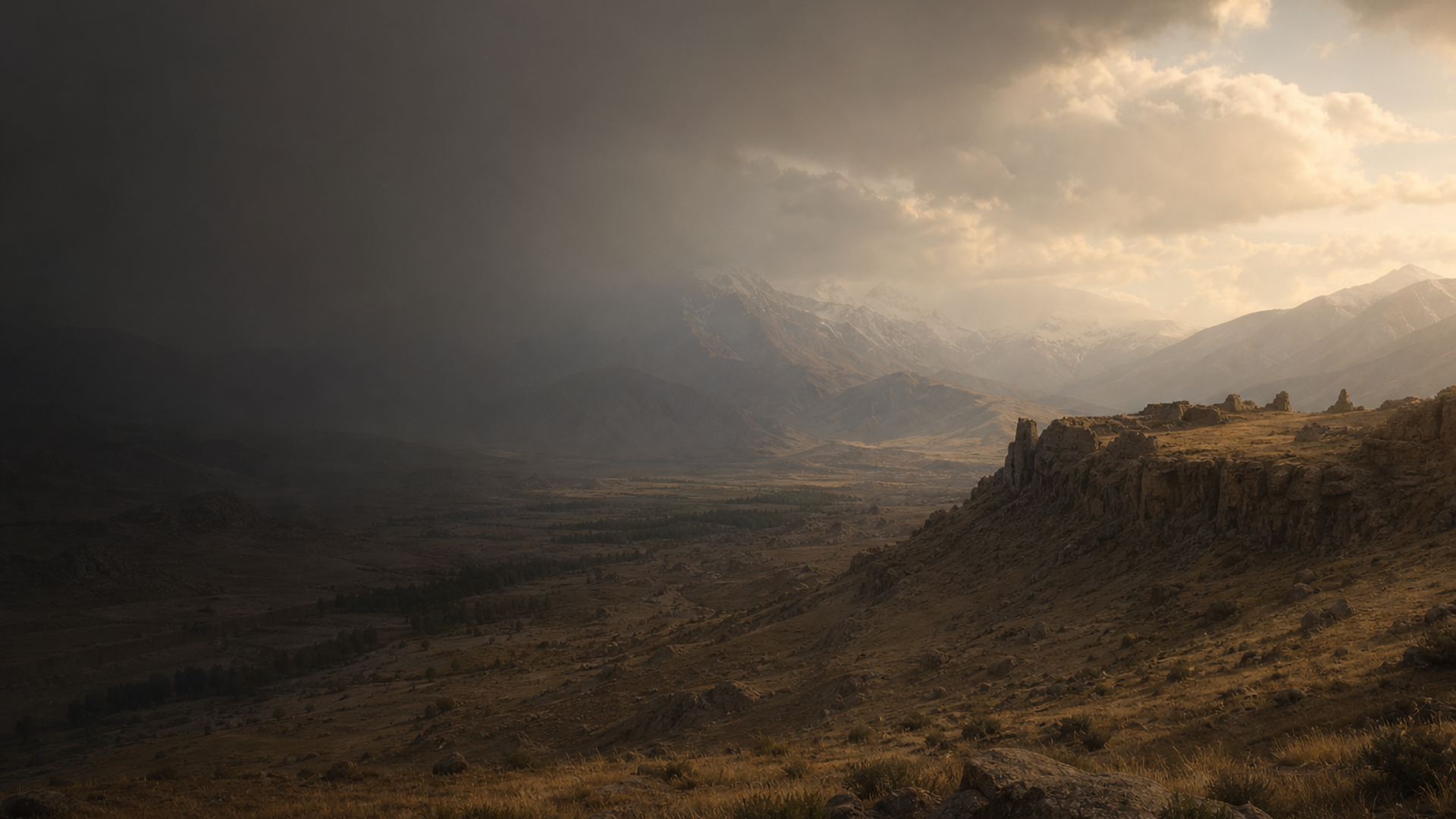
The cinematic image of Abusanteer is of tents and courtyards against mountain light, flocks moving across steppe margins, and caravan goods passing through on long-distance routes. Archaeological parallels in the broader region show burial practices that sometimes include personal items and animal remains, suggesting social distinctions and ritual behaviors tied to livestock economies. Trade goods and craft techniques circulating through the Yili corridor would have introduced new materials and ideas, while local traditions persisted in pottery, textiles, and foodways.

Because excavation reports specific to Abusanteer are still limited, these reconstructions rely on regional analogies. The material texture of everyday life—tools, dwellings, and diet—awaits fuller publication to move from evocative scenario to detailed portrait.

  • Likely mixed pastoralist–agro economy in the Yili valley
  • Position favored seasonal movement and long‑distance exchange
Capítulo V

Genetic Profile

Genetic analysis of six individuals from Abusanteer (sample count n=6) provides an initial, cautious glimpse into the ancestry of this Iron Age community. Y-chromosome lineages include Q in two males and a single L~ designation in one, while maternal lineages are dominated by C4 (three individuals), with T (two) and H2b (one) also present. These markers suggest a tapestry of east–west connections rather than a single homogeneous origin.

mtDNA C4 is common in Siberian and northern Asian populations, and its prevalence here (3/6) points toward substantial northern or eastern Eurasian maternal ancestry in the Abusanteer group. The presence of mtDNA T and H2b—both more frequent in western Eurasia—indicates some maternal connections to west Eurasian lineages. On the paternal side, Y-haplogroup Q is widespread across northern Eurasia and the Americas and is consistent with local steppe-associated male ancestry. The L~ signal (one sample) is less typical for northern Xinjiang and could reflect contact or gene flow from southern or southwestern Asian lineages, but this interpretation must be tentative.

Critically, with fewer than ten samples, any population-level claims remain preliminary. Limited sample size makes it difficult to assess frequencies, substructure, or demographic processes such as admixture timing. Archaeogenetic patterns here are best read as signposts indicating admixture and connectivity along the Yili corridor; further sampling and comparative analyses are required to resolve how these lineages were distributed through time and across social groups.

  • Small sample (n=6) — conclusions are preliminary
  • Maternal lineages mix northern Asian (C4) and west Eurasian (T, H2b) signals
Capítulo VI

Legacy & Modern Connections

The genetic and archaeological glimpses from Abusanteer suggest this Iron Age community was part of long-standing exchanges that shaped Xinjiang's genetic and cultural mosaic. The combination of mtDNA types (C4, T, H2b) and Y-DNA lineages (Q and L~) fits a broader pattern observed across Central Asia: populations formed through repeated movements and mixing between eastern and western Eurasian groups.

For modern populations in Xinjiang and adjacent regions, the Abusanteer signal adds a deep-time layer to ongoing stories of diversity. However, continuity is not guaranteed—later migrations, demographic shifts, and cultural changes can obscure or replace earlier genetic signatures. As always in ancient DNA research, linking ancient individuals to living communities requires many more samples and careful interdisciplinary work. Still, these six individuals offer a cinematic snapshot of a frontier community whose legacy survives in the mosaic of Central Asian ancestry.

  • Signals of east–west admixture hint at long-term regional connectivity
  • Direct links to modern groups are possible but require many more samples
Con IA

Asistente de IA

Haz preguntas sobre la cultura Abusanteer: Iron Age Yili Frontier

Asistente de IA por DNAGENICS

Desbloquear esta función
Pregunta sobre la cultura Abusanteer: Iron Age Yili Frontier. El asistente con IA puede explicar hallazgos genéticos, contexto histórico, pruebas arqueológicas y conexiones modernas, con sus límites de interpretación.
Ejemplo de análisis con IA

La cultura Abusanteer: Iron Age Yili Frontier representa un capítulo de la historia humana...

El análisis genético permite estudiar similitudes con poblaciones anteriores y posibles adaptaciones. Las muestras de ADN antiguo aportan información para investigar patrones migratorios y relaciones entre poblaciones, con límites que dependen del estudio y del contexto arqueológico.

Esta es una vista previa del análisis con IA. Accede al asistente completo para explorar información sobre:

  • Composición y similitud genética
  • Patrones migratorios y orígenes
  • Vida cotidiana y prácticas culturales
  • Contexto genético moderno

Explora más culturas antiguas

Descubre la historia de civilizaciones de distintas partes del mundo antiguo