Preparando el informe

Cargando la información y las referencias disponibles

Consultando el registro arqueológico...

Recopilando registros antiguos

Saltar al contenido principal
Aritgues Late Bronze Age Menorca
Cultura destacada

Aritgues Late Bronze Age Menorca

Sea-sculpted funerary caves and faint genetic echoes from 1200–1000 BCE

1200 CE - 1000 BCE
Balearic Islands, Menorca (Ciutadella)
Desplázate para empezar
Capítulo I

La historia

Comprender la cultura Aritgues Late Bronze Age Menorca

Archaeological and aDNA evidence from Es Forat de ses Aritges (Ciutadella, Menorca) reveals a small Late Bronze Age community (1200–1000 BCE) with predominant Y-DNA R lineages and mixed maternal haplogroups. Limited samples mean conclusions are preliminary.

Time Period

1200–1000 BCE

Region

Balearic Islands, Menorca (Ciutadella)

Common Y-DNA

R (4 of 6 samples)

Common mtDNA

U (2), K (2 incl. K1a), H (1), J (1)

Capítulo II

Cronología

Momentos clave de la historia de esta cultura

2500 BCE

Early Bronze Age maritime networks expand

Emergence of long-distance exchange in the western Mediterranean sets the stage for later Bronze Age cultural links affecting the Balearic Islands.

Capítulo III

Origins & Emergence

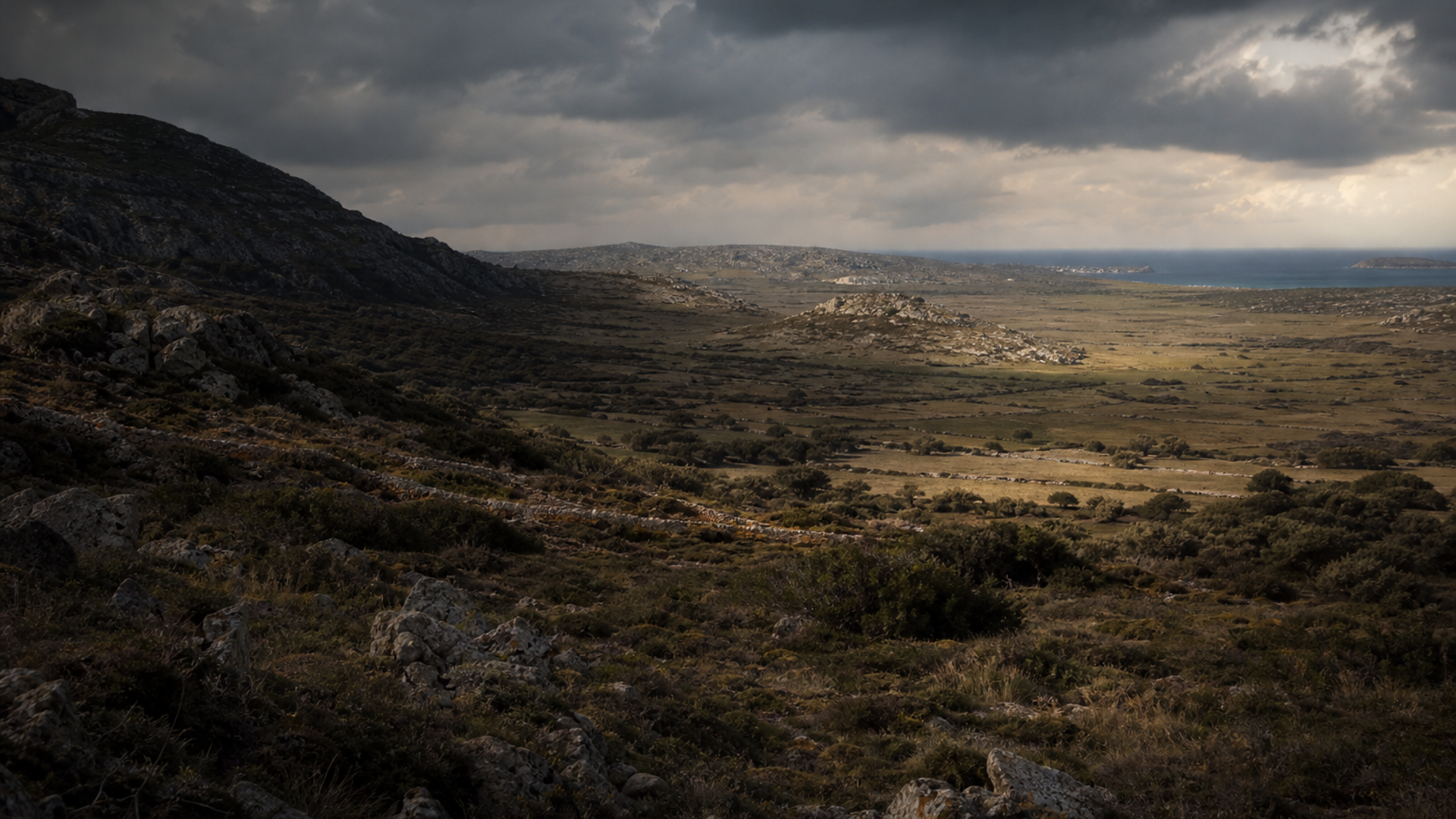
Battered limestone cliffs around Ciutadella hide chambers where Late Bronze Age people laid their dead. At Es Forat de ses Aritges, archaeological stratigraphy and radiocarbon contexts place human activity firmly in the span 1200–1000 BCE, a time when seafaring communities in the western Mediterranean negotiated long-distance exchange, new metal technologies, and shifting social ties.

Material culture from Menorca in this era is fragmentary but evocative: modest bronze tools, local pottery with islander styles, and funerary deposition in natural caves. These traces suggest small, tightly knit groups adapted to island resources—sheep, goats, coastal fishing and opportunistic trade. The island’s geographic isolation produced cultural trajectories that both absorbed and resisted broader Iberian Late Bronze Age influences.

Archaeological data indicates continuity with earlier Balearic traditions alongside novel elements that may reflect contacts with mainland Iberia and other Mediterranean communities. Limited evidence suggests these contact networks were episodic rather than colonizing: goods and ideas traveled, people less frequently did. Crucially, the aDNA samples from Es Forat de ses Aritges give a direct, if preliminary, glimpse into the biological make-up of these islanders, helping tether material culture to ancestry and mobility patterns.

  • Site: Es Forat de ses Aritges, Ciutadella, Menorca
  • Date range: 1200–1000 BCE (Late Bronze Age Spain)
  • Evidence for island-focused subsistence with external contacts
Capítulo IV

Daily Life & Society

Imagine a skyline of low stone shelters, a shoreline threaded with nets, and ovens steaming small flatbreads. Archaeological remains imply a household economy centered on pastoralism—sheep and goats—supplemented by fishing, shellfish gathering, and limited dryland cultivation suitable for the rocky soils of Menorca. Tools recovered in or near burial contexts reflect everyday tasks: cutting, weaving, and repair.

The funerary assemblage at Es Forat de ses Aritges—human remains placed in natural cavities—speaks to community ritual and memory. Burials were often collective or clustered over generations, a pattern that can indicate kin-based social organization. Grave goods, when present, tend to be modest: simple ornaments, a bronze implement, and sometimes shell or bone items, suggesting social differentiation was present but not highly stratified in the archaeological record.

Archaeological data indicates seafaring and exchange were part of island life: imported metal objects and stylistic parallels with mainland Iberia show networks of interaction. Yet the rhythm of daily life likely remained local and resilient, shaped by the Mediterranean’s seasonal cycles and limited arable land.

  • Pastoralism and coastal foraging formed subsistence backbone
  • Burial in natural caves suggests kin-group memory and ritual
Capítulo V

Genetic Profile

Ancient DNA from six individuals at Es Forat de ses Aritges provides a tentative genetic window into Menorca’s Late Bronze Age population. Four of the six male samples carry Y-DNA labeled broadly as R. While the dataset is small, the predominance of R mirrors patterns seen elsewhere in Bronze Age Iberia where R lineages—often R1b in better-sampled contexts—are associated with broader demographic shifts during the second millennium BCE.

Mitochondrial diversity among the six individuals includes U (2), K (2, including K1a), H (1), and J (1). These maternal haplogroups are widespread across prehistoric Europe and the Mediterranean and can reflect both local continuity and incoming maternal lines. The presence of U and H haplotypes suggests threads of continuity with earlier European populations, whereas K and J point to connections that span maritime networks.

Interpretations must remain cautious: with only six samples (fewer than ten), any population-level inference is preliminary. Archaeological context and isotope studies, when available, will be essential to disentangle local birth from immigrant life histories. Nonetheless, the combined genetic and material evidence hints at an island community with male-line continuity tied to broader Bronze Age Iberian trends and a varied maternal ancestry that likely includes both local and external contributions.

  • Y-DNA dominated by R (4 of 6) — suggests links to broader Bronze Age Iberian male lineages
  • mtDNA mix (U, K, H, J) indicates maternal diversity and potential continuity with earlier European populations
Capítulo VI

Legacy & Modern Connections

The genetic threads from Es Forat de ses Aritges are delicate but meaningful: they connect the island’s Late Bronze Age inhabitants to the long tapestry of western Mediterranean prehistory. Modern populations of the Balearics carry layers of ancestry accumulated over millennia; aDNA snapshots like these remind us that some paternal lineages common in later Iberia were already present on the islands by 1200–1000 BCE.

Because the sample count is very small, claims about continuity to living people must be made cautiously. Still, combining archaeology and genetics allows museum audiences to visualize how islanders lived, moved, and intermarried across seascapes. Future, larger-scale sampling could clarify whether the pattern seen at Aritgues represents a local norm or a momentary demographic composition within a mobile Bronze Age world.

  • Offers preliminary genetic linkages between Menorca and broader Bronze Age Iberia
  • Highlights need for more samples to assess continuity with modern Balearic populations
Con IA

Asistente de IA

Haz preguntas sobre la cultura Aritgues Late Bronze Age Menorca

Asistente de IA por DNAGENICS

Desbloquear esta función
Pregunta sobre la cultura Aritgues Late Bronze Age Menorca. El asistente con IA puede explicar hallazgos genéticos, contexto histórico, pruebas arqueológicas y conexiones modernas, con sus límites de interpretación.
Ejemplo de análisis con IA

La cultura Aritgues Late Bronze Age Menorca representa un capítulo de la historia humana...

El análisis genético permite estudiar similitudes con poblaciones anteriores y posibles adaptaciones. Las muestras de ADN antiguo aportan información para investigar patrones migratorios y relaciones entre poblaciones, con límites que dependen del estudio y del contexto arqueológico.

Esta es una vista previa del análisis con IA. Accede al asistente completo para explorar información sobre:

  • Composición y similitud genética
  • Patrones migratorios y orígenes
  • Vida cotidiana y prácticas culturales
  • Contexto genético moderno

Explora más culturas antiguas

Descubre la historia de civilizaciones de distintas partes del mundo antiguo