Preparando el informe

Cargando la información y las referencias disponibles

Consultando el registro arqueológico...

Recopilando registros antiguos

Saltar al contenido principal
Berel: Steppe Voices of the Iron Age
Cultura destacada

Berel: Steppe Voices of the Iron Age

High-status burials from the Berel necropolis reveal blended steppe ancestry in Central Kazakhstan.

400 BCE - 410 CE
Central Kazakhstan (Berel Necropolis)
Desplázate para empezar
Capítulo I

La historia

Comprender la cultura Berel: Steppe Voices of the Iron Age

Archaeological and aDNA evidence from 14 individuals (400 BCE–410 CE) at Berel Necropolis illuminates Iron Age lifeways in Central Kazakhstan and a mix of East and West Eurasian maternal lineages alongside predominantly Q paternal signals.

Time Period

400 BCE – 410 CE

Region

Central Kazakhstan (Berel Necropolis)

Common Y-DNA

Q (5), R (1)

Common mtDNA

A (3), D (2), B (2), J (2), H7b (1)

Capítulo II

Cronología

Momentos clave de la historia de esta cultura

400 BCE

Burials at Berel begin (approx.)

Earliest burials in the Berel necropolis fall near 400 BCE, inaugurating a sequence of Iron Age kurgan interments in Central Kazakhstan.

Capítulo III

Origins & Emergence

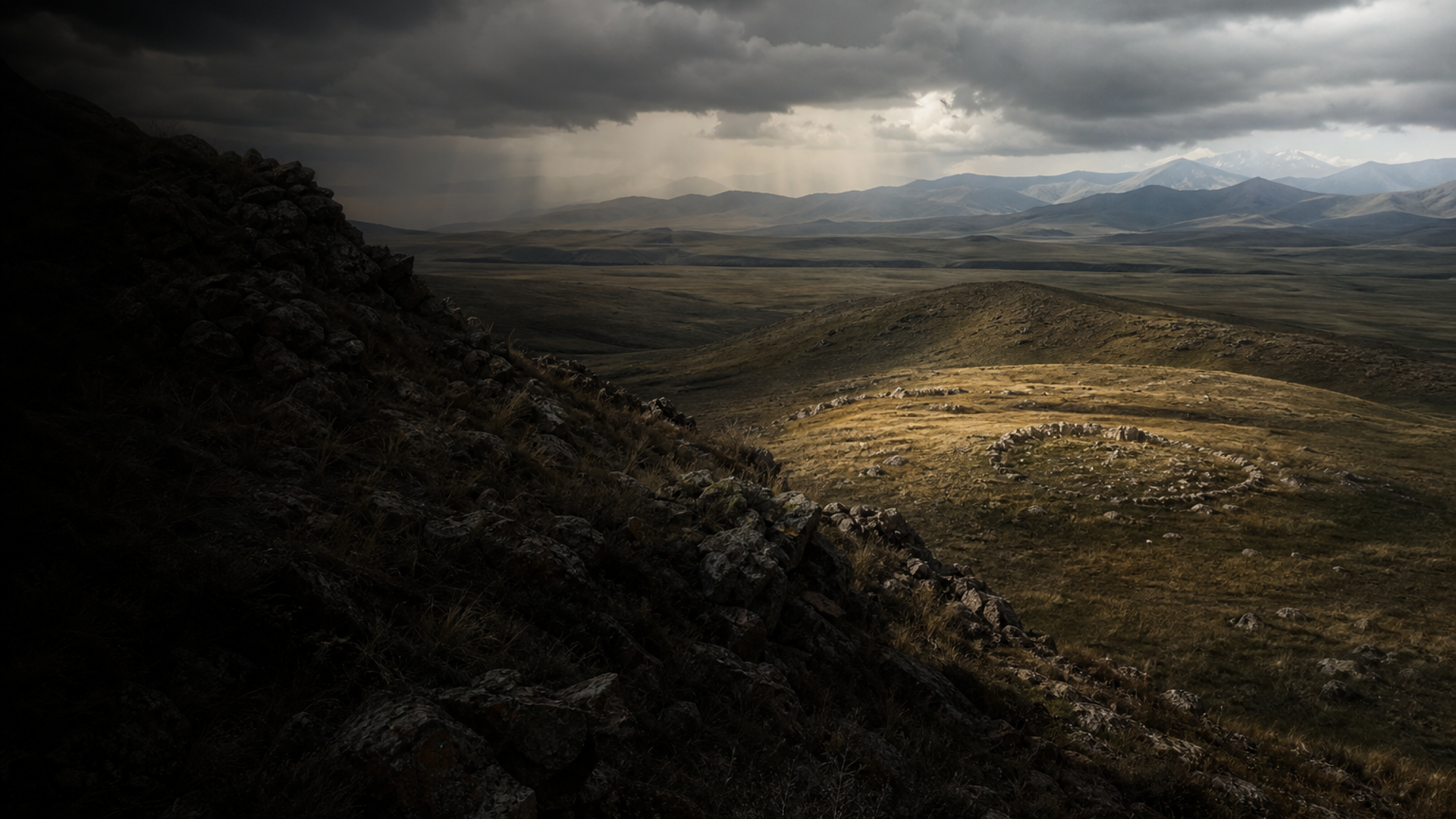
Set against the vast, wind-sculpted steppe of Central Kazakhstan, the Berel necropolis presents a cinematic archive of Iron Age lifeways between about 400 BCE and 410 CE. Archaeological data indicates that excavations at Berel — including mounds 5 and 44 and a suite of catalogued objects (80A/80E, 69, 67A, 76, 90A, 105, 108A, 90) — recover high-status burial contexts that align with the broader Saka/Scythian horizon of the Eurasian steppe. Timber coffins, preserved textile fragments, and complex funerary assemblages have been reported from these kurgans; such finds point to mobile pastoral elites who expressed status through horse equipment, metalwork, and richly worked organic materials.

Culturally, Berel sits at an intersection: archaeological traits reflect pan-steppe traditions of mounted pastoralism and burial display, while local crafts and burial choices suggest regional variation. Limited evidence suggests that these communities participated in long-distance networks of exchange that connected the Altai, Tian Shan margins, and the broad Kazakh steppe. Chronologically, Berel fits into the later Iron Age transformations when mobile polities and rich barrow cemeteries became prominent markers of social complexity in Central Asia.

Bulleted syntheses below condense the emergence story while acknowledging where interpretation remains provisional.

  • Berel burials date from c. 400 BCE to 410 CE and reflect Iron Age steppe traditions.
  • Archaeological data indicates high-status kurgans with organic artifacts preserved in some mounds.
  • Site shows both pan-steppe cultural traits and local regional expressions.
Capítulo IV

Daily Life & Society

The daily rhythms of people interred at Berel can only be reconstructed indirectly from graves, material culture, and environmental context. Archaeological evidence indicates a pastoral economy centered on horses, sheep, and cattle — a mobile lifeway well adapted to the temperate grasslands of Central Kazakhstan. Horse trappings and harness fragments in several mounds suggest that horses were not only practical assets but also central to status performance and ritual display.

Textile fragments, carved wooden fittings, and metal ornaments point to skilled craft traditions and connections to wider steppe styles. Funerary practice — elaborate burial pits with timber elements and curated grave goods — indicates social differentiation: some individuals appear to have been buried with more ostentatious equipment, implying ranked or elite roles within mobile communities. Seasonal movement, exchange of luxury objects, and control of grazing territories are plausible elements of social organization, but direct evidence for household structure, craft specialization, or political hierarchy remains limited.

Archaeology alone leaves many questions open: isotopic and aDNA studies are helping to reveal mobility and kin networks, but more integrated sampling is required to move from evocative scenario to detailed social history.

  • Pastoral mobility centered on horses and livestock.
  • Grave assemblages suggest ranked burials and skilled craft production.
Capítulo V

Genetic Profile

Ancient DNA from 14 individuals associated with the Berel necropolis provides a snapshot of population ancestry at a single Central Kazakh site across the Iron Age. The Y-chromosome record shows a predominance of haplogroup Q (5/14) with a smaller representation of haplogroup R (1/14). Haplogroup Q is widely observed in Siberian and some Central Asian contexts and can signal paternal lineages with deep roots in eastern Eurasia; the presence of R indicates some West/Eurasian paternal input or shared steppe histories in which R lineages were widespread.

Mitochondrial DNA reflects a mixed maternal landscape: East Eurasian lineages are common (A: 3, D: 2, B: 2), while West Eurasian lineages (J: 2, H7b: 1) are also present. This pattern — eastward maternal haplogroups alongside west-associated mtDNA — is consistent with admixture between eastern and western Eurasian populations on the steppe. Such a mosaic fits archaeological expectations of mobility, intermarriage, and long-distance exchange during the Iron Age.

It is important to emphasize uncertainty: although 14 samples are a valuable dataset for a single necropolis, they represent a localized funerary assemblage and may disproportionately reflect specific lineages associated with particular social strata. Comparative analyses with broader Iron Age Kazakhstan datasets and higher-resolution autosomal data are necessary to clarify population structure, sex-biased migration, and the degree of continuity with earlier and later populations.

  • Paternal signal dominated by haplogroup Q, with minority R presence.
  • Maternal lineages show East (A, D, B) and West Eurasian (J, H7b) mixture, indicating admixture.
Capítulo VI

Legacy & Modern Connections

The genetic and archaeological imprint of Berel contributes to a larger story about steppe population dynamics. Elements of the Berel genetic mix — notably haplogroup Q and East Eurasian maternal lineages — persist in varying frequencies among modern Central Asian populations, reflecting long-term admixture and demographic complexity on the steppe. At the same time, the presence of West Eurasian maternal markers underscores ongoing contacts across Eurasia during the Iron Age.

Ancient DNA from Berel helps bridge the material grandeur of kurgan burials with biological ancestry, revealing how mobility, marriage networks, and elite display shaped lineage transmission. However, population turnovers, later medieval migrations, and regional heterogeneity mean that direct line-to-line continuity with specific modern groups should be stated cautiously. Future, wider sampling and comparative studies will sharpen these connections and illuminate how the lives sealed in Berel's timber coffins resonate in the genetic tapestry of Central Asia.

  • Genetic signals at Berel reflect admixture patterns that contribute to modern Central Asian diversity.
  • Caution: later migrations and limited geographic sampling complicate direct continuity claims.
Con IA

Asistente de IA

Haz preguntas sobre la cultura Berel: Steppe Voices of the Iron Age

Asistente de IA por DNAGENICS

Desbloquear esta función
Pregunta sobre la cultura Berel: Steppe Voices of the Iron Age. El asistente con IA puede explicar hallazgos genéticos, contexto histórico, pruebas arqueológicas y conexiones modernas, con sus límites de interpretación.
Ejemplo de análisis con IA

La cultura Berel: Steppe Voices of the Iron Age representa un capítulo de la historia humana...

El análisis genético permite estudiar similitudes con poblaciones anteriores y posibles adaptaciones. Las muestras de ADN antiguo aportan información para investigar patrones migratorios y relaciones entre poblaciones, con límites que dependen del estudio y del contexto arqueológico.

Esta es una vista previa del análisis con IA. Accede al asistente completo para explorar información sobre:

  • Composición y similitud genética
  • Patrones migratorios y orígenes
  • Vida cotidiana y prácticas culturales
  • Contexto genético moderno

Explora más culturas antiguas

Descubre la historia de civilizaciones de distintas partes del mundo antiguo