Preparando el informe

Cargando la información y las referencias disponibles

Consultando el registro arqueológico...

Recopilando registros antiguos

Saltar al contenido principal
Cabeçuda Sambaqui, 3200 BP
Cultura destacada

Cabeçuda Sambaqui, 3200 BP

Shell-mound builders of Brazil's south coast—archaeology meets fragile ancient DNA

1685 CE - 1058 BCE
Cabeçuda, South Coast — Brazil
Desplázate para empezar
Capítulo I

La historia

Comprender la cultura Cabeçuda Sambaqui, 3200 BP

Archaeological and aDNA evidence from Cabeçuda (South Coast, Brazil) dated 1685–1058 BCE links two individuals to Y-haplogroup Q and mtDNA D1/D4. Limited samples mean conclusions are preliminary; data illuminate coastal lifeways and paternal continuity in a Sambaqui context.

Time Period

1685–1058 BCE

Region

Cabeçuda, South Coast — Brazil

Common Y-DNA

Q (both samples)

Common mtDNA

D1, D4 (one each)

Capítulo II

Cronología

Momentos clave de la historia de esta cultura

4000 BCE

Sambaqui tradition develops along coast

Shell-mound building and coastal aggregation emerge across parts of Brazil during the mid–late Holocene (approximate regional onset).

1685 BCE

Earliest dated individual from Cabeçuda

One of the two sampled individuals dates to c. 1685 BCE, from a Sambaqui context on the south coast of Brazil.

1058 BCE

Latest dated individual from Cabeçuda

Second sampled individual dates to c. 1058 BCE, showing continued use of the site into the late 2nd millennium BCE.

Capítulo III

Origins & Emergence

The Cabeçuda assemblage sits within the long-lived Sambaqui tradition of Brazil's Atlantic coast, a landscape shaped over millennia by human-built shell mounds, hearths, and cemetery features. Radiocarbon dates for the two analyzed individuals fall between 1685 and 1058 BCE, placing them in the late Holocene coastal sequence when sambaquis functioned as focal places for food processing, social gatherings, and burial. Archaeological data indicates concentrations of mollusk shells, fish bone, and occasional terrestrial faunal remains at Cabeçuda, reflecting a maritime-adapted economy that exploited estuaries, rocky shores, and nearshore waters.

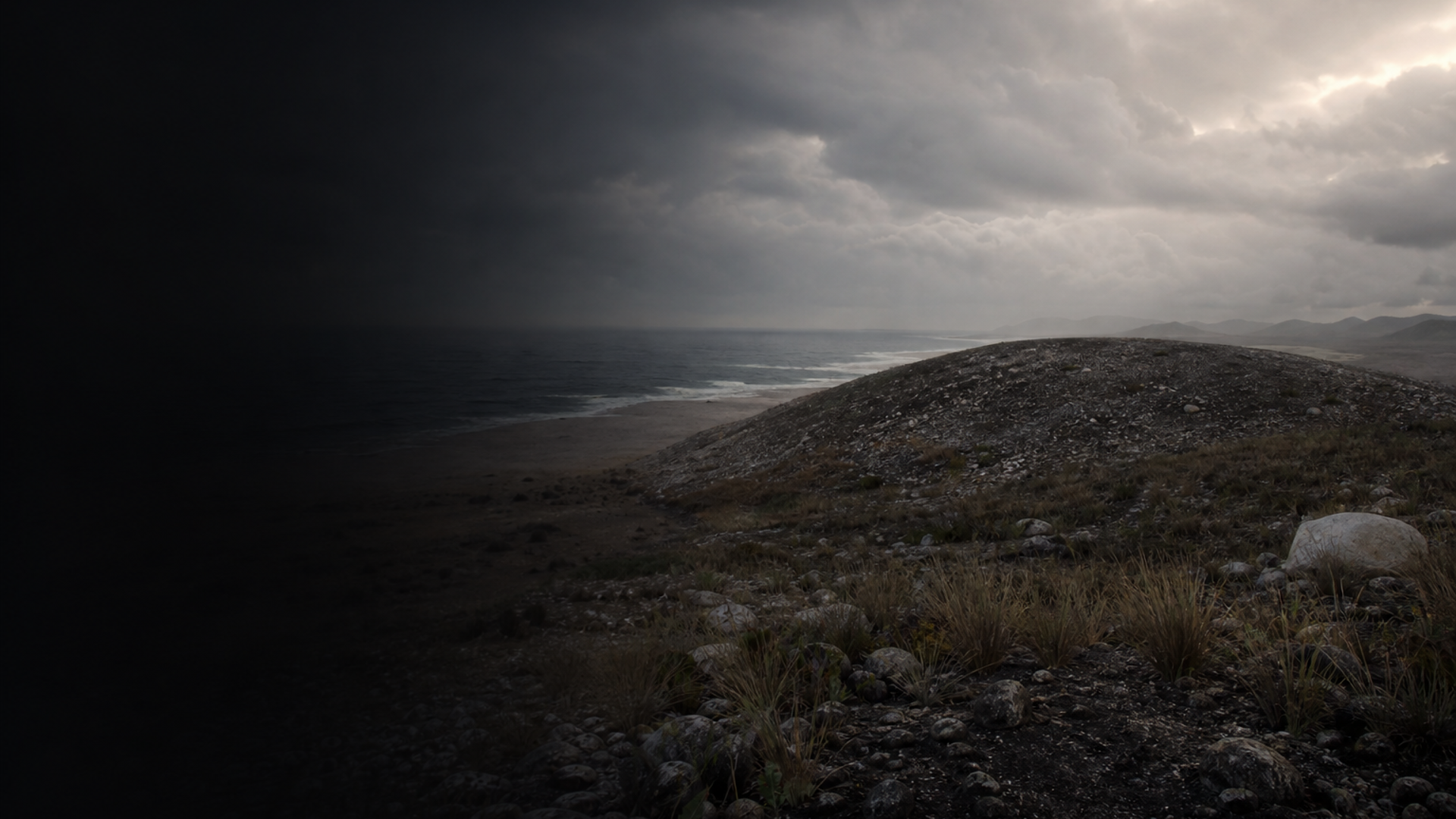
The cinematic silhouette of shell-ridges rising above the shoreline masks complex human histories: episodic occupation, long-term aggregation, and mound construction that altered local topography. Material traces—worked shell, bone tools, and fragmented ceramics found in sambaqui contexts—suggest craft specializations and exchange networks along the coast. Limited evidence from Cabeçuda itself constrains precise reconstructions of origins; however, the site forms part of a broader pattern of coastal settlement visible across southern Brazil during the late Holocene. Ongoing fieldwork and additional aDNA samples are required to refine models of population continuity versus mobility in this maritime world.

  • Part of the Sambaqui shell-mound tradition on Brazil’s south coast
  • Radiocarbon-dated individuals: 1685–1058 BCE
  • Archaeological indicators of intensive coastal resource use
Capítulo IV

Daily Life & Society

Daily life at Cabeçuda would have been dominated by the rhythms of tide and season. Mollusk gathering, fish and crustacean capture, and the processing of marine resources left layered shell deposits—palimpsests of repeated human activities. Hearths and bone concentrations point to communal food preparation and likely seasonal feasting events that accumulated the mounds we see today. Shell and bone tools recovered in nearby sambaquis suggest woodworking, shell-bead manufacture, and fish-processing technologies.

Burials interred within or adjacent to shell deposits are a hallmark of many sambaqui sites; these contexts indicate enduring place-attachment and the use of mounds as social landscapes where ancestry and daily subsistence intertwined. Social organization was probably flexible: households and kin groups embedded in wider coastal networks, with exchange of raw materials and crafted items along the shore. Preservation biases mean that organic technologies and ephemeral structures seldom survive, so reconstructions rely on durable debris and faunal remains. Limited excavation at Cabeçuda means many questions about craft specialization, status differentiation, and seasonal mobility remain open, demanding cautious interpretation.

  • Marine-focused subsistence: shellfish, fish, coastal fauna
  • Shell middens served as both refuse and burial contexts
Capítulo V

Genetic Profile

Ancient DNA from two individuals recovered at Cabeçuda provides preliminary genetic windows into Sambaqui populations. Both male-line profiles carry Y-DNA haplogroup Q—an indigenous paternal lineage widespread across the Americas—suggesting paternal continuity with broader Native American genetic lineages. The two mitochondrial genomes are D1 and D4, maternal haplogroups that are likewise observed across many Native American groups. Together, these markers align the Cabeçuda individuals with pan-American genetic ancestries rather than with recent exogenous inputs.

Crucially, only two samples were analyzed. When sample count is low (<10), population-level inferences are highly tentative: the observed haplogroups may reflect local familial lines, sampling bias, or broader demographic patterns. Archaeogenomic signals must be integrated with stratigraphy, burial context, and radiocarbon dates (1685–1058 BCE) to assess kinship, continuity, and migration. Future sampling across additional sambaqui sites and comparison with modern and ancient genomes from coastal and interior Brazil will be necessary to test whether the Q paternal signal and D1/D4 maternal diversity represent long-term local lineages or episodic demographic events.

  • Both individuals show Y-haplogroup Q—consistent with Native American paternal ancestry
  • mtDNA D1 and D4 reflect maternal lineages common in the Americas; conclusions are preliminary due to small sample size
Capítulo VI

Legacy & Modern Connections

The Cabeçuda finds illuminate a coastal past that continues to shape cultural memory and genetic landscapes in Brazil. While the two genetic samples cannot demonstrate direct descent to any particular modern group, they contribute to a cumulative picture of ancient Native American ancestries along the Atlantic shore. Archaeology and aDNA together foreground the deep time presence of maritime communities whose practices molded beaches and estuaries into social places.

Ethical collaboration with living Indigenous communities and broader sampling across Sambaqui sites are essential next steps. Expanding the ancient DNA dataset will clarify relationships between sambaqui builders and present-day populations, reveal patterns of mobility and continuity, and honor the cultural significance of these shell-mound landscapes.

  • Adds ancient genetic data to long-term coastal occupation narratives
  • Highlights need for more samples and ethical engagement with descendant communities
Con IA

Asistente de IA

Haz preguntas sobre la cultura Cabeçuda Sambaqui, 3200 BP

Asistente de IA por DNAGENICS

Desbloquear esta función
Pregunta sobre la cultura Cabeçuda Sambaqui, 3200 BP. El asistente con IA puede explicar hallazgos genéticos, contexto histórico, pruebas arqueológicas y conexiones modernas, con sus límites de interpretación.
Ejemplo de análisis con IA

La cultura Cabeçuda Sambaqui, 3200 BP representa un capítulo de la historia humana...

El análisis genético permite estudiar similitudes con poblaciones anteriores y posibles adaptaciones. Las muestras de ADN antiguo aportan información para investigar patrones migratorios y relaciones entre poblaciones, con límites que dependen del estudio y del contexto arqueológico.

Esta es una vista previa del análisis con IA. Accede al asistente completo para explorar información sobre:

  • Composición y similitud genética
  • Patrones migratorios y orígenes
  • Vida cotidiana y prácticas culturales
  • Contexto genético moderno

Explora más culturas antiguas

Descubre la historia de civilizaciones de distintas partes del mundo antiguo