Preparando el informe

Cargando la información y las referencias disponibles

Consultando el registro arqueológico...

Recopilando registros antiguos

Saltar al contenido principal
Channel Islands Islanders (700–1700 CE)
Cultura destacada

Channel Islands Islanders (700–1700 CE)

Maritime lifeways on San Clemente and San Catalina, seen through bones and genomes

700 CE - 1700 CE
California Channel Islands, USA
Desplázate para empezar
Capítulo I

La historia

Comprender la cultura Channel Islands Islanders (700–1700 CE)

Archaeological and genetic evidence from San Clemente and San Catalina Islands (700–1700 CE) reveals maritime-adapted communities. Limited ancient DNA (9 samples) shows predominantly mtDNA C and some B, with a few Y-DNA Q lineages, suggesting Native American maternal continuity but preliminary conclusions.

Time Period

700–1700 CE

Region

California Channel Islands, USA

Common Y-DNA

Q (2 of 9 samples)

Common mtDNA

C (7 of 9), B (1 of 9)

Capítulo II

Cronología

Momentos clave de la historia de esta cultura

700 CE

Onset of Late Santa Cruz Island traits

Archaeological sequences on the southern Channel Islands show traits associated with the Late Santa Cruz Island era, anchoring the earliest samples for this dataset.

Capítulo III

Origins & Emergence

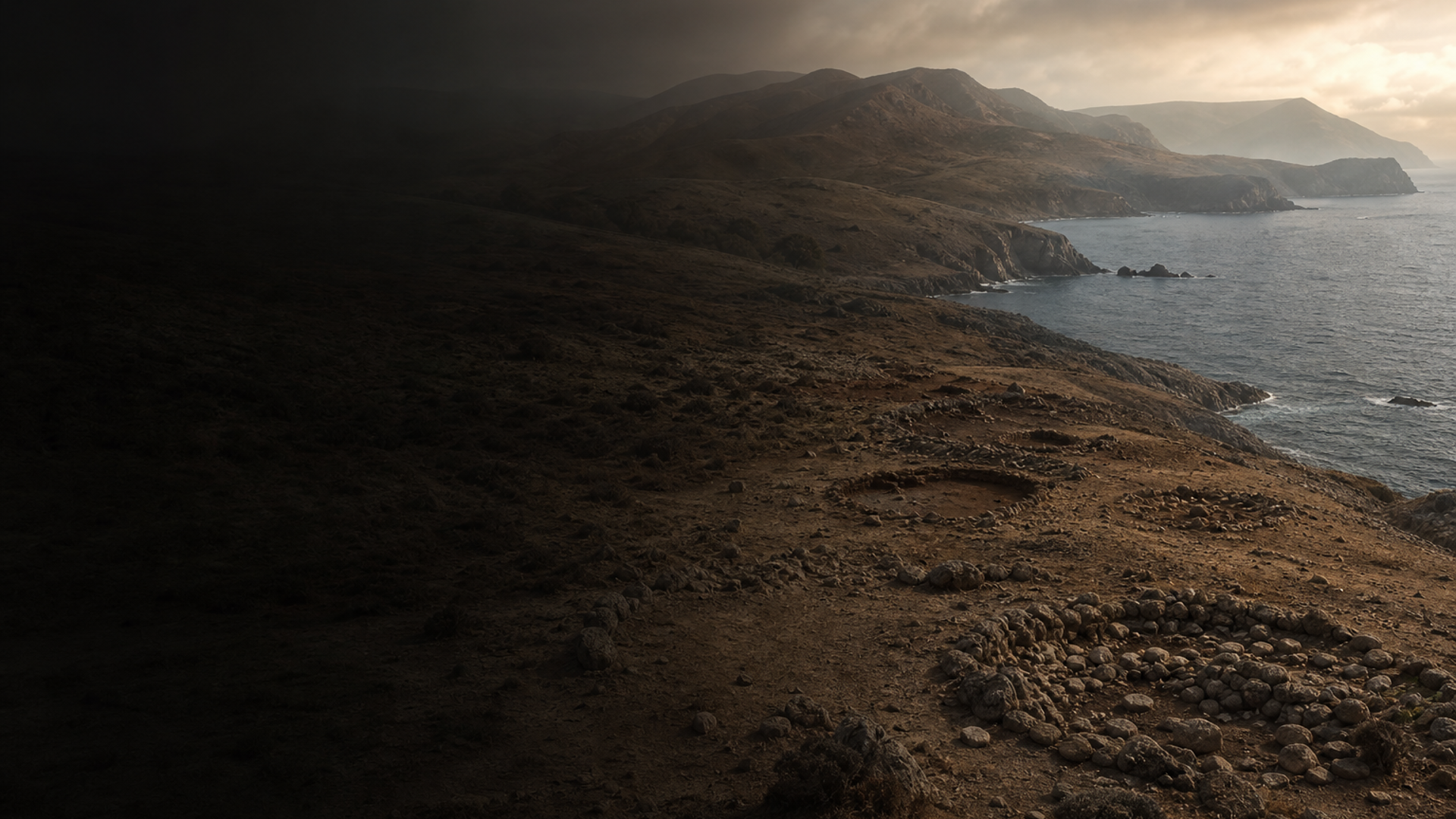
Rising from the salt-spray cliffs of the southern Channel Islands, the communities represented by the USA_CA_LSCI samples are part of the Late Santa Cruz Island cultural horizon. Archaeological data indicates sustained occupation on San Clemente and San Catalina Islands between roughly 700 and 1700 CE. In the archaeological record this period is marked by intensified maritime foraging, specialized shellfish exploitation, and durable ties across islands and the southern California coast.

Limited evidence suggests these island populations developed distinct island-adapted lifeways while remaining connected to mainland networks through trade and occasional mobility. Radiocarbon-dated contexts and midden deposits provide the temporal anchors for these samples, but preservation varies across sites and excavations. The interplay of seafaring, seasonal resource scheduling, and social memory shaped material assemblages that archaeologists now link with the Late Santa Cruz Island era.

While cinematic images of canoes and cliffside camps evoke continuity, the archaeological picture is nuanced: changes in tool types, hearth structures, and faunal remains hint at long-term adaptation to island ecologies and episodic contact with mainland groups. Genetic data from a small set of individuals begins to illuminate biological relationships, but must be read alongside stratigraphy and artifact assemblages to trace origins and movements.

  • Associated with Late Santa Cruz Island archaeological horizon
  • Sites: San Clemente Island and San Catalina Island
  • Evidence of maritime specialization and island adaptations
Capítulo IV

Daily Life & Society

The daily rhythm of island life was orchestrated by tide and season. Archaeological deposits on San Clemente and San Catalina reveal shell middens, fish remains, and worked bone that together sketch a society deeply attuned to the sea. People harvested abalone, fish, seabirds, and intertidal resources; hearth features and plant remains indicate on-island processing and food storage strategies.

Material culture reflects this maritime focus: bone and shell tools, small stone implements suitable for boat-based foraging, and localized tool-styles that differ subtly from mainland assemblages. Architecture, where preserved, consists of ephemeral shelters and hearth-centered living floors rather than large permanent structures, consistent with the logistical demands of island resource scheduling.

Social life likely balanced small, tightly knit residential groups with broader seasonal interactions—exchanges of goods, people, and ideas across islands and the nearby coast. Burials and mortuary treatment, when present, offer glimpses of social identity and continuity, but preservation is uneven and interpretations remain cautious.

Reconstruction of everyday life combines this patchwork archaeological record with emerging genetic signals to illuminate who these islanders were, how they lived, and how they moved through a maritime landscape.

  • Shell middens and faunal remains indicate intensive marine resource use
  • Small-scale, mobile residential patterns with inter-island connections
Capítulo V

Genetic Profile

Nine ancient individuals from San Clemente and San Catalina provide a preliminary genetic window into these island communities. Mitochondrial DNA is dominated by haplogroup C (7 of 9 samples) with a single occurrence of haplogroup B, both of which are established Native American maternal lineages. Y-chromosome data are sparser but include haplogroup Q in two male samples, a paternal lineage commonly observed among Indigenous peoples of the Americas.

These patterns—maternal-centric signals of haplogroup C and presence of Q on the paternal side—are consistent with continuity of Native American ancestry on the Channel Islands. However, the small sample size (n=9) makes population-level inferences preliminary. Limited sampling increases the risk that observed frequencies reflect stochastic sampling rather than demographic norms.

Archaeogenomic interpretation must therefore remain cautious: the mtDNA distribution hints at deep maternal line continuity, while the Y-DNA and unreported autosomal results (if available) would be needed to assess population structure, sex-biased migration, and connections to mainland California groups. Comparative analyses with other Channel Islands and southern California ancient genomes could clarify whether island communities were genetically distinct or part of a broader coastal genealogical network. Until more genomes are analyzed, genetic conclusions should be framed as tentative contributions to a developing story.

  • mtDNA dominated by haplogroup C (7/9), with one B
  • Y-DNA includes haplogroup Q (2/9); sample size limits confidence
Capítulo VI

Legacy & Modern Connections

The genetic and archaeological traces from San Clemente and San Catalina resonate with living Indigenous histories along southern California. Limited aDNA evidence suggests maternal continuities that may reflect long-standing islander lineages, but direct connections to present-day groups require careful, collaborative research and community consent.

Archaeology and genetics together can illuminate past lifeways while supporting contemporary cultural revitalization when undertaken respectfully. Researchers emphasize partnership with Indigenous communities to interpret findings, integrate oral histories, and guide future sampling. As more data accumulate, the legacy of these island peoples will be refined—revealing threads of resilience, mobility, and enduring relationship to sea and shore.

Until then, the current genetic snapshot is an evocative but preliminary chapter that underscores both continuity and the need for expanded, ethical research.

  • Findings suggest maternal continuity but require Indigenous collaboration
  • Preliminary data underscore the need for broader, ethically guided sampling
Con IA

Asistente de IA

Haz preguntas sobre la cultura Channel Islands Islanders (700–1700 CE)

Asistente de IA por DNAGENICS

Desbloquear esta función
Pregunta sobre la cultura Channel Islands Islanders (700–1700 CE). El asistente con IA puede explicar hallazgos genéticos, contexto histórico, pruebas arqueológicas y conexiones modernas, con sus límites de interpretación.
Ejemplo de análisis con IA

La cultura Channel Islands Islanders (700–1700 CE) representa un capítulo de la historia humana...

El análisis genético permite estudiar similitudes con poblaciones anteriores y posibles adaptaciones. Las muestras de ADN antiguo aportan información para investigar patrones migratorios y relaciones entre poblaciones, con límites que dependen del estudio y del contexto arqueológico.

Esta es una vista previa del análisis con IA. Accede al asistente completo para explorar información sobre:

  • Composición y similitud genética
  • Patrones migratorios y orígenes
  • Vida cotidiana y prácticas culturales
  • Contexto genético moderno

Explora más culturas antiguas

Descubre la historia de civilizaciones de distintas partes del mundo antiguo