Preparando el informe

Cargando la información y las referencias disponibles

Consultando el registro arqueológico...

Recopilando registros antiguos

Saltar al contenido principal
Chokhopani Iron Age Echoes
Cultura destacada

Chokhopani Iron Age Echoes

A Himalayan foothill community at Mustang, seen through bones and genomes

850 CE - 700 BCE
Mustang, Nepal (Himalayan foothills)
Desplázate para empezar
Capítulo I

La historia

Comprender la cultura Chokhopani Iron Age Echoes

Archaeological and genetic traces from Chokhopani (Mustang, Nepal; 850–700 BCE) reveal an Iron Age highland community. Limited ancient DNA (3 individuals) hints at East Asian-affiliated Y and mtDNA lineages. Conclusions are provisional but illuminate Himalayan population history.

Time Period

850–700 BCE

Region

Mustang, Nepal (Himalayan foothills)

Common Y-DNA

O (observed in 1 sample)

Common mtDNA

A17 (observed in 1 sample)

Capítulo II

Cronología

Momentos clave de la historia de esta cultura

800 BCE

Chokhopani occupation (approx.)

Occupation and burial activity at Chokhopani in Mustang dated to ca. 850–700 BCE, marking Iron Age highland settlement in Nepal.

Capítulo III

Origins & Emergence

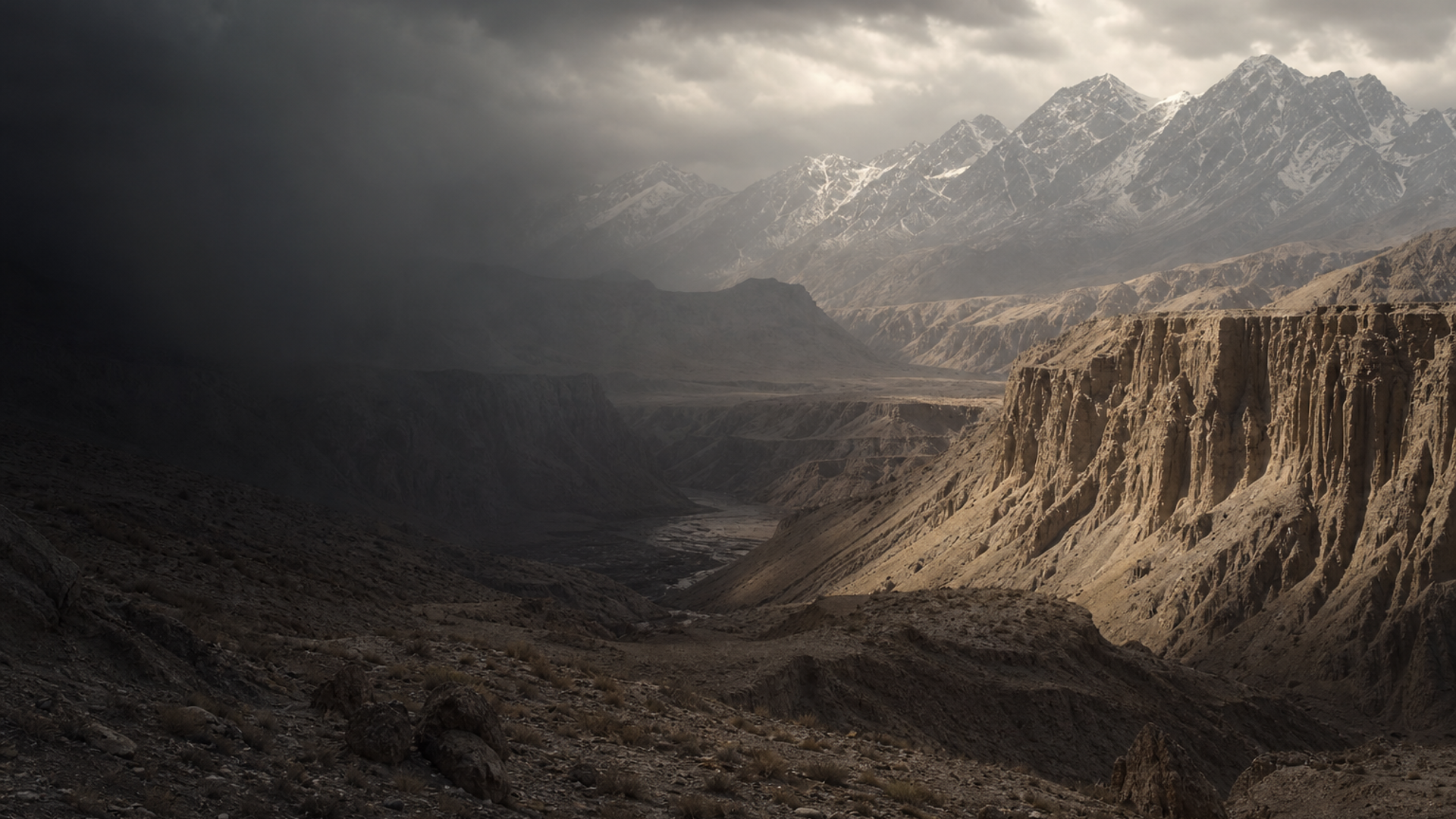
The Chokhopani assemblage sits at the wind-swept margins of the Himalaya, a place where mountain corridors compress cultural and biological flows. Dated between roughly 850 and 700 BCE, Chokhopani (Mustang, Nepal) belongs to the broader Iron Age landscape of Nepal. Archaeological data indicates small, stratified occupations with hearths, ceramic fragments, and mortuary deposits that suggest a settled highland lifeway adapted to cold, arid valleys.

Limited evidence suggests these communities practiced a mixed economy of pastoralism and strategic cultivation in sheltered terraces. The location—on trans-Himalayan routes—would have made Chokhopani a node for exchange: goods, ideas, and people. Material culture shows continuity with earlier Bronze-to-Iron transitions in the region, while also reflecting incoming influences from adjacent plateaus and valleys.

Caution is necessary: the current dataset is small and patchy. Only a handful of excavated contexts and three genetic samples constrain how far we can generalize. Nonetheless, the combined archaeological signature evokes a resilient, locally rooted population negotiating high-altitude life and long-distance connections during the early Iron Age.

  • Occupation dated ca. 850–700 BCE in Mustang, Nepal
  • Material culture links local continuity with regional influences
  • Small sample sizes limit broad generalizations
Capítulo IV

Daily Life & Society

Picture a village clasped to a sun-baked terrace, wind threading through low stone houses. Archaeological deposits at Chokhopani contain household features—hearths, grinding stones, and fragmented ceramics—that point to a diet of cereals, dairy, and pastoral products, supplemented by wild resources from adjacent alpine zones. Bone assemblages and tool types indicate animal herding and butchery practices consistent with transhumant mobility, though evidence also supports year-round occupation of sheltered sites.

Society was likely organized around small kin groups or lineage households. The funerary record shows modest grave goods and body placements that suggest local ritual forms rather than elite monumental display. Trade and mobility left visible traces: exotic objects and raw materials in some layers hint at long-distance contacts across mountain passes.

Archaeological data indicates resilience and adaptability—communities engineered micro-environments, managed herd economies, and engaged in social networks that stretched beyond the valley. Yet many daily practices remain invisible at present; future excavations could reveal textiles, botanical remains, and more detailed craft specialization.

  • Mixed economy: pastoralism, cereal cultivation, and wild resources
  • Household and mortuary evidence suggests kin-based social organization
Capítulo V

Genetic Profile

Ancient DNA from three individuals at Chokhopani offers tantalizing but preliminary glimpses of population ancestry in Mustang during the early Iron Age. Among these limited samples, one Y-chromosome was assigned to haplogroup O and one mitochondrial genome belonged to haplogroup A17. Both lineages are more commonly observed across East and Northeast Asia in modern and ancient datasets, which suggests possible East Asian-derived ancestry components reaching the Himalayan foothills by this period.

Important caveats frame these observations. With only three samples, any population-level inference is provisional: the small sample count (<10) restricts statistical power and may miss genetic diversity present at the site. The presence of haplogroup O in a single male does not establish it as dominant in the broader community; likewise, mtDNA A17 in one individual indicates maternal lineage connectivity but cannot resolve the full maternal spectrum.

Archaeogenetic interpretation therefore focuses on possibilities rather than certainties. These genetic signals are compatible with archaeological indicators of cross-mountain exchange and with broader models where Tibeto-Burman and other East Asian-affiliated groups contributed ancestry to Himalayan populations. Expanded sampling and genome-wide data will be essential to test whether Chokhopani represents a localized community with mixed ancestry or a transient node within larger demographic flows.

  • Y haplogroup O observed in 1 of 3 samples; mtDNA A17 observed in 1
  • Sample size (n=3) makes conclusions preliminary and tentative
Capítulo VI

Legacy & Modern Connections

The Chokhopani traces form a quiet bridge between ancient foothill lifeways and the living peoples of the Himalaya. Archaeological continuity in material forms and valley settlement patterns resonates with ethnographic patterns among present-day Mustang communities. Genetically, early-presence signals of East Asian-affiliated lineages (haplogroup O, mtDNA A17) align with broader patterns seen in Himalayan and Tibeto-Burman-speaking populations, but the small sample size makes links tentative.

Cultural memory, highland adaptation strategies, and routes of exchange endure in the landscape. Chokhopani reminds us that the Himalayan past was not isolated: it was shaped by mountain mobility, converging ancestries, and local innovations. Future interdisciplinary work—more aDNA samples, archaeobotany, and regional surveys—will refine how these early Iron Age occupants contributed to the genetic and cultural tapestry of modern Himalayan peoples.

  • Possible ancestral links to modern Himalayan/Tibeto-Burman groups (tentative)
  • Highlights need for more ancient genomes and archaeological data
Con IA

Asistente de IA

Haz preguntas sobre la cultura Chokhopani Iron Age Echoes

Asistente de IA por DNAGENICS

Desbloquear esta función
Pregunta sobre la cultura Chokhopani Iron Age Echoes. El asistente con IA puede explicar hallazgos genéticos, contexto histórico, pruebas arqueológicas y conexiones modernas, con sus límites de interpretación.
Ejemplo de análisis con IA

La cultura Chokhopani Iron Age Echoes representa un capítulo de la historia humana...

El análisis genético permite estudiar similitudes con poblaciones anteriores y posibles adaptaciones. Las muestras de ADN antiguo aportan información para investigar patrones migratorios y relaciones entre poblaciones, con límites que dependen del estudio y del contexto arqueológico.

Esta es una vista previa del análisis con IA. Accede al asistente completo para explorar información sobre:

  • Composición y similitud genética
  • Patrones migratorios y orígenes
  • Vida cotidiana y prácticas culturales
  • Contexto genético moderno

Explora más culturas antiguas

Descubre la historia de civilizaciones de distintas partes del mundo antiguo