Preparando el informe

Cargando la información y las referencias disponibles

Consultando el registro arqueológico...

Recopilando registros antiguos

Saltar al contenido principal
Echoes from the Armenian Highlands
Cultura destacada

Echoes from the Armenian Highlands

Late Bronze to Early Iron Age communities revealed by bones, pottery and DNA

1500 BCE - 330 CE
Armenian Highlands (modern Armenia)
Desplázate para empezar
Capítulo I

La historia

Comprender la cultura Echoes from the Armenian Highlands

Archaeological and genetic data from 54 individuals (1500 BCE–330 CE) across Armenian sites illuminate dynamic population continuity and admixture in the highlands. mtDNA shows diverse maternal lineages; Y-DNA is not consistently reported, so male-line conclusions remain tentative.

Time Period

1500 BCE – 330 CE

Region

Armenian Highlands (modern Armenia)

Common Y-DNA

Not consistently reported / varied

Common mtDNA

H (7), K (6), U (5), T (4), J (4)

Capítulo II

Cronología

Momentos clave de la historia de esta cultura

1500 BCE

Beginning of sampled period

Material culture and burials from c.1500 BCE mark Late Bronze Age communities in the Armenian Highlands.

900 BCE

Fortified settlements and regional interaction

Fortresses such as Lori Berd reflect increased regional fortification and long-distance exchange networks.

330 CE

Endpoint of sampled timespan

By 330 CE, the archaeological sequence sampled here reaches the Late Antique horizon represented in the dataset.

Capítulo III

Origins & Emergence

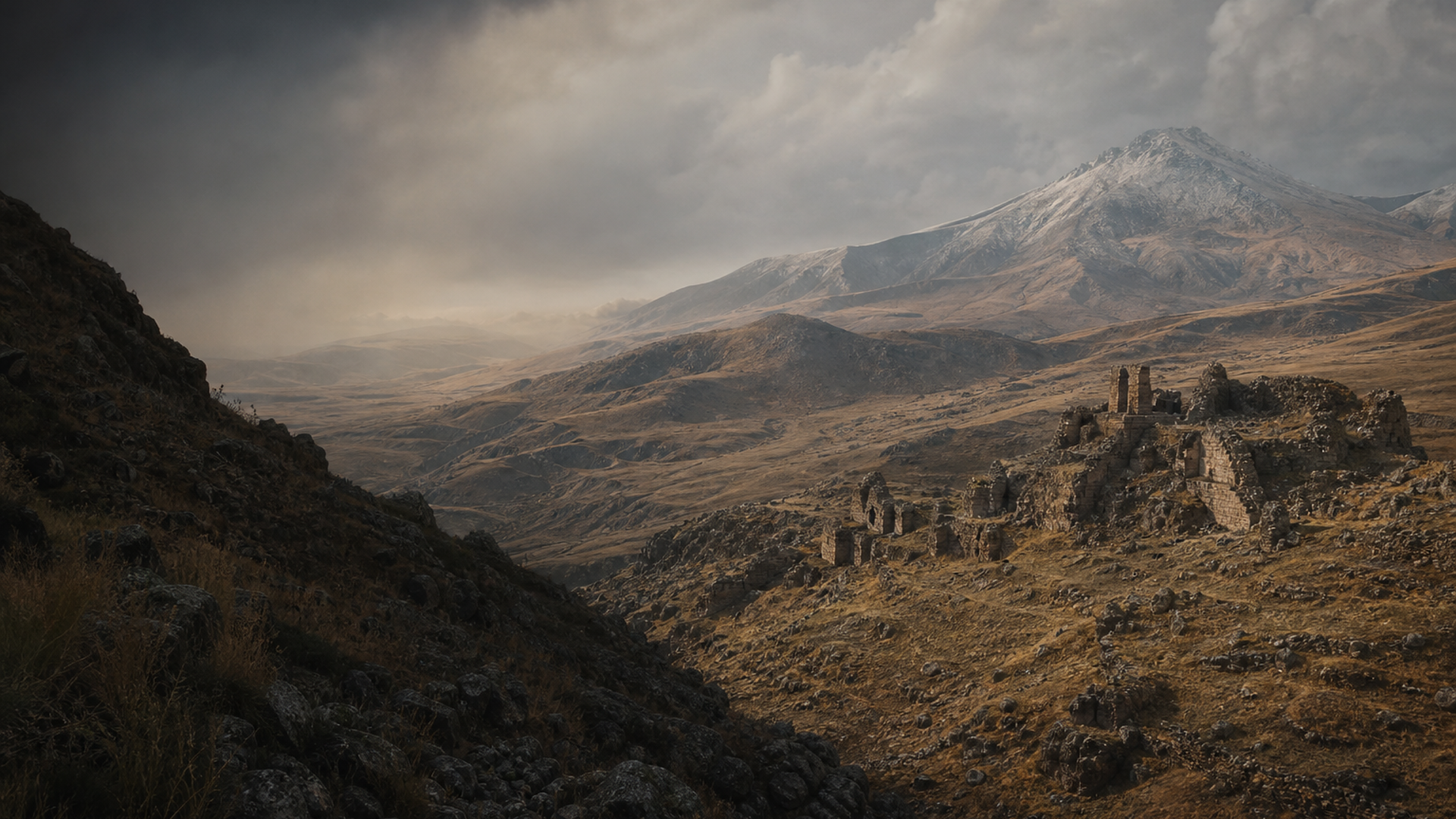
From the rim of the Armenian Plateau, communities of the Late Bronze Age into the Early Iron Age (c. 1500 BCE–330 CE) emerge in a landscape of terraced hills and storm-swept basalt fortresses. Archaeological contexts sampled here include Bardzryal Archaeological Complex, Bagheri Tchala, Nerkin Getashen, Lori Berd Cemetery, the Black Fortress, Lchashen cemetery, Noratus, Bover Cemetery and Sarukhan. Material culture—metalwork, fortified hilltops, and burial rites—shows local continuity layered with external influences.

Archaeological data indicates sustained settlement and cemetery use across centuries; continuity in ceramic forms and mortuary patterns suggests enduring regional traditions even as exchange networks widened. Limited evidence suggests episodes of migration and cultural contact: imported goods, new burial customs, and shifts in settlement hierarchy appear episodically.

Genetically, the sampled individuals (n=54) provide a window onto these processes. While not every site is evenly represented, the dataset is large enough to detect broad patterns of maternal lineage diversity and to hint at admixture between long-established Caucasus groups and incoming elements associated with Bronze Age mobility. However, precise demographic mechanisms—slow diffusion, elite migration, or episodic influx—remain open questions pending denser sampling and high-resolution chronological anchors.

  • Sites sampled across Armenian Highlands (Bardzryal, Lchashen, Noratus, etc.)
  • Continuity in material culture with periodic external influences
  • Moderate sample size (n=54) allows regional trends but limits fine-scale chronology
Capítulo IV

Daily Life & Society

Stone lanes, hearth smoke and the metallic ring of bronze tools shape the daily world of Late Bronze–Early Iron Age Armenia. Excavations at Lori Berd, Lchashen and Nerkin Getashen reveal mixed economies: small-scale agriculture on terraced slopes, pastoralism across upland pastures, and specialized craft production in hamlets and fortress towns. Burials range from simple inhumations to richer interments with metalwork and beads, reflecting social differentiation but not extreme inequality.

Archaeobotanical and zooarchaeological traces (where recovered) indicate cereals, pulses and managed herds; the proximity of fortresses like the Black Fortress and Lori Berd points to communities organized around defensible centers, likely responding to interregional competition and trade. Grave goods — bronze tools, ornaments, and imported items — highlight long-distance connections to Anatolia, the Caucasus and the Iranian plateau.

Isotopic and genetic sampling begin to illuminate life histories: dietary isotopes suggest mixed farming and herding diets, while DNA documents kinship patterns within cemeteries at sites such as Lchashen. Archaeological interpretation must remain cautious: taphonomic bias and uneven excavation coverage mean everyday life is reconstructed from fragments rather than a full panorama.

  • Mixed farming and pastoral economies with craft specialization
  • Varied burial practices indicate social differentiation without clear hierarchical extremes
Capítulo V

Genetic Profile

The genetic dataset from Armenia_LBA_EIA comprises 54 individuals sampled across multiple cemeteries and sites. Mitochondrial DNA shows a diverse maternal spectrum: haplogroups H (7), K (6), U (5), T (4) and J (4) are the most frequent, consistent with broader West Eurasian maternal diversity in the Late Bronze–Iron Age Caucasus. These mtDNA lineages reflect long-standing connections to neighboring regions and suggest no single maternal founder effect in the sampled communities.

Y-chromosome data are not consistently reported across the dataset, so robust statements about prevailing male-line haplogroups are premature. Where present in related regional studies, Late Bronze–Iron Age males often carry a mix of local Caucasus-related and Steppe-related Y-lineages; limited evidence here hints at similar heterogeneity, but conclusions must be cautious.

Genome-wide patterns (where available from related regional research) typically indicate a tapestry of ancestries: local Caucasus Hunter-Gatherer/Neolithic-derived components, Anatolian-related farmers, and varying degrees of Steppe-related ancestry arriving during the Bronze Age. In this dataset, the maternal haplogroup diversity and archaeological continuity suggest substantial local ancestry with episodic admixture. Because the sample size is moderate and Y-DNA coverage uneven, finer details of sex-biased migration, kinship structure, and temporal changes will require additional targeted sampling and high-resolution radiocarbon dating.

  • mtDNA diversity dominated by H, K, U, T, J haplogroups
  • Y-DNA not consistently reported—male-line patterns remain tentative
Capítulo VI

Legacy & Modern Connections

The echoes of Bronze Age and Early Iron Age peoples still resonate in the Armenian Highlands. Archaeology records persistent settlement landscapes and cultural practices that help shape local identity; genetic signals point to deep-rooted maternal continuity combined with episodes of admixture.

Modern populations of the South Caucasus carry threads of these ancient lineages, though millennia of later migrations (Urartian, Persian, Hellenistic, Arab, Turkic and others) layered additional genetic and cultural inputs. The dataset from Bardzryal, Lchashen and Noratus contributes a crucial chapter: it anchors maternal diversity in place and time and provides a framework for tracing how ancient population dynamics feed into present-day genetic landscapes.

Caveat: while the sample count (n=54) is useful for regional patterns, reconstructing direct ancestry to modern groups requires far denser sampling, careful temporal sequencing and integration with archaeological context.

  • Ancient maternal lineages contribute to the genetic tapestry of modern South Caucasus
  • Long-term cultural continuity evident, but later migrations add complexity
Con IA

Asistente de IA

Haz preguntas sobre la cultura Echoes from the Armenian Highlands

Asistente de IA por DNAGENICS

Desbloquear esta función
Pregunta sobre la cultura Echoes from the Armenian Highlands. El asistente con IA puede explicar hallazgos genéticos, contexto histórico, pruebas arqueológicas y conexiones modernas, con sus límites de interpretación.
Ejemplo de análisis con IA

La cultura Echoes from the Armenian Highlands representa un capítulo de la historia humana...

El análisis genético permite estudiar similitudes con poblaciones anteriores y posibles adaptaciones. Las muestras de ADN antiguo aportan información para investigar patrones migratorios y relaciones entre poblaciones, con límites que dependen del estudio y del contexto arqueológico.

Esta es una vista previa del análisis con IA. Accede al asistente completo para explorar información sobre:

  • Composición y similitud genética
  • Patrones migratorios y orígenes
  • Vida cotidiana y prácticas culturales
  • Contexto genético moderno

Explora más culturas antiguas

Descubre la historia de civilizaciones de distintas partes del mundo antiguo