Preparando el informe

Cargando la información y las referencias disponibles

Consultando el registro arqueológico...

Recopilando registros antiguos

Saltar al contenido principal
Echoes from Umnak: Paleo-Aleut Voices
Cultura destacada

Echoes from Umnak: Paleo-Aleut Voices

Maritime lifeways on Umnak Island revealed by Chaluka Midden archaeology and ancient DNA

350 BCE - 1640 CE
Umnak Island, Aleutian Islands, Alaska, USA
Desplázate para empezar
Capítulo I

La historia

Comprender la cultura Echoes from Umnak: Paleo-Aleut Voices

Archaeological and aDNA evidence from Chaluka Midden (Umnak Island, Aleutians) spans 350 BCE–1640 CE. Four ancient genomes show mtDNA D (4) and Y haplogroups Q (2) and P (1). Limited samples indicate strong maternal continuity and maritime adaptations.

Time Period

350 BCE – 1640 CE

Region

Umnak Island, Aleutian Islands, Alaska, USA

Common Y-DNA

Q (2), P (1)

Common mtDNA

D (4)

Capítulo II

Cronología

Momentos clave de la historia de esta cultura

350 BCE

Earliest sampled occupation at Chaluka

The oldest directly dated individual in this dataset is about 350 BCE, indicating Chaluka use by maritime communities in the Late Holocene.

Capítulo III

Origins & Emergence

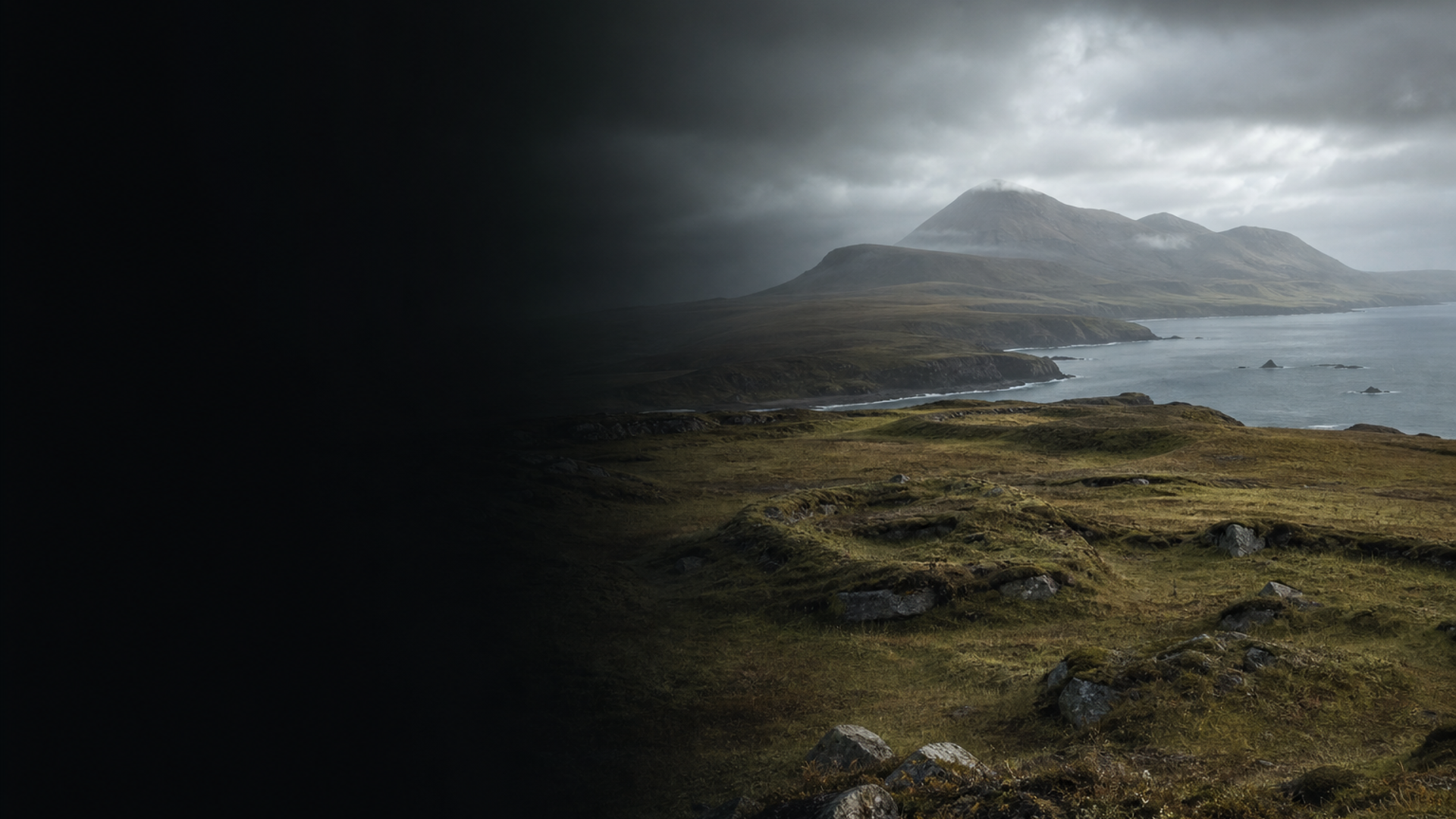
On the windswept flank of Umnak Island, the Chaluka Midden registers a long human presence in the Aleutian chain. Archaeological data indicates repeated occupation episodes spanning the late first millennium BCE through the early modern era (sample dates here: 350 BCE to 1640 CE). Shell, bone, and charcoal strata preserve the echoes of hearths, seal and fish processing areas, and the detritus of a seaborne lifeway.

Limited evidence from the Chaluka context suggests these people belonged to the broader Paleo-Aleut cultural horizon — coastal hunter-gatherers adapted to an island-edge ecology of steel-gray seas, kelp forests, and migrating seabirds. Lithic tools, bone points, and dense midden deposits point to specialized technologies for hunting pinnipeds and seabirds and for processing marine resources. Radiocarbon sequences from Chaluka (reported in regional literature) show episodic occupation that aligns with climatic and ecological shifts in the North Pacific.

From a cinematic vantage: these were communities whose calendars were keyed to the sea — to tides, migrations, and weather — and whose material traces accumulated in layered middens. Archaeology frames their emergence; genetic data begins to place them within a deeper story of Beringian and North American population history, though current DNA evidence remains preliminary due to small sample numbers.

  • Chaluka Midden, Umnak Island: multi-century occupation
  • Archaeology indicates specialized maritime subsistence
  • Radiocarbon and stratigraphy show episodic coastal use
Capítulo IV

Daily Life & Society

Life on Umnak was organized around the sea. Archaeological assemblages from Chaluka include dense shell layers, fish bone, and marine mammal remains that imply repeated harvesting of seals, sea lions, fish, and seabirds. Tasks of processing, drying, and storage likely took place in sheltered areas; bone and stone tools testify to a craft economy tuned to skin-working, netting, and hafted points for harpooning.

Shelter traces and ethnographic analogy to historic Aleut (Unangan) architecture suggest semi-subterranean winter houses and temporary seasonal structures. Material culture — beads, bone toggling harpoons, and expertly flaked points (where preserved) — implies social knowledge transmission across generations. Oral traditions of later Aleut communities record complex seasonal rounds, kin networks, and seafaring expertise; archaeology provides the slow-motion film of those practices.

Yet caution is essential: the human story reconstructed from middens and tools is partial. Taphonomic loss, coastal erosion, and uneven recovery mean many daily activities leave faint traces. Combined archaeological and genetic approaches offer complementary lenses: artifacts show how people lived; DNA begins to reveal who they were biologically and how they related to other populations.

  • Maritime subsistence: seal, fish, seabirds central to diet
  • Material evidence points to specialized hunting and processing
Capítulo V

Genetic Profile

Four ancient individuals sampled from the Chaluka Midden provide a small but illuminating genetic window. All four carry mitochondrial haplogroup D, a lineage common across Beringia and many Native American populations, suggesting maternal continuity in this island context. On the paternal side, two Y-chromosomes assign to haplogroup Q and one to haplogroup P; Q is frequently observed among Indigenous peoples of the Americas, while P (in non-specific notation) can reflect deep northern Eurasian/Beringian connections.

These genetic signals align with broader models in which the Aleutian populations derive much of their ancestry from Beringian/First American lineages, with regional differentiation shaped by island isolation and maritime lifeways. However, the sample count is very small (N=4). Limited evidence suggests maternal continuity in this sample set, but strong inferences about population structure, migration pulses, or sex-biased gene flow are premature.

Genetic data can be powerfully combined with archaeology: shared haplogroups hint at connections across the North Pacific, while differences between sites or time slices could reflect local mobility, trade, or demographic shifts. Any interpretive narrative must acknowledge uncertainty and the need for many more samples and community collaboration to refine the story.

  • All four samples: mtDNA haplogroup D (maternal continuity)
  • Y-DNA: Q (2 samples) and P (1 sample); small N requires caution
Capítulo VI

Legacy & Modern Connections

Archaeology and ancient DNA together create a bridge between past island life and the living descendants of the Aleutian region. The genetic patterns observed at Chaluka are consistent with long-term maternal lineages in the North Pacific and with paternal lineages common in indigenous American populations — a picture that resonates with the cultural persistence seen in historic Unangan communities.

However, with only four ancient genomes, conclusions remain provisional. Responsible interpretation emphasizes collaboration with descendant communities, where archaeological stewardship, oral histories, and genetic research can be ethically integrated. The legacy of the Paleo-Aleut on Umnak is both tangible — in midden strata and tool fragments — and living, in cultural memory, language, and ongoing connections to sea and land.

  • Genetic patterns suggest continuity with broader Beringian ancestries
  • Research must be collaborative and cautious given small sample size
Con IA

Asistente de IA

Haz preguntas sobre la cultura Echoes from Umnak: Paleo-Aleut Voices

Asistente de IA por DNAGENICS

Desbloquear esta función
Pregunta sobre la cultura Echoes from Umnak: Paleo-Aleut Voices. El asistente con IA puede explicar hallazgos genéticos, contexto histórico, pruebas arqueológicas y conexiones modernas, con sus límites de interpretación.
Ejemplo de análisis con IA

La cultura Echoes from Umnak: Paleo-Aleut Voices representa un capítulo de la historia humana...

El análisis genético permite estudiar similitudes con poblaciones anteriores y posibles adaptaciones. Las muestras de ADN antiguo aportan información para investigar patrones migratorios y relaciones entre poblaciones, con límites que dependen del estudio y del contexto arqueológico.

Esta es una vista previa del análisis con IA. Accede al asistente completo para explorar información sobre:

  • Composición y similitud genética
  • Patrones migratorios y orígenes
  • Vida cotidiana y prácticas culturales
  • Contexto genético moderno

Explora más culturas antiguas

Descubre la historia de civilizaciones de distintas partes del mundo antiguo