Preparando el informe

Cargando la información y las referencias disponibles

Consultando el registro arqueológico...

Recopilando registros antiguos

Saltar al contenido principal
Goyet Q116-1: A Paleolithic Echo
Cultura destacada

Goyet Q116-1: A Paleolithic Echo

A single Upper Paleolithic individual from Goyet cave linking archaeology and ancient DNA

33678 CE - 32771 BCE
Goyet cave, Namur Province, Belgium
Desplázate para empezar
Capítulo I

La historia

Comprender la cultura Goyet Q116-1: A Paleolithic Echo

A 33,678–32,771 BCE individual from the Troisième caverne of Goyet (Belgium). Archaeological context and ancient DNA (Y C1a, mtDNA M) offer a rare window into deep Eurasian lineages in Upper Paleolithic western Europe—results are preliminary due to a single sample.

Time Period

33678–32771 BCE

Region

Goyet cave, Namur Province, Belgium

Common Y-DNA

C1a (observed in 1 sample)

Common mtDNA

M (observed in 1 sample)

Capítulo II

Cronología

Momentos clave de la historia de esta cultura

33678 BCE

Chronology of Goyet Q116-1

Radiocarbon dating places the sampled individual at Goyet between ~33,678 and 32,771 BCE, within the Upper Paleolithic occupation of the cave.

Capítulo III

Origins & Emergence

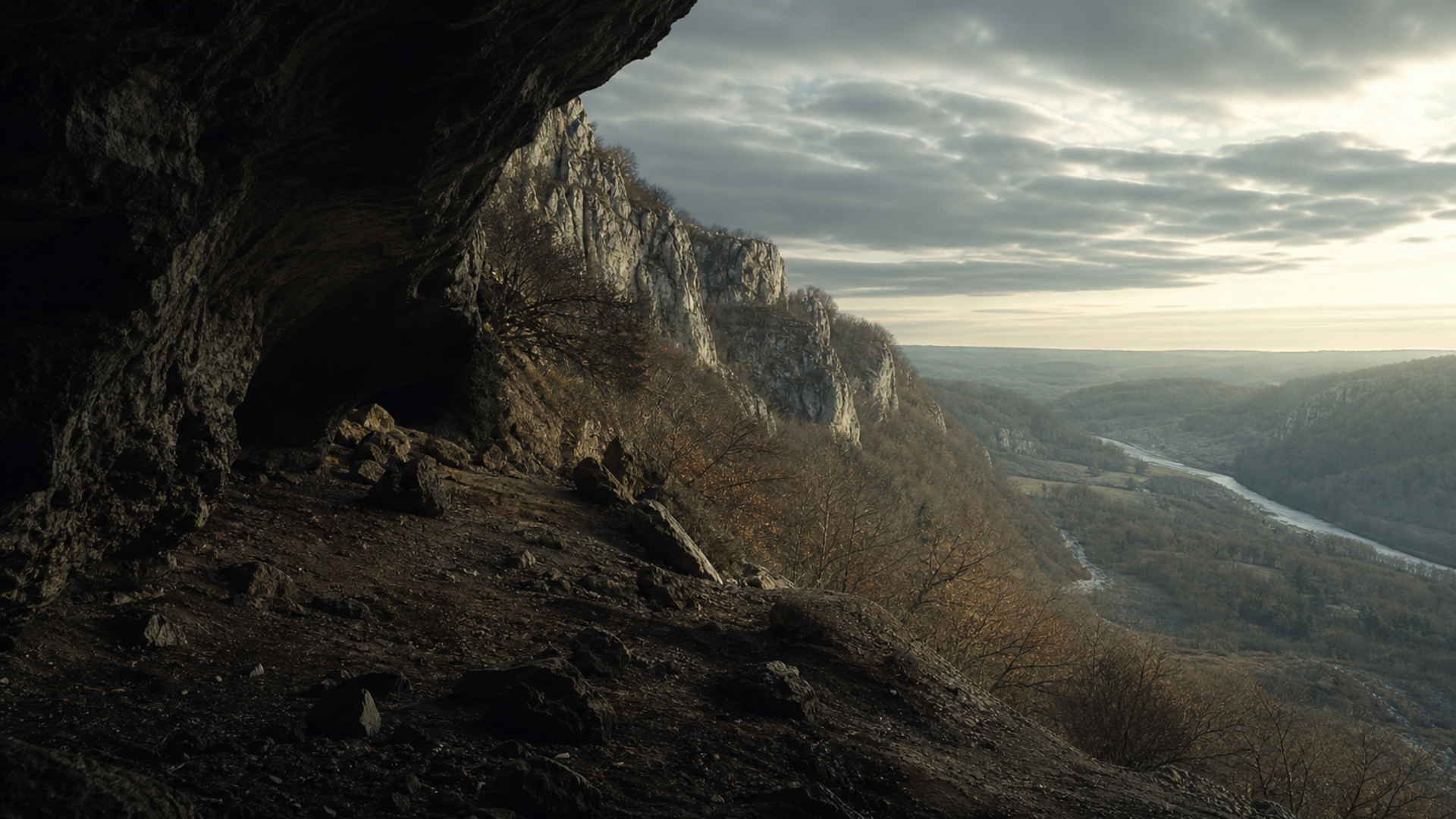
Beneath the quarry-dark floors of the Troisième caverne at Goyet, human presence is stamped into a long, cold horizon of the Upper Paleolithic. Radiocarbon dates for the Goyet Q116-1 individual place this burial between roughly 33,678 and 32,771 BCE, a time when hunter-gatherer groups spread across periglacial Europe. Archaeological data from Goyet cave more broadly indicate repeated occupations: lithic scatters, faunal remains and personal ornaments testify to episodic camps and ritual gestures repeated through millennia.

The genetic signal carried by this individual speaks to origins older and wider than the local landscape: the presence of Y-haplogroup C1a and mtDNA M are notable because, while C1 lineages appear in several Upper Paleolithic European finds, mtDNA M is today more common further east. This combination may reflect early dispersal routes and multiple waves of anatomical modern humans moving across Eurasia during the Late Pleistocene. Limited evidence suggests these lineages persisted locally for some time, but the picture is fragmentary—especially because conclusions rest on a single sampled individual. Archaeological and genetic threads together evoke a network of far-reaching connections rather than a single, uniform population.

  • Radiocarbon-dated to 33,678–32,771 BCE from Troisième caverne, Goyet cave
  • Archaeological layers at Goyet contain lithics, faunal remains, and ornaments
  • Genetic signals hint at deep Eurasian connections but are preliminary
Capítulo IV

Daily Life & Society

The material world recovered from Goyet—worked stone, animal bones, ochre-stained fragments and personal adornment—paints a cinematic, tactile image of life on the margins of Ice Age Europe. Groups exploiting the Meuse valley used the cave as a seasonal hub: hunters chased reindeer and horse across tundra-steppe mosaics, while skilled flintknappers produced bladelets and backed tools suited to a mobile toolkit. Faunal assemblages and cut-mark patterns indicate coordinated hunting and carcass processing, and ornament fragments suggest identity signaling and social networks that stretched between camps.

Social life in this era involved small, flexible bands with knowledge encoded in toolcraft, tracking skills and exchange of objects and ideas. Archaeological data indicates ritual behaviors at Goyet—burial activity and curated items—though interpretations must be cautious. The Q116-1 individual lived within a community tuned to seasonal rhythms and long-distance ties; the DNA hints that some of those ties may have had genetic dimensions reaching far beyond the Meuse valley. Still, with only a single genetic sample from this context, reconstructions of social structure and mobility remain tentative and centered on multidisciplinary inference.

  • Seasonal occupation patterns in the Meuse valley with hunting and butchery evidence
  • Personal ornaments and curated objects suggest social signaling and exchange
Capítulo V

Genetic Profile

The genomic fingerprint from Goyet Q116-1 is compact but evocative: Y-chromosome haplogroup C1a and mitochondrial haplogroup M in a single Upper Paleolithic individual. Y-C1a appears in several Paleolithic European contexts and is often interpreted as one component of the early male lineages present during the post-glacial recolonization and regional persistence of hunter-gatherer groups. Mitochondrial M is today more frequent in populations of Asia and Oceania; its presence in an Upper Paleolithic European individual illustrates how ancient distributions of maternal lineages were more complex before later population turnovers.

Archaeogenetic interpretation must emphasize scale and uncertainty. With a sample count of one, any inference about population-level frequencies, migrations, or continuity is provisional. However, the combination of C1a and M aligns with a broader pattern seen in some Upper Paleolithic assemblages: a mosaic of lineages reflecting multiple dispersal routes and interactions across Eurasia. Future samples from Goyet and contemporaneous sites could confirm whether these lineages represent local persistence, episodic incoming groups, or admixture between distant populations. For now, the DNA offers a singular but vital data point linking the human story at Goyet to wider Pleistocene population dynamics.

  • Y-haplogroup C1a present; found in some Paleolithic European contexts
  • mtDNA M observed; suggests maternal lineages with wider Eurasian ties (preliminary)
Capítulo VI

Legacy & Modern Connections

The trace of Goyet Q116-1 is a whisper through deep time: a genetic and archaeological imprint that complicates simple maps of ancestry. While many later European populations are dominated by lineages introduced or amplified during the Mesolithic and Neolithic, Early Upper Paleolithic individuals like Q116-1 reveal the layered ancestry that underpins modern diversity. The presence of mtDNA M and Y-C1a shows that some maternal and paternal lineages once reached far into western Europe before later demographic events reshaped the continent.

Practical legacy: this individual contributes to a baseline for modeling how Ice Age populations spread, mixed and were later replaced or assimilated. Because the dataset here is a single specimen, any connection to modern populations must be framed as tentative. Nonetheless, when combined with broader ancient DNA sampling, Goyet Q116-1 helps archaeologists and geneticists reconstruct migration corridors, contact zones and the rhythms of human movement across Pleistocene Eurasia.

  • Adds to baseline data for Late Pleistocene European ancestry models
  • Highlights deep, sometimes unexpected maternal and paternal lineages in western Europe
Con IA

Asistente de IA

Haz preguntas sobre la cultura Goyet Q116-1: A Paleolithic Echo

Asistente de IA por DNAGENICS

Desbloquear esta función
Pregunta sobre la cultura Goyet Q116-1: A Paleolithic Echo. El asistente con IA puede explicar hallazgos genéticos, contexto histórico, pruebas arqueológicas y conexiones modernas, con sus límites de interpretación.

Ejemplo de análisis con IA

La cultura Goyet Q116-1: A Paleolithic Echo representa un capítulo de la historia humana...

El análisis genético permite estudiar similitudes con poblaciones anteriores y posibles adaptaciones. Las muestras de ADN antiguo aportan información para investigar patrones migratorios y relaciones entre poblaciones, con límites que dependen del estudio y del contexto arqueológico.

Esta es una vista previa del análisis con IA. Accede al asistente completo para explorar información sobre:

  • Composición y similitud genética
  • Patrones migratorios y orígenes
  • Vida cotidiana y prácticas culturales
  • Contexto genético moderno

Explora más culturas antiguas

Descubre la historia de civilizaciones de distintas partes del mundo antiguo