Preparando el informe

Cargando la información y las referencias disponibles

Consultando el registro arqueológico...

Recopilando registros antiguos

Saltar al contenido principal
Grand Est Middle Neolithic
Cultura destacada

Grand Est Middle Neolithic

Echoes of farmers and foragers in eastern France (4800–3350 BCE)

4800 CE - 3349 BCE
Grand-Est, eastern France
Desplázate para empezar
Capítulo I

La historia

Comprender la cultura Grand Est Middle Neolithic

Archaeogenetic and archaeological evidence from Grand-Est sites (Bergheim, Buchères, Pont-sur-Seine, Rosheim, Wettolsheim) reveals a Middle Neolithic community blending farmer and local hunter-gatherer ancestries. Limited sample sizes mean conclusions are preliminary but reveal striking paternal and maternal diversity.

Time Period

4800–3349 BCE

Region

Grand-Est, eastern France

Common Y-DNA

I (4), H (1), H2 (1)

Common mtDNA

U (4), W5b, J, K, H5u

Capítulo II

Cronología

Momentos clave de la historia de esta cultura

4800 BCE

Middle Neolithic occupation begins in Grand-Est

Archaeological layers at sites like Bergheim and Rosheim show sustained farming settlements and material culture changes characteristic of the Middle Neolithic.

Capítulo III

Origins & Emergence

The Middle Neolithic of Grand-Est unfolds between roughly 4800 and 3350 BCE across the plains and low hills of eastern France. Archaeological evidence from sites such as Bergheim (Saulager), Buchères (PLA D39), Pont-sur-Seine (Ferme de l'Ile), Rosheim ("Mittelfeld" / Rosenmeer) and Wettolsheim documents settlements embedded in river valleys and fertile loess soils. Ceramic styles, lithic reduction debris and agricultural indicators point to communities practicing cereal cultivation, animal husbandry and pottery production adapted to local resources.

Genetic data from ten published individuals sampled across these sites reveal a tapestry of ancestries. Archaeological data indicate continuity of settlement through the Middle Neolithic, and ancient DNA suggests this cultural horizon was composed of people with mixed ancestries: incoming Anatolian-derived farmer-related ancestry interacting with persistent Western hunter-gatherer ancestry. Limited sample numbers and uneven spatial sampling mean these patterns are provisional; they nevertheless align with broader European Neolithic trends that show admixture and regional differentiation rather than wholesale replacement.

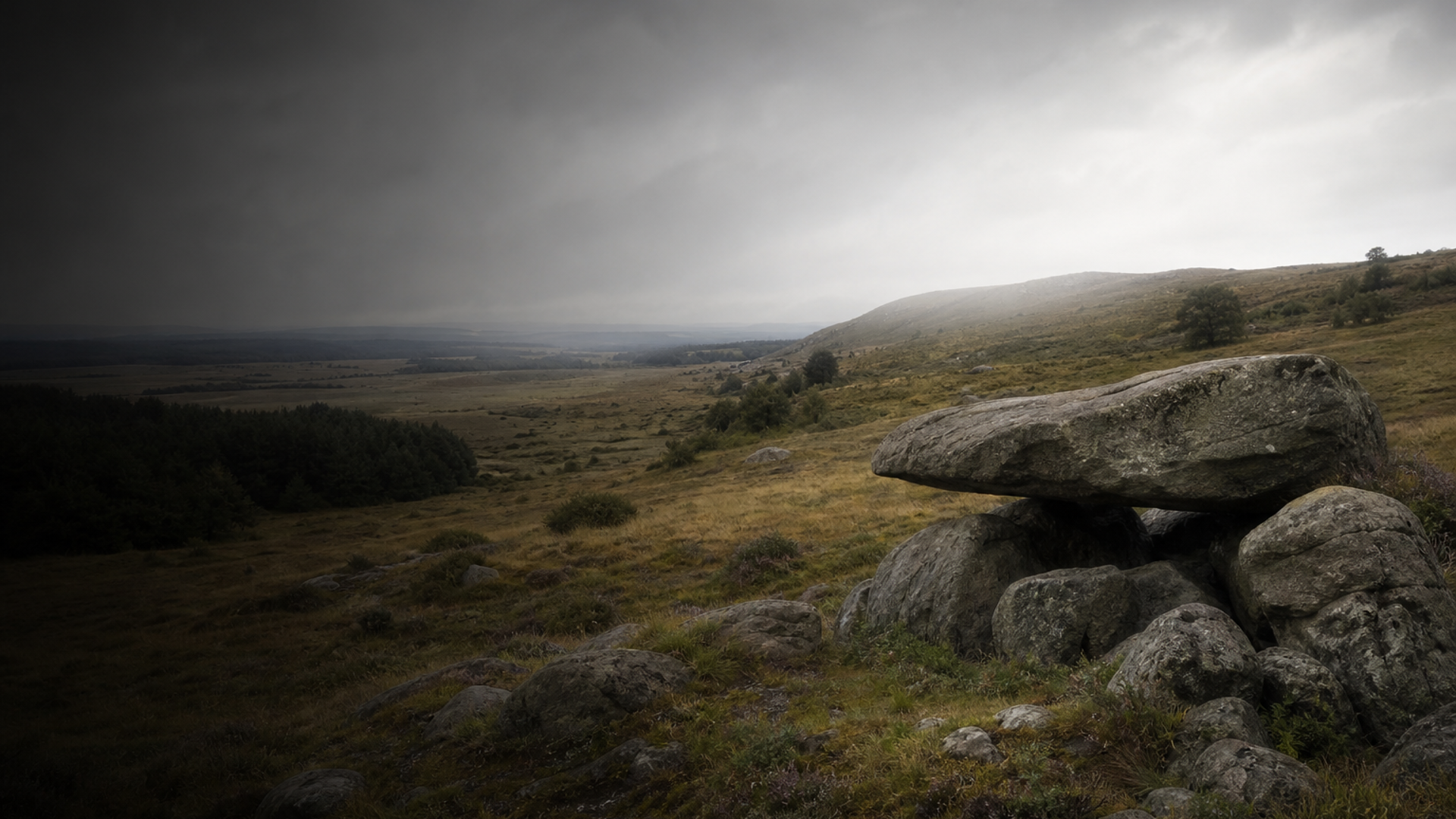
Visually and materially, the Grand-Est record appears as an intimate landscape of fields, ponds and hamlets—communities shaped by riverine corridors and long-distance connections that threaded cultural elements across the Seine and Rhine drainage basins.

  • Sites sampled: Bergheim, Buchères, Pont-sur-Seine, Rosheim, Wettolsheim
  • Period: Middle Neolithic, c. 4800–3349 BCE
  • Evidence for mixed farmer and local hunter-gatherer ancestry
Capítulo IV

Daily Life & Society

Archaeological data indicates daily life in Grand-Est Middle Neolithic villages revolved around small-scale agriculture, herding and pottery production. Fields of emmer and einkorn, along with cattle and sheep, would have structured seasonal rhythms; hearths, storage pits and pottery sherd scatters at sites like Ferme de l'Ile and Rosheim suggest domestic economies anchored to family households. Wood and bone tools, along with flint from local and more distant sources, point to craft specializations and exchange networks.

The material record evokes a tactile world: heavy pots for boiling and storage, polished stone axes for clearing forest, and carefully knapped blades for everyday tasks. Burial evidence in the region is variable; where present, interments sometimes reflect subtle social differentiation, but the archaeological signal is fragmentary. Organic materials rarely survive in quantity, so reconstructions rely on artifact clusters, spatial layouts and seasonal indicators preserved in the soils.

Archaeological data indicate mobility was primarily local, but exotic raw materials and stylistic influences imply long-range contacts—rivers served as highways of culture and gene flow. The lived landscape combined rooted farming lifeways with flexibility to exploit wetlands, floodplains and wooded edges.

  • Economy: cereals, cattle, sheep — household-focused farming
  • Material culture: pottery, polished axes, flint tools; evidence for exchange
Capítulo V

Genetic Profile

Ten individuals sampled from Grand-Est Middle Neolithic contexts display a mixture of paternal and maternal lineages that reflect both local continuity and incoming diversity. On the Y chromosome the most represented lineage is haplogroup I (4 individuals), a paternal lineage commonly associated with European Mesolithic hunter-gatherers and frequently found in Neolithic contexts as part of regional continuity. The presence of Y-haplogroups annotated as H and H2 (each observed once) introduces additional paternal diversity; H2 has been reported in some early farmer-associated contexts elsewhere in Europe. These findings suggest a palimpsest of male ancestries rather than a single incoming paternal wave.

Mitochondrial diversity is likewise mixed: U lineages (4 individuals) are often linked to pre-Neolithic European hunter-gatherer maternal ancestry, while W5b, J, K and H5u—each observed among the remaining samples—are commonly associated with Neolithic farmer maternal lineages originating from Anatolia and surrounding regions. Together, the mtDNA and Y-DNA patterns align with a model of Anatolian-derived farmer ancestry admixing with resident Western hunter-gatherer groups during the Middle Neolithic.

Caveats: with only ten samples the portrait is preliminary. Archaeogenetic inference of proportions of ancestry, kinship networks and demographic events will sharpen as sample sizes grow and temporal resolution improves. Nevertheless, the current dataset from Bergheim, Buchères, Pont-sur-Seine, Rosheim and Wettolsheim offers a vivid snapshot of genetic pluralism in Middle Neolithic eastern France.

  • Paternal dominance of haplogroup I with pockets of H/H2 diversity
  • Maternal mix: hunter-gatherer-associated U and farmer-associated W5b, J, K, H5u
Capítulo VI

Legacy & Modern Connections

Archaeological and genetic signals from Grand-Est Middle Neolithic populations persist in the deep ancestry of modern Europeans, including people in northeastern France. Components of Anatolian-farmer and Western hunter-gatherer ancestry that characterize these Neolithic individuals are detectable in present-day genomes, but they have been reshaped by later migrations (Bronze Age steppe expansions, Iron Age movements and historical admixture).

The material legacy—landscapes shaped by early clearance, long-lived field systems in loess soils, and pottery traditions—also echoes in later rural practices. Scientific caution is important: ten samples cannot map direct lines of descent from specific individuals to modern families. Instead, these genomes illuminate the demographic processes (admixture, regional continuity, local diversity) that contributed to the complex genetic mosaic of Europe. Ongoing sampling in Grand-Est and integration with archaeological context will clarify how these Middle Neolithic communities fit into the broader story of European population history.

  • Ancestral components found here contribute to modern European genomes
  • Cultural and landscape impacts endured, though genetic signals were later reshaped
Con IA

Asistente de IA

Haz preguntas sobre la cultura Grand Est Middle Neolithic

Asistente de IA por DNAGENICS

Desbloquear esta función
Pregunta sobre la cultura Grand Est Middle Neolithic. El asistente con IA puede explicar hallazgos genéticos, contexto histórico, pruebas arqueológicas y conexiones modernas, con sus límites de interpretación.
Ejemplo de análisis con IA

La cultura Grand Est Middle Neolithic representa un capítulo de la historia humana...

El análisis genético permite estudiar similitudes con poblaciones anteriores y posibles adaptaciones. Las muestras de ADN antiguo aportan información para investigar patrones migratorios y relaciones entre poblaciones, con límites que dependen del estudio y del contexto arqueológico.

Esta es una vista previa del análisis con IA. Accede al asistente completo para explorar información sobre:

  • Composición y similitud genética
  • Patrones migratorios y orígenes
  • Vida cotidiana y prácticas culturales
  • Contexto genético moderno

Explora más culturas antiguas

Descubre la historia de civilizaciones de distintas partes del mundo antiguo