Preparando el informe

Cargando la información y las referencias disponibles

Consultando el registro arqueológico...

Recopilando registros antiguos

Saltar al contenido principal
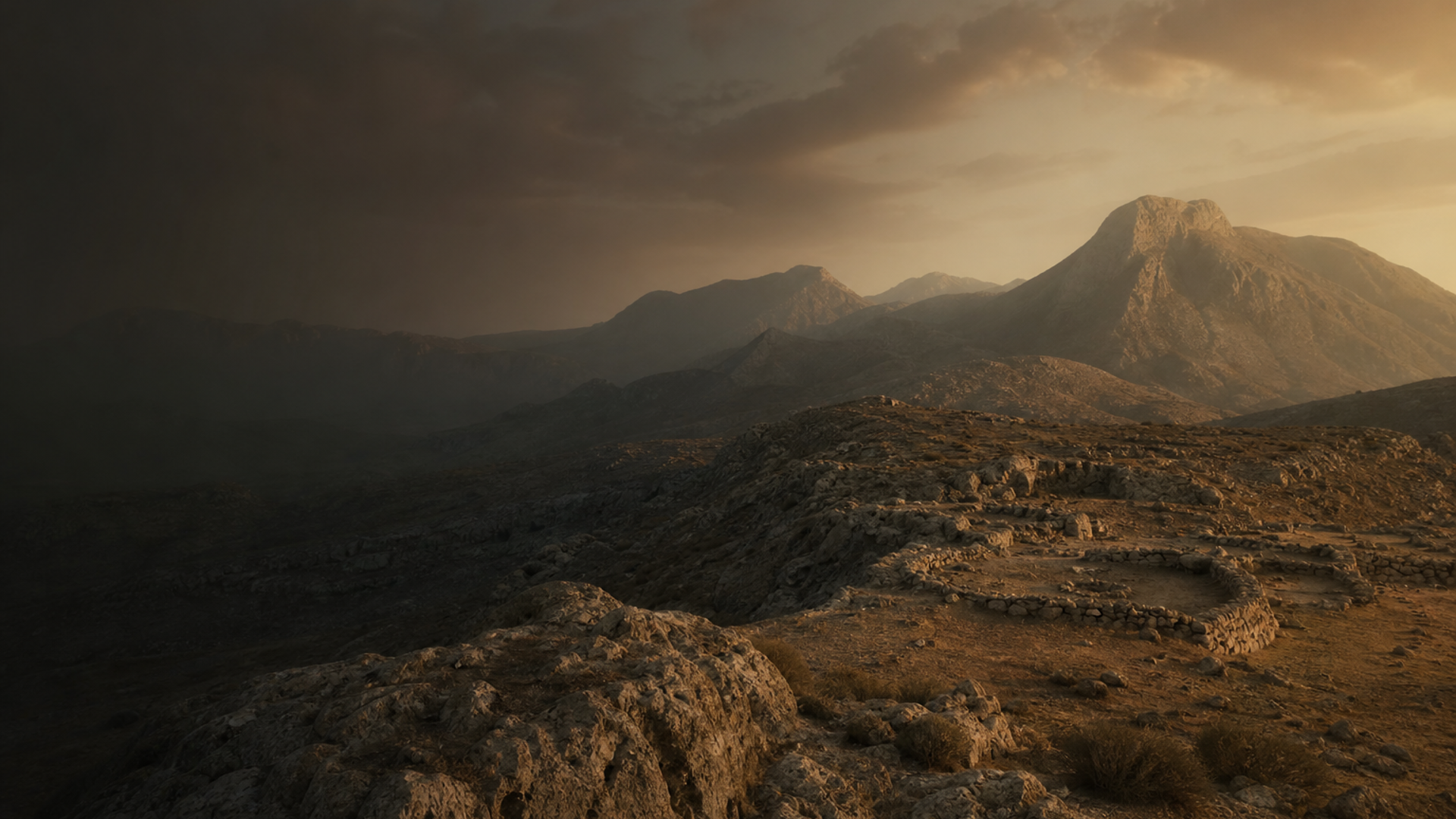
Hagios Charalambos, Crete (EMBA)
Cultura destacada

Hagios Charalambos, Crete (EMBA)

A Lasithi community (2300–1900 BCE) where cave burials and genomes illuminate Bronze Age lives

2300 CE - 1900 BCE
Lasithi, Crete, Greece
Desplázate para empezar
Capítulo I

La historia

Comprender la cultura Hagios Charalambos, Crete (EMBA)

Archaeological and ancient DNA data from Lasithi (Crete) connect cave burial traditions to a predominantly J-line paternal signal and diverse maternal lineages, revealing a Mediterranean Bronze Age community shaped by local continuity and long-range interactions.

Time Period

2300–1900 BCE

Region

Lasithi, Crete, Greece

Common Y-DNA

J (dominant), T, G

Common mtDNA

H, HV+, T, I5a, U

Capítulo II

Cronología

Momentos clave de la historia de esta cultura

2300 BCE

Emergence of EMBA Lasithi Communities

Local cave-burial traditions and Bronze Age material culture appear in Lasithi, anchored by Hagios Charalambos contexts.

2100 BCE

Intensified Exchange Networks

Material links and exotic raw materials indicate growing maritime connections across the eastern Mediterranean.

1900 BCE

End of the Sampled Horizon

Archaeological change and shifting social dynamics mark the close of this sampled Early–Middle Bronze Age interval.

Capítulo III

Origins & Emergence

The Early–Middle Bronze Age community sampled in Lasithi (2300–1900 BCE) occupies a transitional moment on Crete when local Neolithic traditions met expanding Bronze Age networks. Archaeological data indicates continued use of cave burial contexts—most notably at Hagios Charalambos Cave and nearby deposits at Schinokapsala and Vornospilia—where skeletons were placed with pottery, stone tools, and occasional exotic materials. These funerary settings suggest a community rooted in local ritual landscapes but connected to wider maritime exchange across the eastern Mediterranean.

Material culture shows continuity with earlier Minoan forms alongside innovations in metal use and craft production typical of the Early Bronze Age. Radiocarbon dates from regional contexts place many associated assemblages between 2300 and 1900 BCE, a period of social reconfiguration rather than abrupt population replacement. Limited evidence suggests influences from mainland Greece and Anatolia, but the pattern appears complex: archaeological signals of trade and stylistic contact coexist with persistent local burial practices.

Bulleted archaeological takeaways:

  • Hagios Charalambos Cave: key burial locus tying the sample set to established ritual use in Lasithi.
  • Regional continuity: pottery traditions and cave interment indicate strong local cultural persistence.
  • Interaction networks: trade goods and stylistic parallels imply long-range maritime connections, not wholesale demographic change.
  • Hagios Charalambos Cave anchors the burial assemblage
  • Local pottery traditions continue alongside Bronze Age innovations
  • Material links indicate maritime exchange across the Aegean
Capítulo IV

Daily Life & Society

The daily rhythms of Lasithi's Early–Middle Bronze Age people would have been shaped by a patchwork of upland and coastal resources. Archaeobotanical and zooarchaeological analogues from Crete indicate mixed farming—cereals, pulses, olives—and herding of sheep and goats, supplemented by coastal fishing. Caves such as Hagios Charalambos served both funerary and possibly ritual roles, placing the dead within landscapes of memory that regulated social bonds.

Craft specialists likely produced pottery, stone tools, and emerging metalwork; fragments of obsidian and non-local stones hint at exchange and specialized procurement. Household archaeology across Crete from this era points to small, autonomous communities with interlinked exchange networks rather than centralized urban cores. Social differentiation is subtle in the burial record: grave goods vary, but clear elite markers are less pronounced than in later Bronze Age palaces.

Archaeological indicators of mobility—exotic raw materials and stylistic influences—coexisted with local identity markers, suggesting that residents participated in wider networks while maintaining community-specific rituals.

Bulleted daily-life points:

  • Mixed farming and herding formed the economic base, with coastal resources supplementing diet.
  • Craft production and exchange connected Lasithi to Aegean trade routes while local rituals anchored social life.
  • Economy: mixed farming, herding, and coastal foraging
  • Craft and exchange: evidence for specialized production and long-distance contacts
Capítulo V

Genetic Profile

Ancient DNA from 28 individuals associated with Early–Middle Bronze Age Lasithi (samples concentrated around Ierapetra, Schinokapsala, Vornospilia, and Hagios Charalambos contexts) reveals a clear paternal skew and diverse maternal heritage. Among males with reported Y-chromosome results, haplogroup J is dominant (18 individuals), with smaller counts of T (2) and G (1). This prevalence of J aligns with long-standing signals of Near Eastern–Mediterranean paternal lineages in the Aegean; however, haplogroups do not map one-to-one onto cultural labels, and local continuity cannot be excluded.

Mitochondrial DNA shows greater variety: haplogroup H (6), HV+ (4), T (3), I5a (2), and U (1) among reported mtDNA calls. This maternal diversity suggests a mixed ancestry for women in the community or greater female mobility across networks. The contrast between a dominant Y-lineage and varied mtDNA may reflect social practices such as patrilocal residence, exogamous marriage, or differential preservation and sampling bias.

Interpretive cautions: the dataset (n=28) is regionally concentrated in Lasithi, so conclusions about all of Crete are provisional. Genetic affinities point to Mediterranean and Near Eastern connections rather than clear evidence for large-scale population replacement. Further sampling from other Cretan regions and temporal layers is needed to refine demographic models.

Bulleted genetic findings:

  • Predominant Y-DNA J among males suggests a strong paternal continuity or influx of Mediterranean/Near Eastern lineages.
  • Diverse mtDNA haplogroups indicate mixed maternal ancestry and possible female-mediated mobility.
  • Dominant paternal signal: J (18/28 male-derived calls), with T and G present
  • Diverse maternal lineages (H, HV+, T, I5a, U) point to complex ancestry and mobility
Capítulo VI

Legacy & Modern Connections

The genetic and archaeological portrait of Hagios Charalambos-era Lasithi paints a picture of continuity within connectivity. Modern populations across Crete and the eastern Mediterranean retain a blend of paternal and maternal markers that trace, in part, to Bronze Age substrates, but millennia of migrations have layered additional complexity. Archaeogenetic links between these Early–Middle Bronze Age samples and broader Mediterranean lineages emphasize long-term interaction rather than straightforward ancestry lines.


For modern genetic ancestry platforms, these samples help anchor regional baselines: a high frequency of Y-haplogroup J and a mosaic of mtDNA haplogroups are consistent with a Mediterranean coastal population engaged in exchange. Nevertheless, because the sample set is geographically concentrated and limited to one subregion of Crete, extrapolating to all Cretans or labeling continuity as direct ancestry should be done cautiously. Future sampling across Crete and later Bronze Age strata will clarify how this Early–Middle Bronze Age signature contributed to the island's genetic history.

Bulleted legacy points:

  • Provides a regional genetic baseline linking Bronze Age Lasithi to Mediterranean lineages.
  • Useful for ancestry models but limited by regional sampling and temporal scope.
  • Anchors regional DNA baselines for Crete in the Early–Middle Bronze Age
  • Valuable for ancestry inference but requires broader sampling for island-wide claims
Con IA

Asistente de IA

Haz preguntas sobre la cultura Hagios Charalambos, Crete (EMBA)

Asistente de IA por DNAGENICS

Desbloquear esta función
Pregunta sobre la cultura Hagios Charalambos, Crete (EMBA). El asistente con IA puede explicar hallazgos genéticos, contexto histórico, pruebas arqueológicas y conexiones modernas, con sus límites de interpretación.
Ejemplo de análisis con IA

La cultura Hagios Charalambos, Crete (EMBA) representa un capítulo de la historia humana...

El análisis genético permite estudiar similitudes con poblaciones anteriores y posibles adaptaciones. Las muestras de ADN antiguo aportan información para investigar patrones migratorios y relaciones entre poblaciones, con límites que dependen del estudio y del contexto arqueológico.

Esta es una vista previa del análisis con IA. Accede al asistente completo para explorar información sobre:

  • Composición y similitud genética
  • Patrones migratorios y orígenes
  • Vida cotidiana y prácticas culturales
  • Contexto genético moderno

Explora más culturas antiguas

Descubre la historia de civilizaciones de distintas partes del mundo antiguo