Preparando el informe

Cargando la información y las referencias disponibles

Consultando el registro arqueológico...

Recopilando registros antiguos

Saltar al contenido principal
Issyk‑Kul Saka: Chilpek & Ken‑Su Burials
Cultura destacada

Issyk‑Kul Saka: Chilpek & Ken‑Su Burials

A cinematic glimpse into Iron Age Saka lifeways on the shores of Issyk‑Kul, revealed by archaeology and ancient DNA.

751 BCE - 884 CE
Issyk‑Kul region, Kyrgyzstan
Desplázate para empezar
Capítulo I

La historia

Comprender la cultura Issyk‑Kul Saka: Chilpek & Ken‑Su Burials

Archaeological and genetic evidence from eight burials (Chilpek mounds & Ken‑Su) in Issyk‑Kul, Kyrgyzstan (c. 751 BCE–884 CE) suggests a mixed West–East Eurasian ancestry consistent with Saka-era steppe networks, though low sample numbers make conclusions preliminary.

Time Period

c. 751 BCE – 884 CE

Region

Issyk‑Kul region, Kyrgyzstan

Common Y-DNA

J (2), R (1)

Common mtDNA

U (2), H1, F, U1a, A16

Capítulo II

Cronología

Momentos clave de la historia de esta cultura

700 BCE

Saka-era presence near Issyk‑Kul

Regional archaeological evidence indicates Saka-associated mounded burials and mobile pastoral economies around Issyk‑Kul, marking the area's integration into steppe networks (brief, provisional statement).

Capítulo III

Origins & Emergence

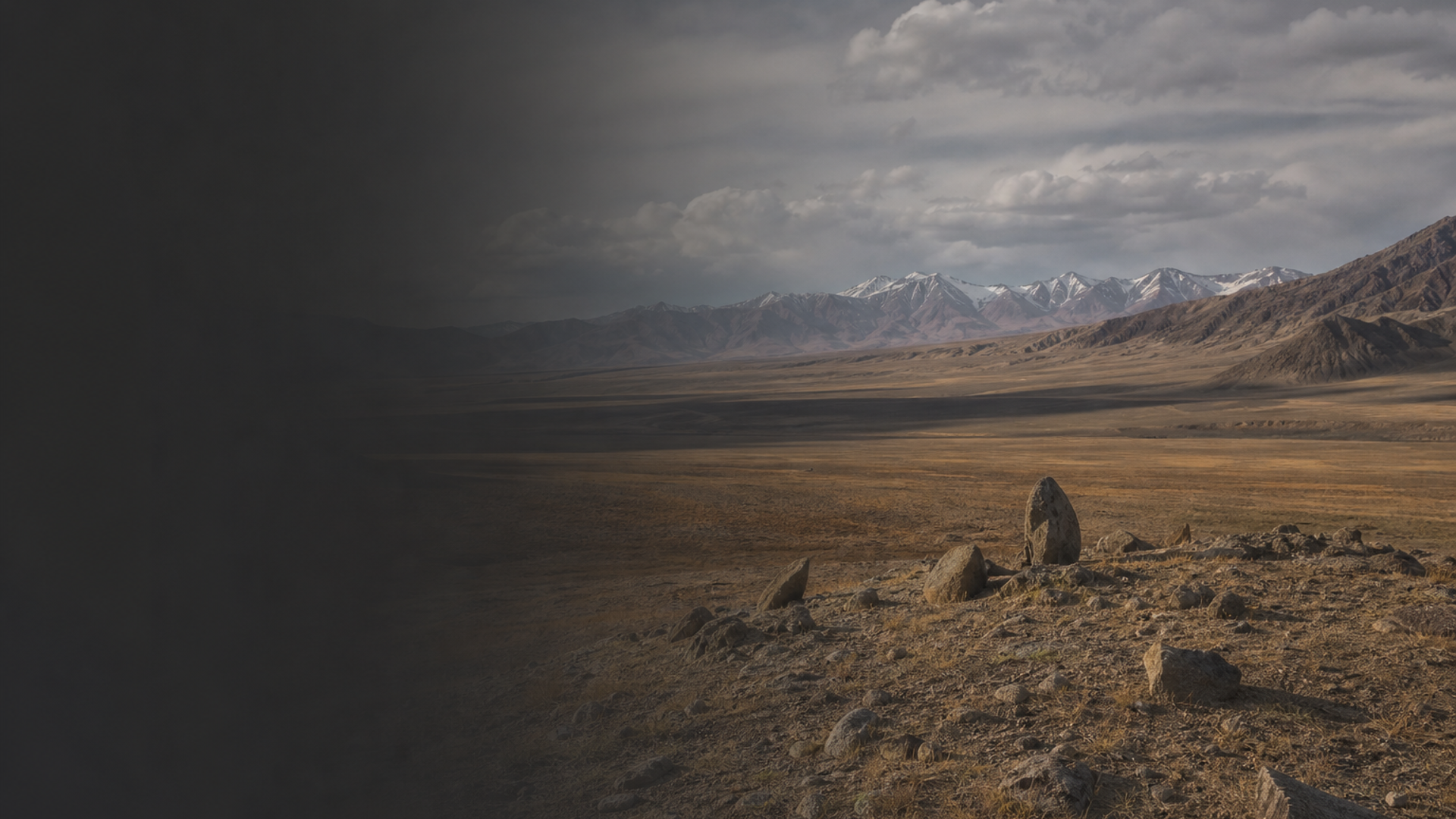
The Chilpek and Ken‑Su burial grounds on the northern rim of Lake Issyk‑Kul occupy a dramatic landscape of high steppe and mountain shadow. Archaeological data indicates these mounded graves are part of the broader Iron Age Saka world — a network of mobile pastoralists and warriors that spanned the Tian Shan and adjoining steppes. Radiocarbon dates from associated contexts and regional parallels place activity here broadly within the first millennium BCE and into the early medieval period, though the direct dates for the eight genetic samples range from about 751 BCE to 884 CE.

Material markers commonly associated with Saka contexts — mounded interments, horse-related funerary practice, and regional metalwork styles — create a cultural horizon visible across Central Asia. Limited evidence from Chilpek and Ken‑Su aligns these burials with that horizon, but preservation, site disturbance, and variable excavation histories mean that precise cultural attributions must remain cautious.

From a genetic perspective, the skeletal assemblage appears to capture people whose maternal and paternal lineages reflect both West and East Eurasian components. This biological complexity dovetails with archaeological signals of long-distance connections: highland corridors, caravan routes, and seasonal mobility all provided channels for gene flow as well as goods and ideas. The interplay of material culture and genome-level data invites a narrative of emergence shaped by connectivity rather than simple isolation.

  • Chilpek (mounds 2,4,6,7,8) and Ken‑Su (#551, #556, #651) cluster on Issyk‑Kul’s north shore
  • Burials fit regional Iron Age Saka mortuary patterns, but site preservation varies
  • Dates span c. 751 BCE–884 CE, emphasizing deep temporal depth
Capítulo IV

Daily Life & Society

Visualize a wind-swept shoreline where herds graze beneath snow-capped peaks and seasonal campsropes connect valleys to lake pastures. Archaeological indicators from the Issyk‑Kul basin suggest communities organized around pastoral mobility, with livestock (sheep, goats, horses) at the core of subsistence and social life. Mounded burials point to ritualized remembrance and status differentiation: some graves are larger, suggesting individuals or households with greater wealth or prestige.

Artifacts and landscape patterns across the region imply specialized crafts — metalworking, leatherworking, and horse gear production — that accompanied nomadic lifeways. Exchange networks are archaeologically visible in stylistic influences and nonlocal materials, indicating ties to both western Eurasian and Inner Asian spheres. Seasonal movement between high and low pastures would have structured social calendars, marriage alliances, and competition over grazing territories.

Burial contexts at Chilpek and Ken‑Su capture moments of those lives: they are snapshots of mobility codified in earth and bone. Yet archaeological visibility is uneven. Looting, erosion, and limited excavation constrain our picture, so reconstructions of everyday life remain probabilistic and dependent on future fieldwork.

  • Pastoral mobility and horse culture likely structured seasonal life and social relations
  • Grave mound variability suggests social differentiation and wide exchange networks
Capítulo V

Genetic Profile

Ancient DNA from eight individuals recovered at Chilpek and Ken‑Su provides a tantalizing, if preliminary, genetic window into the Issyk‑Kul Saka-associated population. The sample set (n = 8) is small — below the threshold where broad population-level claims are secure — so interpretations must be cautious. Still, the observed haplogroups point to a mosaic ancestry.

Y‑chromosome results show multiple paternal lineages: two individuals carry haplogroup J, and one carries R. Haplogroup J is often linked to western and southwestern Eurasian distributions, while R is widespread across Eurasia and common in steppe contexts. On the maternal side, mitochondrial haplogroups include U (two individuals), H1, U1a, F, and A16. Haplogroups U and H variants are frequently associated with West Eurasian maternal ancestries; F and A16 are more typical of East and Central Asian maternal lineages.

Taken together, the genetic signature suggests admixture between western Eurasian and eastern/Central Asian ancestries — a pattern well aligned with archaeological expectations for Saka-era populations who inhabited crossroads of the steppe. Yet, the low sample count, broad temporal span (c. 751 BCE–884 CE), and potential kinship among buried individuals mean that these genetic results should be treated as provisional. Expanded sampling, higher-resolution autosomal analysis, and direct radiocarbon dating of each genome will be essential to move from intriguing glimpses to robust population history.

  • Small sample (n=8) shows mixed West–East Eurasian maternal and paternal lineages
  • Presence of J and R Y‑DNA and U, H, F, A mitochondrial lineages suggests admixture
Capítulo VI

Legacy & Modern Connections

The Chilpek and Ken‑Su burials are part of a larger tapestry tying the Issyk‑Kul basin to Iron Age steppe identities that shaped Central Asia’s history. Archaeological continuity in burial traditions and material styles hints at durable cultural practices, even as gene flow and mobility reconfigured populations through time. Genetic echoes — mixtures of western and eastern lineages — resonate in many modern Central Asian groups, suggesting partial continuity but also repeated waves of migration and admixture.

For local communities and scholars, these burials illuminate ancestral complexity: people of the Saka horizon were not monolithic but formed through centuries of interaction. Future archaeological excavation, combined with expanded ancient DNA sampling and precise dating, will clarify how these pastoral societies contributed to the genetic and cultural landscapes of contemporary Kyrgyzstan and neighboring regions. Until then, the Chilpek and Ken‑Su genomes remain vivid, provisional portraits of lives lived at the edge of lakes and empires.

  • Genetic mixtures here mirror broader Central Asian ancestry patterns seen today
  • Further sampling needed to assess direct lineage continuity with modern populations
Con IA

Asistente de IA

Haz preguntas sobre la cultura Issyk‑Kul Saka: Chilpek & Ken‑Su Burials

Asistente de IA por DNAGENICS

Desbloquear esta función
Pregunta sobre la cultura Issyk‑Kul Saka: Chilpek & Ken‑Su Burials. El asistente con IA puede explicar hallazgos genéticos, contexto histórico, pruebas arqueológicas y conexiones modernas, con sus límites de interpretación.
Ejemplo de análisis con IA

La cultura Issyk‑Kul Saka: Chilpek & Ken‑Su Burials representa un capítulo de la historia humana...

El análisis genético permite estudiar similitudes con poblaciones anteriores y posibles adaptaciones. Las muestras de ADN antiguo aportan información para investigar patrones migratorios y relaciones entre poblaciones, con límites que dependen del estudio y del contexto arqueológico.

Esta es una vista previa del análisis con IA. Accede al asistente completo para explorar información sobre:

  • Composición y similitud genética
  • Patrones migratorios y orígenes
  • Vida cotidiana y prácticas culturales
  • Contexto genético moderno

Explora más culturas antiguas

Descubre la historia de civilizaciones de distintas partes del mundo antiguo