Preparando el informe

Cargando la información y las referencias disponibles

Consultando el registro arqueológico...

Recopilando registros antiguos

Saltar al contenido principal
Iwade Kofun: Honshu Cave Burials
Cultura destacada

Iwade Kofun: Honshu Cave Burials

Late Kofun-period burials from Kanazawa that hint at maternal continuity and continental contacts

541 CE - 655 CE
Honshu, Ishikawa Prefecture (Kanazawa)
Desplázate para empezar
Capítulo I

La historia

Comprender la cultura Iwade Kofun: Honshu Cave Burials

Three late Kofun-period individuals (541–655 CE) from the Iwade horizontal cave tombs, Ishikawa Prefecture. Archaeological evidence ties them to late Kofun practices; mitochondrial DNA (D, B, M) hints at diverse maternal ancestries. Low sample count makes conclusions preliminary.

Time Period

541–655 CE (late Kofun)

Region

Honshu, Ishikawa Prefecture (Kanazawa)

Common Y-DNA

Not reported / insufficient data

Common mtDNA

D (1), B (1), M (1)

Capítulo II

Cronología

Momentos clave de la historia de esta cultura

538 CE

Traditional arrival of Buddhism

Mid-6th century introductions of continental religion and ideas; dates commonly cited as 538/552 CE reflect growing continental ties.

541 CE

Earliest Iwade sample

One individual from the Iwade horizontal cave tombs dates to the early part of the site's 541–655 CE range.

655 CE

Latest Iwade sample

The most recent of the three analyzed burials falls near 655 CE, reflecting late Kofun-period occupation of the site.

Capítulo III

Origins & Emergence

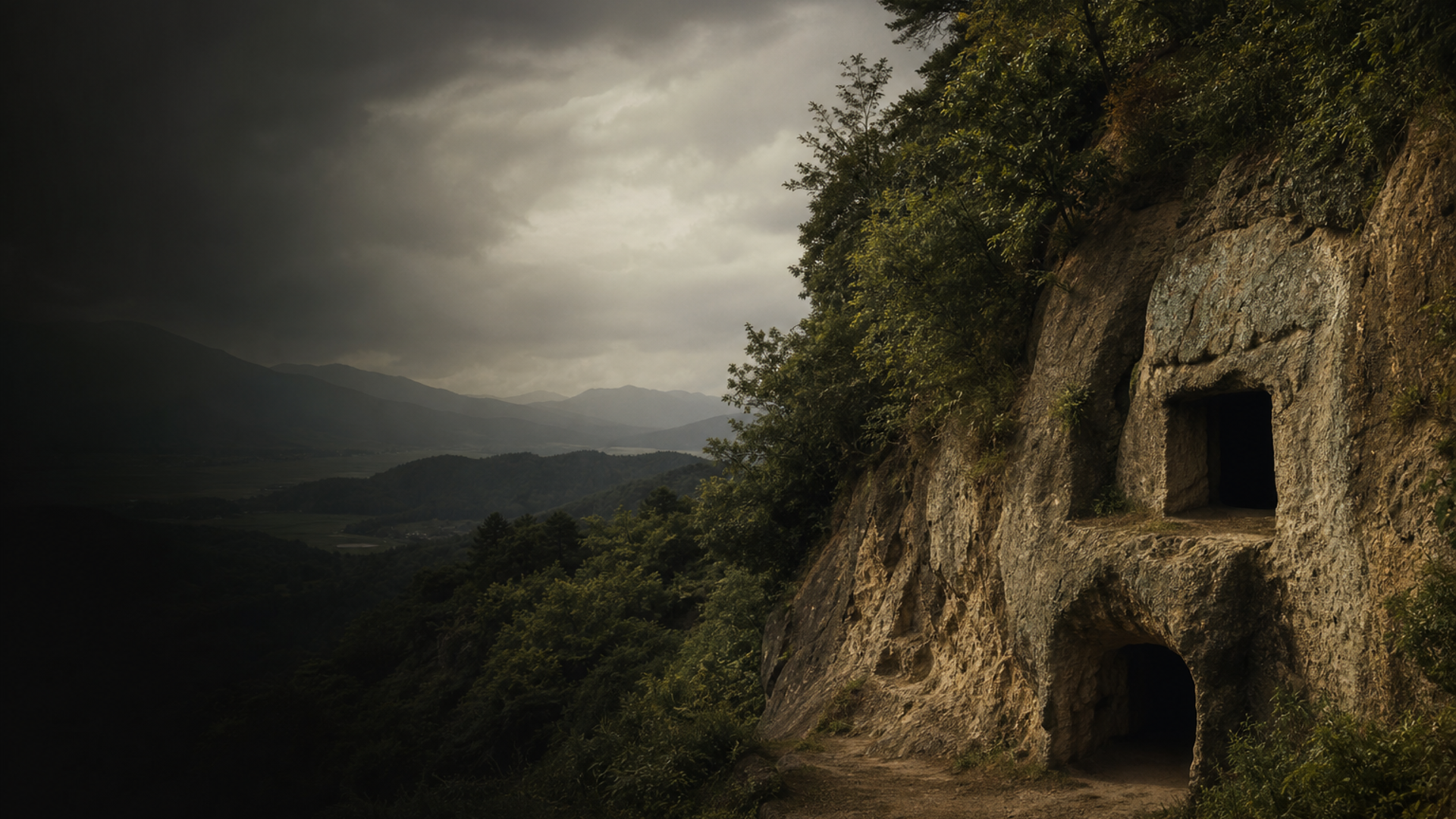
The Iwade horizontal cave tombs in Kanazawa sit at the twilight of the Kofun cultural horizon, dated here between 541 and 655 CE. Archaeological data indicates that these cave burials represent a late local expression of broader mortuary traditions that, earlier in the Kofun period, had been dominated by monumental keyhole mounds (zenpokoenfun). By the sixth–seventh centuries, burial architecture diversified: horizontal cave tombs appear across Honshu and can reflect regional styles, shifting social organization, and local responses to continental influence.

Material traces from late Kofun contexts often record a tense, cinematic encounter of local older traditions and newly arriving practices — changes visible in pottery styles, grave goods, and tomb construction. Limited evidence from Ishikawa Prefecture suggests communities here maintained distinctive local rites while participating in exchange networks across the Sea of Japan. Radiocarbon and stratigraphic data from the Iwade assemblage place these interments in a period of rapid political and cultural transformation on the Japanese archipelago.

Because the dataset for this specific site is small (three sequenced individuals), any broader model of population movements or cultural transmission must be cautious. Archaeological context frames hypotheses; ancient DNA offers a new lens, but it is a lens that needs more samples to sharpen regional narratives.

  • Late Kofun-era horizontal cave tombs (Iwade, Kanazawa)
  • Dates: 541–655 CE — period of political and cultural change
  • Local burial traditions interacting with continental influences
Capítulo IV

Daily Life & Society

Life around the Iwade tombs would have been shaped by paddy agriculture, craft production, and local leadership structures visible in mortuary variability. Archaeological data indicates communities in Ishikawa maintained rice cultivation, ceramic production, and metallurgy consistent with late Kofun economies. The presence of horizontal cave tombs suggests households or lineages invested labor into communal or kin-based burial spaces rather than the massive kofun mounds of earlier elites.


Trade and diplomatic ties across the Korean Strait and with the Japanese archipelago’s interior are archaeologically plausible for the mid-1st millennium CE: imported objects, metallurgical styles, and shared iconographies in nearby regions point to active exchange. Textual sources from slightly later centuries record growing centralization and the entry of continental ideas — including Buddhism — into elite life, but local communities often blended such influences with established practices.

The Iwade burials capture a human scale: people who lived through social reorganization, shifting alliances, and new rituals. Yet archaeological visibility is uneven — household evidence is fragmentary and funerary remains can overrepresent specific social segments. For this reason, reconstructions of daily life near Iwade rely on regional comparisons and cautious inference.

  • Paddy agriculture and local craft production likely prominent
  • Regional exchange networks with the Korean Peninsula and other Honshu communities
Capítulo V

Genetic Profile

Three sequenced individuals from the Iwade horizontal cave tombs yield mitochondrial haplogroups D, B, and M (one each). These maternal lineages are broadly distributed across East Asia and the Japanese archipelago. Haplogroup D in particular is commonly associated with both ancient Jomon and later populations in Japan; haplogroups B and M have deep roots across East and Southeast Asia as well.

Because no consistent Y-DNA pattern is reported for these three individuals, paternal lineage conclusions cannot be drawn from this dataset. More broadly, published ancient genomic work on Kofun-period individuals from other regions has shown signals of increased continental-derived ancestry relative to earlier Jomon-associated groups; archaeological data indicates substantial interaction with continental polities during the sixth–seventh centuries. However, with only three mitochondrial genomes here, any inference about population replacements, admixture proportions, or sex-biased migration at Iwade is highly preliminary.

Limited evidence suggests the Iwade maternal profiles are compatible with a mixed ancestry landscape: continuity of local maternal lineages alongside influxes from continental East Asia. Future sampling — especially autosomal genomes and Y-chromosome data — is necessary to test hypotheses about mobility, kinship, and the social scale of migration during the late Kofun era.

  • mtDNA: D, B, M (each observed once) — suggests diverse maternal lineages
  • Sample size (n=3) is too small for robust demographic conclusions
Capítulo VI

Legacy & Modern Connections

The genetic profile from Iwade hints at threads that continue into modern Japan: mitochondrial haplogroups such as D and certain M lineages remain present in contemporary Japanese populations, suggesting elements of maternal continuity. Archaeological continuity in certain material practices and settlement patterns around Ishikawa also points to long-term local resilience.

Yet the legacy is complex. Japan’s population history is the result of multiple waves of movement and local adaptation — Jomon hunter-gatherers, Yayoi farmers, and later arrivals during the Kofun and Asuka periods all contributed. The three Iwade genomes offer a cinematic glimpse into that tapestry but cannot on their own map modern ancestry. Ongoing, geographically broad ancient DNA sampling — paired with careful archaeological context — is the path to turning evocative hints into well-supported narratives connecting past lives to present populations.

  • Maternal lineages observed are present in modern Japanese populations
  • Broader sampling needed to clarify the contribution of late Kofun groups to present-day ancestry
Con IA

Asistente de IA

Haz preguntas sobre la cultura Iwade Kofun: Honshu Cave Burials

Asistente de IA por DNAGENICS

Desbloquear esta función
Pregunta sobre la cultura Iwade Kofun: Honshu Cave Burials. El asistente con IA puede explicar hallazgos genéticos, contexto histórico, pruebas arqueológicas y conexiones modernas, con sus límites de interpretación.
Ejemplo de análisis con IA

La cultura Iwade Kofun: Honshu Cave Burials representa un capítulo de la historia humana...

El análisis genético permite estudiar similitudes con poblaciones anteriores y posibles adaptaciones. Las muestras de ADN antiguo aportan información para investigar patrones migratorios y relaciones entre poblaciones, con límites que dependen del estudio y del contexto arqueológico.

Esta es una vista previa del análisis con IA. Accede al asistente completo para explorar información sobre:

  • Composición y similitud genética
  • Patrones migratorios y orígenes
  • Vida cotidiana y prácticas culturales
  • Contexto genético moderno

Explora más culturas antiguas

Descubre la historia de civilizaciones de distintas partes del mundo antiguo