Preparando el informe

Cargando la información y las referencias disponibles

Consultando el registro arqueológico...

Recopilando registros antiguos

Saltar al contenido principal
Kara-Djigach: Black Death–Era Kyrgyz DNA
Cultura destacada

Kara-Djigach: Black Death–Era Kyrgyz DNA

Five medieval burials from a Christian cemetery in Chüy reveal a fragile genetic portrait of pandemic-era Central Asia.

1248 CE - 1379 CE
Chüy Region, Kyrgyzstan (Ysyk‑Ata District)
Desplázate para empezar
Capítulo I

La historia

Comprender la cultura Kara-Djigach: Black Death–Era Kyrgyz DNA

Human remains (1248–1379 CE) from Kara‑Djigach, Chüy Region, Kyrgyzstan, link archaeological evidence of a Christian cemetery to early aDNA data. With only five samples, results hint at mixed West and East Eurasian maternal lineages and a single Y‑Q signal — preliminary but evocative.

Time Period

1248–1379 CE

Region

Chüy Region, Kyrgyzstan (Ysyk‑Ata District)

Common Y-DNA

Q (observed in 1/5 samples)

Common mtDNA

HV, T, B (each observed, low counts)

Capítulo II

Cronología

Momentos clave de la historia de esta cultura

1347 CE

Black Death pandemic across Eurasia

Mid‑14th century pandemic disrupted trade and demography across Eurasia; Kara‑Djigach burials overlap this turbulent century and may reflect pandemic‑era social change (preliminary).

Capítulo III

Origins & Emergence

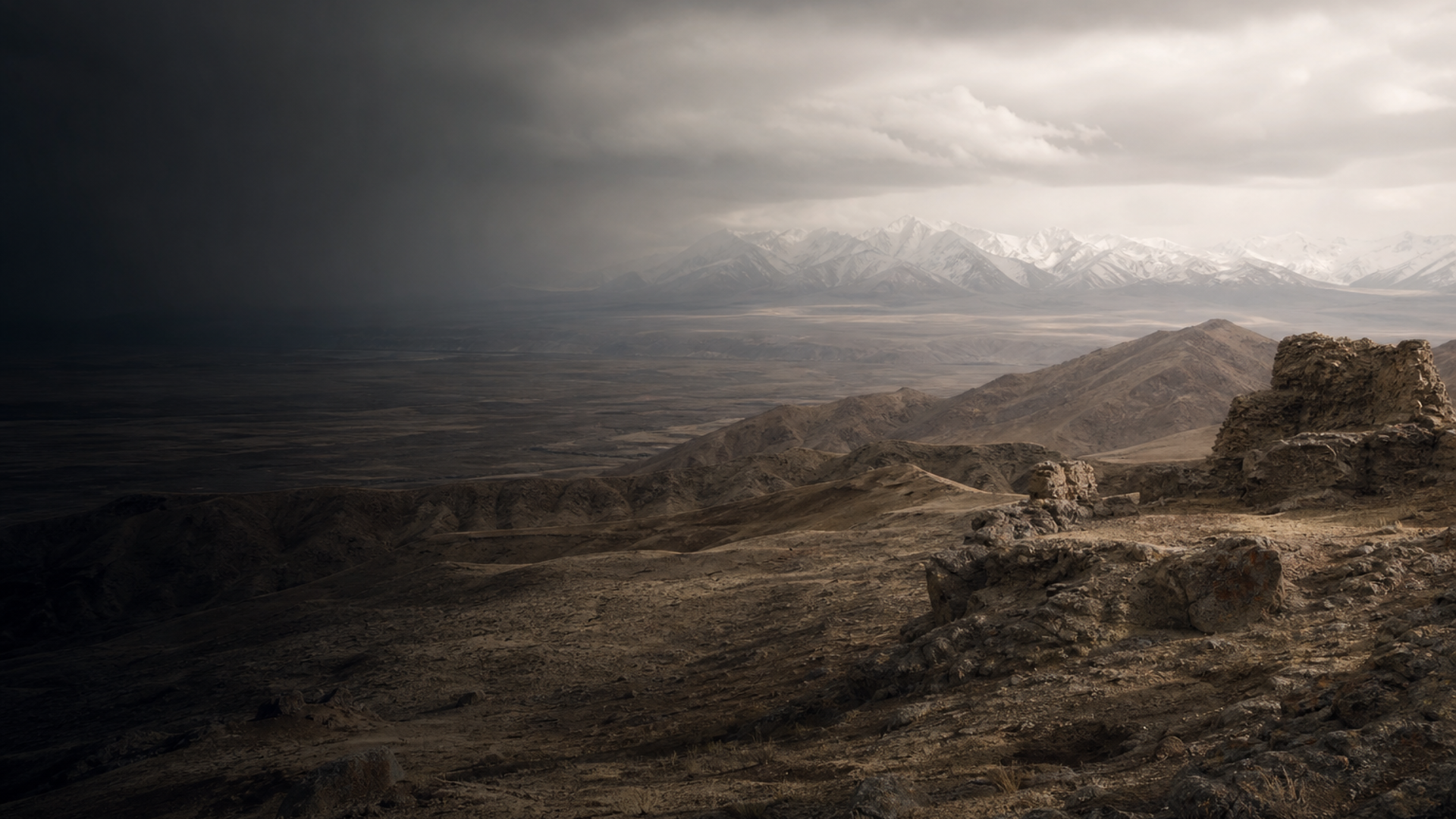
The Kara‑Djigach assemblage sits at an intersection of steppe mobility and Silk Road exchange. Archaeological excavation in the Ysyk‑Ata District (Chüy Region) uncovered a Christian cemetery with burials dated by stratigraphy and associated finds between 1248 and 1379 CE. This places the site squarely in the medieval period when trans‑Eurasian contacts — commercial, religious, and military — intensified.

Limited evidence suggests that Kara‑Djigach was used by a community with Christian funerary practices; the material record is sparse, and the precise denominational identity (for example, local converts, Church of the East/Nestorian networks, or migrant communities) cannot be resolved with current data. The cemetery’s chronology overlaps the centuries of Mongol polities and the mid‑14th century pandemic wave known as the Black Death, factors that reshaped population movement and cultural landscapes across Central Asia.

Archaeologically, the site reflects a region accustomed to cultural layering: material types and burial orientations show both local steppe continuity and external influences arriving via caravan routes. Genetic data from five individuals provide initial clues about ancestry and mobility, but with such a low sample count these patterns remain provisional. Further sampling and direct radiocarbon dating are needed to refine chronological and demographic models.

  • Site: Kara‑Djigach Christian cemetery, Ysyk‑Ata District, Chüy Region
  • Date range: 1248–1379 CE; medieval, pandemic‑era overlap
  • Evidence of mixed local steppe and Silk Road interactions
Capítulo IV

Daily Life & Society

The material traces from Kara‑Djigach suggest lives lived at the margins of great currents. In the medieval Chüy Valley, pastoralism remained a dominant economic strategy; herding cycles, seasonal camps, and control of pastureland shaped social rhythms. Yet the discovery of a Christian cemetery hints at a community with ritual practices that differ from strictly animistic or traditional Turkic funerary customs, implying either conversion, settlement of migrant groups, or integration of diverse belief systems along caravan corridors.

Archaeological indicators — grave goods, burial construction, and the cemetery’s placement in the landscape — point to small, perhaps kin‑based burial groups rather than a large urban population. Caravan traffic along routes linking Kashgar, Samarkand, and the steppe hinterlands could have introduced objects, ideas, and people; traders and clerics often formed transient nodes that left religious and genetic signatures in local cemeteries.

However, the funerary record at Kara‑Djigach is fragmentary. There is no clear economic assemblage that would allow full reconstruction of daily diets, crafts, or household organization. The presence of isolated Christian burials amid a largely pastoral landscape underscores how individual life stories at the edge of empire can preserve traces of wider connectivity — if more excavations and biomolecular analyses are undertaken.

  • Pastoral economy with seasonal mobility likely dominant
  • Christian burials suggest migrant, converted, or cosmopolitan community influences
Capítulo V

Genetic Profile

Ancient DNA (aDNA) from five individuals at Kara‑Djigach provides a slender but valuable genetic window. Results show a single observed Y‑chromosome haplogroup Q (1/5), and mitochondrial haplogroups HV, T, and B each present in individual samples. These markers paint a picture of mixed Eurasian ancestry: HV and T are typically associated with West Eurasian and Near Eastern maternal lineages, while B is more frequent in East Asian and Siberian maternal pools. Haplogroup Q on the paternal side has deep roots in Central Eurasia and Siberia and is also a lineage known from wider steppe and northern Asian contexts.

Because only five genomes were analyzed, any population‑level inference must be cautious. Low sample counts (<10) make statistical statements about frequency and population structure preliminary; stochastic sampling can overrepresent rare lineages. Nevertheless, the co‑occurrence of West and East Eurasian maternal lineages alongside a Q paternal signal is consistent with historical models of Central Asia as a contact zone where Turkic, Mongolic, Iranian, and local steppe groups mixed over centuries.

Genetic signals here may reflect recent mobility (medieval migrations, trade, or marital networks) or deeper multilayered ancestry resulting from millennia of steppe dynamics. Future wider sampling across cemeteries in Chüy and comparative analyses with contemporaneous Silk Road sites will clarify whether Kara‑Djigach reflects a localized blend or a broader regional pattern.

  • Y‑DNA: Q observed in 1 of 5 individuals (preliminary)
  • mtDNA: HV, T, B detected — suggesting both West and East Eurasian maternal inputs
Capítulo VI

Legacy & Modern Connections

The Kara‑Djigach burials offer a humanizing counterpoint to empire narratives: they show how small communities embodied broad genetic and cultural exchanges. Modern populations of Kyrgyzstan carry signatures of steppe movements, Silk Road exchanges, and later historical processes; the mixed maternal and paternal markers at Kara‑Djigach echo that long history of admixture. However, any direct line from these five medieval individuals to present‑day groups is tentative without larger comparative datasets.

Culturally, the presence of Christian burials in a predominantly Turkic landscape hints at religious diversity in medieval Central Asia and the permeability of cultural boundaries. Genetically, the mixture of HV/T and B maternal lineages alongside a Q paternal lineage reinforces the image of the Chüy corridor as a meeting place between West and East Eurasia.

In sum, Kara‑Djigach is a preliminary but evocative snapshot: it reminds us that the human past in Kyrgyzstan was dynamic, networked, and often unpredictable. Further archaeological excavation and expanded aDNA sampling will be needed to trace how these medieval threads tie into the tapestry of modern Central Asian ancestry.

  • Reflects long‑term Eurasian admixture seen in modern Central Asia
  • Suggests medieval religious and cultural diversity in the Chüy Valley
Con IA

Asistente de IA

Haz preguntas sobre la cultura Kara-Djigach: Black Death–Era Kyrgyz DNA

Asistente de IA por DNAGENICS

Desbloquear esta función
Pregunta sobre la cultura Kara-Djigach: Black Death–Era Kyrgyz DNA. El asistente con IA puede explicar hallazgos genéticos, contexto histórico, pruebas arqueológicas y conexiones modernas, con sus límites de interpretación.
Ejemplo de análisis con IA

La cultura Kara-Djigach: Black Death–Era Kyrgyz DNA representa un capítulo de la historia humana...

El análisis genético permite estudiar similitudes con poblaciones anteriores y posibles adaptaciones. Las muestras de ADN antiguo aportan información para investigar patrones migratorios y relaciones entre poblaciones, con límites que dependen del estudio y del contexto arqueológico.

Esta es una vista previa del análisis con IA. Accede al asistente completo para explorar información sobre:

  • Composición y similitud genética
  • Patrones migratorios y orígenes
  • Vida cotidiana y prácticas culturales
  • Contexto genético moderno

Explora más culturas antiguas

Descubre la historia de civilizaciones de distintas partes del mundo antiguo