Preparando el informe

Cargando la información y las referencias disponibles

Consultando el registro arqueológico...

Recopilando registros antiguos

Saltar al contenido principal
La Clape: Caves of Late Neolithic to Bronze Ages
Cultura destacada

La Clape: Caves of Late Neolithic to Bronze Ages

A coastal ensemble of burials and bones linking Neolithic farmers and Bronze Age shifts

3495 CE - 1547 BCE
La Clape, Aude, southern France
Desplázate para empezar
Capítulo I

La historia

Comprender la cultura La Clape: Caves of Late Neolithic to Bronze Ages

Archaeological finds from La Clape (Grotte Basse de la Vigne Perdue; Grotte du Rouquet), dated 3495–1547 BCE, reveal changing lifeways on the Aude coast. Limited genetic data (9 samples) show a mix of local maternal lineages and male lines reflecting both Mesolithic/Neolithic roots and Bronze Age influxes.

Time Period

3495–1547 BCE

Region

La Clape, Aude, southern France

Common Y-DNA

I (4), R (1)

Common mtDNA

J (2), U (2), T (1), H (1), V (1)

Capítulo II

Cronología

Momentos clave de la historia de esta cultura

2500 BCE

Late Neolithic–Early Bronze transitions visible at La Clape

Archaeological and genetic signals indicate increasing external influences and changing mortuary practices around 2500 BCE in the La Clape caves.

Capítulo III

Origins & Emergence

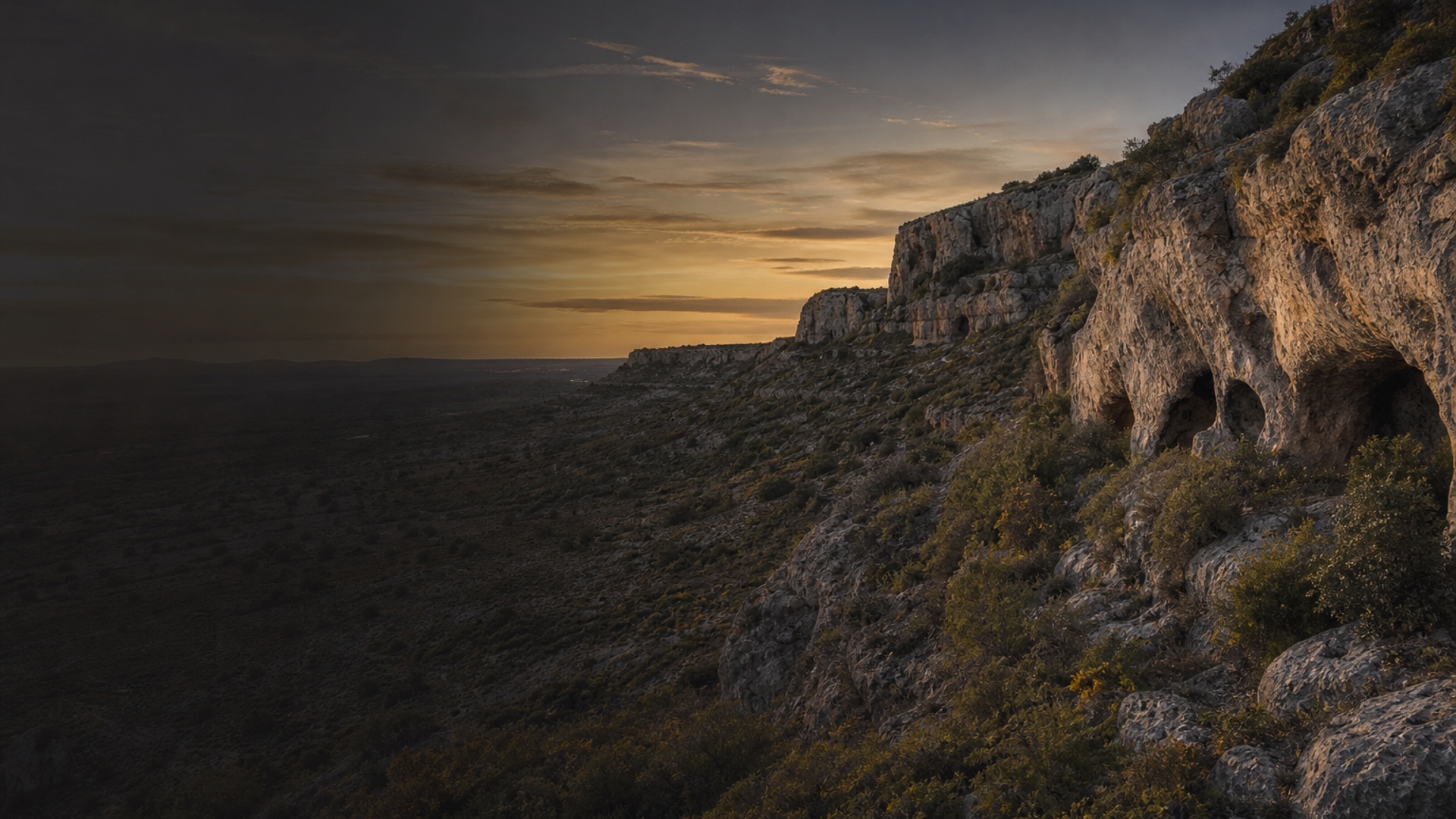
The La Clape assemblage sits on a limestone promontory on the Mediterranean coast near present-day Narbonne. Archaeological contexts — notably the Grotte Basse de la Vigne Perdue and the Grotte du Rouquet — preserve human remains and occasional artefacts spanning the Late Neolithic into the Early–Middle Bronze Age (radiocarbon dates cluster between ca. 3495 and 1547 BCE). These cave deposits likely represent episodic use for burials and secondary interment rather than continuous occupation, a pattern seen at other coastal cave sites in southern France.

Material culture from the region suggests a long-standing tradition of farming, herding and coastal resource use that experienced new influences during the third and second millennia BCE. Limited evidence indicates changes in mortuary practice and in the composition of grave goods that may track shifting social networks and mobility along the western Mediterranean. Archaeological data indicates contact with inland lowland groups and maritime connections that could have carried new ideas, goods, and people into La Clape.

Genetic evidence from nine individuals provides a focused, if small, snapshot: patterns are compatible with local Neolithic ancestry augmented by later incoming lineages. Because sample numbers are low and contexts mixed, any reconstruction of population origins remains preliminary and should be treated cautiously.

  • La Clape caves used episodically for burial between 3495–1547 BCE
  • Archaeology indicates farming, herding and coastal resource use
  • Limited dataset points to local continuity with later external inputs
Capítulo IV

Daily Life & Society

Daily life around La Clape would have been shaped by a rugged coastal landscape: terraced fields and pastures on limestone slopes, vineyards or cereals on pocket soils, and a daily pull toward the sea for fish, shellfish and salt. Archaeological traces in the broader Aude region record a mixed agro-pastoral economy in which households combined crop cultivation, caprine and ovine herding, and exploitation of marine resources. Tools made of flint and local stone, and pottery with regional styles, speak to familiar crafts and household routines.

Caves like Grotte Basse de la Vigne Perdue and Grotte du Rouquet appear primarily in ritual and funerary roles. The cinematic contrast of a small coastal community bringing its dead into the cool dark of rock shelters evokes tightly knit kin networks and place-based memory. Burial arrangements and sparse grave goods suggest communities organized around extended family groups rather than large hierarchical polities, although the arrival of new artifacts in later centuries hints at growing interregional exchange. Mortuary deposition in caves also suggests beliefs that tied dead and landscape together—an enduring cultural choreography between people and shore.

  • Mixed farming, herding and marine resource use dominated subsistence
  • Caves used mainly for burial, implying strong local kin networks
Capítulo V

Genetic Profile

Ancient DNA from nine individuals recovered at La Clape offers a tentative genetic portrait of coastal southern France across nearly two millennia. Y-chromosome calls show a predominance of haplogroup I (4 individuals), with a single individual assigned to haplogroup R. Mitochondrial diversity includes J (2), U (2), T (1), H (1) and V (1). These maternal and paternal markers are consistent with broader regional trends: mtDNA lineages such as J and T are often associated with Neolithic farmer ancestries, while U and V can reflect older hunter‑gatherer contributions. Y haplogroup I is frequently found among long-standing European lineages deriving from Mesolithic and Neolithic male ancestry; the presence of R may indicate a Bronze Age influx of steppe-derived paternal ancestry, though the dataset is small.

Autosomal patterns (where recoverable) likely reflect a tri-partite mix typical of later prehistoric Europe: substantial Anatolian farmer ancestry, persistent Western hunter‑gatherer ancestry, and increasing Steppe-related ancestry entering in the third and second millennia BCE. Given the modest sample size (n=9) and temporal span from 3495 to 1547 BCE, any inference about the tempo of admixture or social patterning (e.g., sex-biased migration) is preliminary. Future sampling from stratified contexts would clarify whether changes in haplogroup frequencies reflect demographic replacement, elite mobility, or local adoption of new lineages through marriage networks.

  • Y-DNA: I predominant; R present — suggests local continuity with some Bronze Age input
  • mtDNA: mix of farmer-associated and hunter-gatherer-associated lineages; conclusions are tentative (n=9)
Capítulo VI

Legacy & Modern Connections

The genetic echoes of La Clape are subtle threads in the tapestry of modern southern France. Haplogroups observed at the site—both paternal I and the occasional R, and a variety of maternal lineages—mirror components that survive, in different proportions, among later medieval and contemporary populations of the region. Archaeologically, the use of coastal caves for burial forms part of a long regional repertoire that contributes to local identity and landscape memory.

Caution is essential: with only nine dated samples, we cannot claim direct ancestry links between any single ancient individual and living people. Instead, La Clape illuminates processes—local persistence of Neolithic-derived communities, episodic arrival of new lineages, and long-term coastal lifeways—that helped shape the genetic and cultural background of Mediterranean France. As more DNA and stratified archaeological data accumulate, La Clape will help refine how mobility, marriage, and trade knit the ancient Mediterranean into the peoples who followed.

  • Genetic components at La Clape contribute to the deep ancestral layers of southern France
  • Small sample size limits direct lineage-to-modern claims; patterns highlight continuity and contact
Con IA

Asistente de IA

Haz preguntas sobre la cultura La Clape: Caves of Late Neolithic to Bronze Ages

Asistente de IA por DNAGENICS

Desbloquear esta función
Pregunta sobre la cultura La Clape: Caves of Late Neolithic to Bronze Ages. El asistente con IA puede explicar hallazgos genéticos, contexto histórico, pruebas arqueológicas y conexiones modernas, con sus límites de interpretación.
Ejemplo de análisis con IA

La cultura La Clape: Caves of Late Neolithic to Bronze Ages representa un capítulo de la historia humana...

El análisis genético permite estudiar similitudes con poblaciones anteriores y posibles adaptaciones. Las muestras de ADN antiguo aportan información para investigar patrones migratorios y relaciones entre poblaciones, con límites que dependen del estudio y del contexto arqueológico.

Esta es una vista previa del análisis con IA. Accede al asistente completo para explorar información sobre:

  • Composición y similitud genética
  • Patrones migratorios y orígenes
  • Vida cotidiana y prácticas culturales
  • Contexto genético moderno

Explora más culturas antiguas

Descubre la historia de civilizaciones de distintas partes del mundo antiguo