Preparando el informe

Cargando la información y las referencias disponibles

Consultando el registro arqueológico...

Recopilando registros antiguos

Saltar al contenido principal
Limão Sambaqui: Shells, Shores, and Stories
Cultura destacada

Limão Sambaqui: Shells, Shores, and Stories

Ancient coastal lifeways on Brazil's southeast shore revealed through archaeology and DNA

850 BCE - 1650 CE
Southeast Coast, Brazil (Sambaqui do Limão)
Desplázate para empezar
Capítulo I

La historia

Comprender la cultura Limão Sambaqui: Shells, Shores, and Stories

Archaeological and genetic evidence from Sambaqui do Limão (Southeast Brazil) traces coastal forager-fisher communities between 850 BCE and 1650 CE. Four ancient genomes show Indigenous Y and mtDNA lineages, offering preliminary glimpses of population continuity and maritime lifeways.

Time Period

850 BCE – 1650 CE

Region

Southeast Coast, Brazil (Sambaqui do Limão)

Common Y-DNA

Q

Common mtDNA

A, D, C1b

Capítulo II

Cronología

Momentos clave de la historia de esta cultura

850 BCE

Emergence of Limão Sambaqui

Initial mound-building and sustained coastal occupation at Sambaqui do Limão begins, according to radiocarbon dates and stratified deposits.

Capítulo III

Origins & Emergence

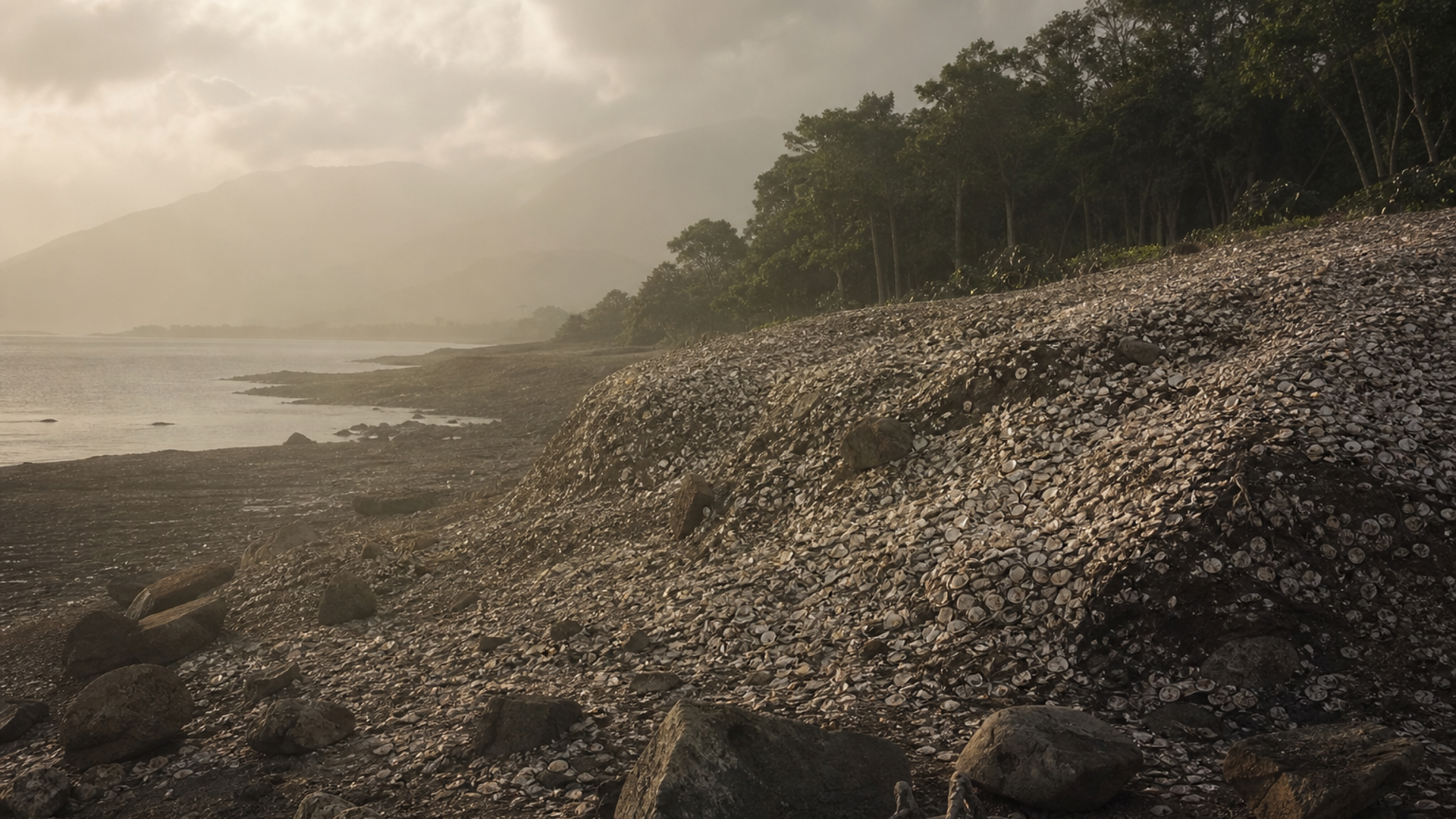
The sambaqui mounds that frame the landscape of Sambaqui do Limão are both monument and archive. Built from successive layers of shell, bone and refuse, these middens record centuries of coastal life. Radiocarbon dates associated with deposits at Limão indicate human activity spanning roughly 850 BCE to 1650 CE, situating this local expression within the long-lived Sambaqui cultural phenomenon of Brazil's Atlantic coast.

Archaeological data indicates a sequence of episodic mound construction, intensive shellfish harvesting, and periodic burial practices. Material culture—stone tools, fishhooks, and ornamented shells—speaks to specialized maritime adaptation. Limited evidence suggests changes over time in resource emphasis and mound architecture, possibly reflecting shifts in population density, social organization, or environmental conditions.

Genetic data from four sampled individuals provides a tentative anchor for these archaeological patterns. While the small sample size is insufficient to map full demographic trajectories, the presence of Indigenous genetic markers (see Genetics section) supports continuity of local coastal lineages through much of the pre-contact and contact periods. Together, mound stratigraphy and aDNA begin to illuminate how people built, inhabited, and remembered this shoreline for more than a millennium.

  • Sambaqui do Limão: layered shell mounds and habitation deposits
  • Radiocarbon span: ~850 BCE to 1650 CE
  • Mounds record long-term coastal occupation and periodic burial
Capítulo IV

Daily Life & Society

Life at Limão unfolded to the rhythm of tides and seasons. Archaeological remains show intensive shellfish collection, fish processing, and exploitation of coastal fauna and plants. Excavation layers reveal hearths, concentrations of fishbone and shell, and tool assemblages specialized for netting, hooking and processing marine resources. Ornamentation—perforated shells and personal adornments—suggests networks of exchange and identity.

Burial evidence within some sambaquis points to ritualized treatment of the dead integrated into everyday refuse mounds, transforming midden into memory. Spatial patterns in the deposits suggest places for working, feasting and interment rather than dense, long-term architectural settlements; however, repeated mound maintenance implies a degree of territorial attachment and social continuity.

Environmental reconstructions indicate that shifting shorelines and resource availability likely influenced mobility and subsistence choices. Archaeological data indicates that Limão inhabitants combined mobility with place-based reuse of rich coastal foraging grounds, creating monumental middens that are both household debris and community statement.

  • Maritime-focused subsistence: shellfish, fish, coastal fauna
  • Middens served as living spaces, production zones, and cemeteries
Capítulo V

Genetic Profile

Ancient DNA from four individuals recovered at Sambaqui do Limão yields a concise but meaningful genetic portrait. All identified uniparental markers belong to lineages widely observed among Indigenous peoples of the Americas: one Y-DNA Q paternal lineage and maternal haplogroups A (two individuals), D (one), and C1b (one). These haplogroups are consistent with founding Native American ancestries and with other ancient and modern populations in coastal and inland South America.

Because the dataset includes only four samples, conclusions must remain provisional. Limited evidence suggests genetic continuity of Indigenous lineages in this coastal community over centuries, aligning with archaeological signals of long-term occupation. The dominance of mtDNA A and presence of C1b and D reflect maternal diversity typical of regional pre-contact populations.

Genome-wide analyses would be necessary to test for finer-scale patterns—such as gene flow between sambaqui communities, affinities with inland groups, or demographic impacts from European contact late in the chronology. For now, the uniparental markers corroborate archaeological interpretations of a persistent, locally rooted Indigenous presence along the Limão shore.

  • Uniparental markers: Y Q; mtDNA A, D, C1b
  • Sample size (n=4) is small—interpretations are preliminary
Capítulo VI

Legacy & Modern Connections

The shell mounds of Limão remain visible palimpsests on the landscape—silent witnesses to coastal economies, social life, and ancestral ties. Archaeological layers paired with genetic signals highlight continuity of Indigenous presence along Brazil's southeast shore into the era of European contact, though the scale and timing of later demographic changes remain uncertain.

For descendant communities and researchers, the Limão data offers a vital, if preliminary, link between material culture and biological ancestry. It underscores how archaeological context enriches genetic findings: shells, tools, and stratigraphy provide the life-history that aDNA alone cannot. Future, larger-scale aDNA studies and respectful collaboration with contemporary Indigenous peoples can refine how the stories encoded in the mounds connect to living heritage today.

  • Middens as cultural and genealogical archives
  • Further aDNA sampling and community engagement needed for fuller stories
Con IA

Asistente de IA

Haz preguntas sobre la cultura Limão Sambaqui: Shells, Shores, and Stories

Asistente de IA por DNAGENICS

Desbloquear esta función
Pregunta sobre la cultura Limão Sambaqui: Shells, Shores, and Stories. El asistente con IA puede explicar hallazgos genéticos, contexto histórico, pruebas arqueológicas y conexiones modernas, con sus límites de interpretación.
Ejemplo de análisis con IA

La cultura Limão Sambaqui: Shells, Shores, and Stories representa un capítulo de la historia humana...

El análisis genético permite estudiar similitudes con poblaciones anteriores y posibles adaptaciones. Las muestras de ADN antiguo aportan información para investigar patrones migratorios y relaciones entre poblaciones, con límites que dependen del estudio y del contexto arqueológico.

Esta es una vista previa del análisis con IA. Accede al asistente completo para explorar información sobre:

  • Composición y similitud genética
  • Patrones migratorios y orígenes
  • Vida cotidiana y prácticas culturales
  • Contexto genético moderno

Explora más culturas antiguas

Descubre la historia de civilizaciones de distintas partes del mundo antiguo