Preparando el informe

Cargando la información y las referencias disponibles

Consultando el registro arqueológico...

Recopilando registros antiguos

Saltar al contenido principal
Nagabaka: Echoes of Historic Japan
Cultura destacada

Nagabaka: Echoes of Historic Japan

Four samples from Nagabaka, Japan (900 BCE–1950 CE) linking archaeology and DNA in a long human story

900 BCE - 1950 CE
Nagabaka, Japan
Desplázate para empezar
Capítulo I

La historia

Comprender la cultura Nagabaka: Echoes of Historic Japan

Nagabaka preserves a deep palimpsest of life in Japan. Four sampled individuals dated 900 BCE–1950 CE provide a tentative bridge between archaeological contexts and genetic patterns known across prehistoric and historic Japan. Conclusions remain preliminary.

Time Period

900 BCE – 1950 CE

Region

Nagabaka, Japan

Common Y-DNA

Not reported (4 samples)

Common mtDNA

Not reported (4 samples)

Capítulo II

Cronología

Momentos clave de la historia de esta cultura

900 BCE

Earliest sampled context at Nagabaka

A burial context dated to ca. 900 BCE provides the oldest genetic snapshot from the site, potentially reflecting late-Yayoi-era transformations.

Capítulo III

Origins & Emergence

The stones and soil of Nagabaka hold layered human histories. Archaeological contexts dated between 900 BCE and the modern era indicate occupation and reuse of mortuary and settlement spaces across centuries. Limited evidence suggests some contexts align with the later phases of the Yayoi period (broadly ca. 900 BCE–250 CE), a transformative era marked by wet-rice agriculture and new material cultures arriving from the continent. Over subsequent centuries—Kofun, Nara, Heian and later—Nagabaka appears in the archaeological record as a locus where local traditions and imported practices interwove.

Excavations at Nagabaka have revealed burial features and associated artifacts that provide stratigraphic anchors for the four sampled individuals. Archaeological data indicates temporal heterogeneity among those samples: a sample dated to the early first millennium BCE contrasts with others from later historic contexts into the 19th and 20th centuries. Such temporal breadth creates a cinematic portrait of continuity and change: ritual deposits and household debris, pottery forms shifting, and landscape use evolving with social complexity.

Because only four individuals have been genetically sampled, origins inferred from DNA must be treated cautiously. Nevertheless, the archaeological record of Nagabaka situates these individuals within a long-term trajectory of regional interaction, demographic shifts, and cultural transformation across millennia.

  • Site: Nagabaka, Japan; contexts dated 900 BCE–1950 CE
  • Material culture aligns with late Yayoi through historic Japanese periods
  • Only 4 genetic samples: archaeological context crucial for interpretation
Capítulo IV

Daily Life & Society

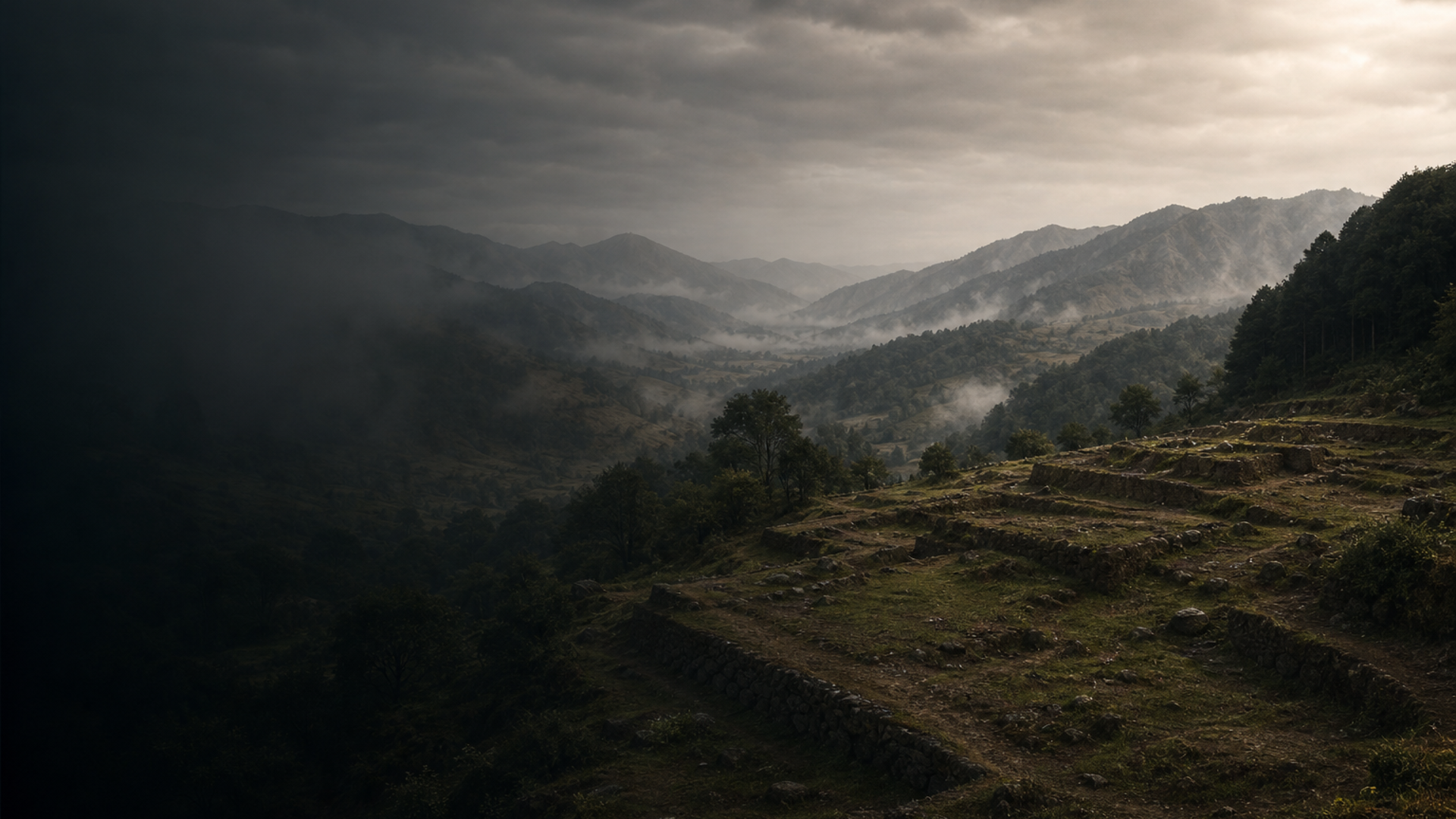
Archaeology at Nagabaka offers glimpses of everyday rhythms—fields cut into hillsides, hearths and postholes, and grave goods that speak of social roles and craft. In the earlier layers, the arrival of wet-rice farming in the region reshaped settlements: larger, more permanent villages; storage pits; and pottery styles adapted for cooking and storage. By the Kofun and later historic periods, the landscape bears traces of growing social stratification, with some burials showing more elaborate treatment than others.

Archaeological data indicates shifts in diet, technology, and mobility. Botanical remains and faunal assemblages imply intensified agriculture and animal husbandry; metal objects and imported goods point to long-distance exchange. Everyday objects—ceramics, lacquer fragments, tools—give texture to lives otherwise invisible in the soil. For the modern-period samples, cemetery organization and grave markers reflect institutional practices of the Edo and Meiji eras, when written records begin to complement the material record.

These material traces combine with DNA to form a richer story: genes can hint at ancestry and mobility, while artifacts reveal cultural choices, economy, and belief. At Nagabaka, the interplay of material culture and genetic data is especially evocative because it spans both prehistoric transformations and historic social worlds.

  • Evidence for agriculture and village life in early contexts
  • Later burials reflect social differentiation and historic-period mortuary norms
Capítulo V

Genetic Profile

The genetic dataset from Nagabaka is small—four individuals dated between 900 BCE and 1950 CE—so any genomic narrative must be cautious. No common Y-DNA or mtDNA haplogroups were reported in the supplied metadata, and archaeological context therefore guides interpretation. Broadly, published ancient DNA research across the Japanese archipelago identifies a mixture of local Jomon ancestry (deep Paleolithic hunter-gatherer lineages) and continental East Asian ancestry associated with the spread of Yayoi agriculture. Modern Japanese populations exhibit varying proportions of these components, with regional differences.

For Nagabaka, the available genetic samples can be seen as provisional snapshots: an early sample near 900 BCE may capture increased continental influence associated with Yayoi movements, while later historic-period samples likely reflect centuries of admixture, social mobility, and localized demographic events. If additional sequencing data were available, researchers would test affinities to Jomon reference genomes, Northeast Asian agriculturalist groups, and comparative modern Japanese populations. Given the low sample count (<10), patterns observable at Nagabaka are preliminary—informative as case studies but insufficient to generalize across Japan without more data.

Future work that increases sample numbers, integrates isotopic mobility studies, and compares Nagabaka genomes to broader regional datasets will clarify whether the site preserves unique local continuity or conforms to island-wide demographic trends.

  • Only 4 DNA samples: conclusions preliminary and tentative
  • No Y or mt haplogroups reported in metadata; comparisons rely on broader Japanese aDNA models
Capítulo VI

Legacy & Modern Connections

Nagabaka's layered record creates an evocative bridge from ancient lifeways to the present. Archaeological deposits and the handful of genetic samples together suggest continuity of place: fields tilled, houses rebuilt, and cemeteries reused across centuries. For descendants and scholars alike, Nagabaka exemplifies how local sequences of settlement, migration, and cultural change contribute to the genetic and cultural mosaic of modern Japan.

Archaeological data indicates that modern inhabitants inherit landscape modifications and material traditions rooted in deep time. Genetically, while the small sample set cannot define modern ancestry, it gestures toward the kinds of population processes—migration, admixture, persistence—that shaped the archipelago. As more ancient genomes are analyzed and integrated with the archaeological record, places like Nagabaka will sharpen our understanding of how identity, movement, and continuity unfolded across the islands.

  • Nagabaka exemplifies long-term landscape use and cultural continuity
  • Genetic insights remain tentative but point toward typical Jomon–Yayoi–historic admixture dynamics
Con IA

Asistente de IA

Haz preguntas sobre la cultura Nagabaka: Echoes of Historic Japan

Asistente de IA por DNAGENICS

Desbloquear esta función
Pregunta sobre la cultura Nagabaka: Echoes of Historic Japan. El asistente con IA puede explicar hallazgos genéticos, contexto histórico, pruebas arqueológicas y conexiones modernas, con sus límites de interpretación.
Ejemplo de análisis con IA

La cultura Nagabaka: Echoes of Historic Japan representa un capítulo de la historia humana...

El análisis genético permite estudiar similitudes con poblaciones anteriores y posibles adaptaciones. Las muestras de ADN antiguo aportan información para investigar patrones migratorios y relaciones entre poblaciones, con límites que dependen del estudio y del contexto arqueológico.

Esta es una vista previa del análisis con IA. Accede al asistente completo para explorar información sobre:

  • Composición y similitud genética
  • Patrones migratorios y orígenes
  • Vida cotidiana y prácticas culturales
  • Contexto genético moderno

Explora más culturas antiguas

Descubre la historia de civilizaciones de distintas partes del mundo antiguo