Preparando el informe

Cargando la información y las referencias disponibles

Consultando el registro arqueológico...

Recopilando registros antiguos

Saltar al contenido principal
Punic Sardinia: Voices from Monte Sirai
Cultura destacada

Punic Sardinia: Voices from Monte Sirai

Echoes of Phoenician and indigenous life on Sardinia (800–208 BCE) revealed by archaeology and DNA

800 CE - 208 BCE
Sardinia, Italy
Desplázate para empezar
Capítulo I

La historia

Comprender la cultura Punic Sardinia: Voices from Monte Sirai

Archaeological remains from Monte Sirai, S'Orcu 'e Tueri and Villamar (800–208 BCE) reveal Punic-era communities on Sardinia. Four ancient genomes show a mix of local and Mediterranean lineages; small sample size means conclusions are preliminary but suggest close contact between Phoenician networks and island populations.

Time Period

800–208 BCE

Region

Sardinia, Italy

Common Y-DNA

G, I

Common mtDNA

H, J, HV, I

Capítulo II

Cronología

Momentos clave de la historia de esta cultura

800 BCE

Early Phoenician contacts

Phoenician mariners establish coastal trading nodes; archaeological activity at Monte Sirai begins in the early Iron Age.

238 BCE

Roman takeover of Sardinia

Following the First Punic War, Rome begins control of Sardinia, altering political and economic ties across the island.

208 BCE

Second Punic War context

Late Iron Age upheavals during the Second Punic War mark the final years encompassed by these samples.

Capítulo III

Origins & Emergence

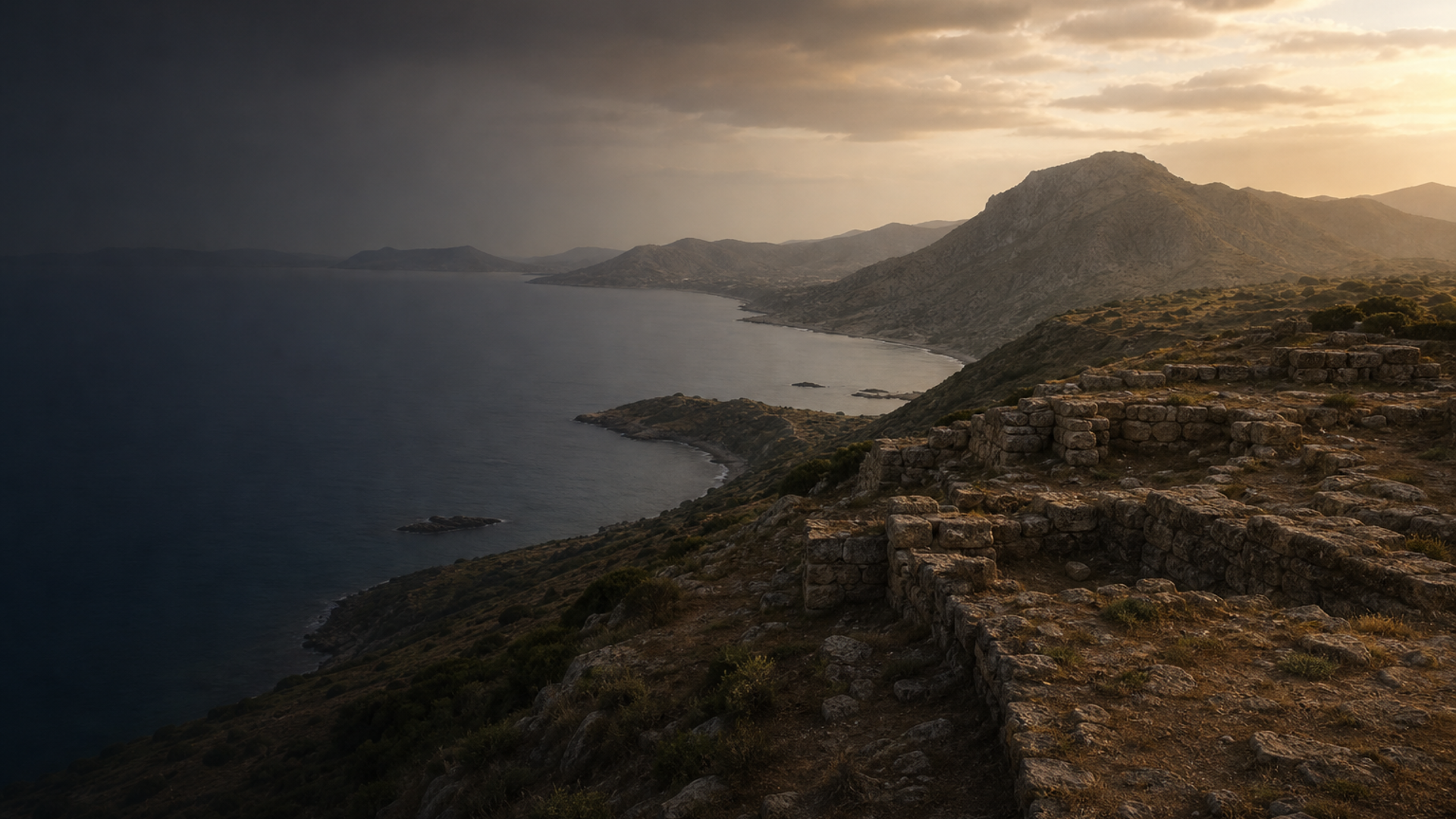
Along Sardinia's western and central coasts, the Iron Age landscape became a stage of encounters. From ca. 800 BCE onward, Phoenician mariners established trading enclaves and urbanizing settlements; Monte Sirai (near Carbonia) is among the best-known of these, with fortifications, houses and cemeteries that archaeologists link to Phoenician–Punic occupations. Archaeological data indicates that these coastal nodes did not simply replace indigenous communities: instead, a mosaic of interactions unfolded between Nuragic populations inland and maritime networks bringing goods, ideas and people.

At S'Orcu 'e Tueri (Perdasdefogu) and burial contexts near Villamar, material culture shows varying mixes of local Sardinian traditions and imported Mediterranean forms. This pattern is consistent with a model of selective adoption and exchange rather than wholesale colonization. Limited evidence suggests that coastal settlements served as hubs for trade in metals, salt and agricultural produce, and that social landscapes shifted as Carthaginian power expanded in the central Mediterranean during the 6th–3rd centuries BCE.

While pottery styles, architectural remains and burial practices provide a vivid archaeological record, they cannot alone resolve the biological origins of inhabitants. Ancient DNA from four individuals offers a first, cautious glimpse into the human stories threaded through these materials—stories that require careful integration of archaeology, isotope chemistry and genetics to read fully.

  • Phoenician–Punic coastal settlements (ca. 8th–3rd c. BCE) interact with inland Nuragic communities
  • Monte Sirai is a principal archaeological locus for Punic Sardinia
  • Material culture reflects exchange, selective adoption, and long-distance trade
Capítulo IV

Daily Life & Society

Imagine a harbor dawn with amphorae stacked on quays, craftsmen at the hearth, and ritual lights in family tombs. Archaeological remains from Monte Sirai and nearby cemeteries suggest a life shaped by maritime trade, agriculture and craft specialization. Artisans worked metal and ceramics; imported wares—Phoenician fineware, oil and wine amphorae—sat alongside locally produced pottery. Funerary contexts vary: some tombs follow island traditions, others reflect Mediterranean mortuary practices, indicating social diversity and possibly different identity claims within the same community.

Evidence from settlement layouts hints at social complexity—compact neighborhoods, defensive walls, and workshops point to organized civic life. Agricultural terraces and pastureland inland connected coastal settlements to Nuragic hinterlands, sustaining a mixed economy of cereals, olives, and livestock. Ritual practice—seen in votive finds and burial assemblages—evokes a cultural atmosphere in which local beliefs and foreign cults could coexist.

Archaeological data indicates that gendered divisions of labor, trade-linked mobility, and intermittent conflict all shaped daily experience. Yet material culture alone cannot reveal personal biographies; genetic and isotopic data add human dimensions, clarifying mobility patterns, kinship and the ways people moved between sea and land.

  • Mixed economy: maritime trade, agriculture and specialized crafts
  • Funerary diversity suggests coexistence of local and Mediterranean practices
Capítulo V

Genetic Profile

Four ancient genomes from Sardinian sites dated between 800 and 208 BCE provide a preliminary window into the biological makeup of individuals living in Punic-era contexts. Y-chromosome haplogroups observed include G (1 sample) and I (1 sample); mitochondrial haplogroups include H, J, HV and I (one each). These lineages are not unexpected in the central Mediterranean: haplogroup I and mtDNA H are common in long-standing European populations, while Y-haplogroup G and mtDNA J/HV can reflect earlier Neolithic expansions and Mediterranean connectivity.

Interpreting these signals requires caution. With only four samples, statistical power is low and the dataset may not capture community-wide diversity. Nevertheless, the mix of paternal and maternal lineages is compatible with archaeological models of interaction: some ancestry components appear local (consistent with long-term Sardinian lineages), while others are plausibly tied to broader Mediterranean networks that included Near Eastern and North African connections through Phoenician and Carthaginian routes.

Genetic evidence alone cannot specify cultural identity; instead it informs questions of mobility, sex-biased gene flow, and contact. For example, a spread of certain Y-lineages might reflect male-mediated migration or the presence of seafaring merchants, while diverse mtDNA points to female lineage heterogeneity. Future sampling across more burials and isotopic work on diet and mobility will be essential to refine these tentative readings. Because the sample count is below ten, all conclusions are preliminary and should be treated as hypotheses to be tested by larger datasets.

  • Small sample (n=4): results are preliminary and low-power
  • Observed mix of local European and broader Mediterranean lineages suggests contact and mobility
Capítulo VI

Legacy & Modern Connections

The Punic-era communities of Sardinia left durable imprints on the island's archaeology, place-names and multicultural heritage. Monte Sirai's ruins and cemetery records evoke a period when sailors, traders and local families shaped hybrid lifeways. Genetically, modern Sardinians carry distinctive profiles shaped by deep Neolithic ancestry and later contacts; the four ancient samples hint that Punic-period connections contributed threads to this tapestry but do not alone define modern genetics.

Archaeological continuity in settlement patterns and craft traditions suggests cultural resonances that survive in local topography and material memory. Yet biological continuity is complex: centuries of mobility, Roman integration after 238 BCE, and later historical movements have layered additional ancestry onto earlier foundations. Integrating more ancient genomes from coastal and inland Sardinia, alongside isotopes and archaeology, will better clarify the extent to which Punic-era gene flow shaped present-day Sardinians. For now, these remains offer evocative glimpses of lives lived at the crossroads of sea and island, where identities were negotiated through trade, kinship and daily practice.

  • Punic-period contact contributed to Sardinia's multicultural archaeological record
  • Modern genetic continuity is complex; these four samples suggest contribution but are not definitive
Con IA

Asistente de IA

Haz preguntas sobre la cultura Punic Sardinia: Voices from Monte Sirai

Asistente de IA por DNAGENICS

Desbloquear esta función
Pregunta sobre la cultura Punic Sardinia: Voices from Monte Sirai. El asistente con IA puede explicar hallazgos genéticos, contexto histórico, pruebas arqueológicas y conexiones modernas, con sus límites de interpretación.
Ejemplo de análisis con IA

La cultura Punic Sardinia: Voices from Monte Sirai representa un capítulo de la historia humana...

El análisis genético permite estudiar similitudes con poblaciones anteriores y posibles adaptaciones. Las muestras de ADN antiguo aportan información para investigar patrones migratorios y relaciones entre poblaciones, con límites que dependen del estudio y del contexto arqueológico.

Esta es una vista previa del análisis con IA. Accede al asistente completo para explorar información sobre:

  • Composición y similitud genética
  • Patrones migratorios y orígenes
  • Vida cotidiana y prácticas culturales
  • Contexto genético moderno

Explora más culturas antiguas

Descubre la historia de civilizaciones de distintas partes del mundo antiguo