Preparando el informe

Cargando la información y las referencias disponibles

Consultando el registro arqueológico...

Recopilando registros antiguos

Saltar al contenido principal
Tiryns: Fortress of the Late Bronze Sea
Cultura destacada

Tiryns: Fortress of the Late Bronze Sea

Palatial citadel in the Argolid whose stones and genes whisper of wide networks

1440 CE - 1229 BCE
Tiryns, Argolid (Greece)
Desplázate para empezar
Capítulo I

La historia

Comprender la cultura Tiryns: Fortress of the Late Bronze Sea

Late Helladic Tiryns (1440–1229 BCE) was a palatial center in the Argolid. Archaeology and three ancient DNA samples suggest local Aegean roots with eastern Mediterranean connections; conclusions remain preliminary due to low sample count.

Time Period

1440–1229 BCE

Region

Tiryns, Argolid (Greece)

Common Y-DNA

J (observed in 2 of 3 samples)

Common mtDNA

V (observed in 1 of 3 samples)

Capítulo II

Cronología

Momentos clave de la historia de esta cultura

1400 BCE

Palatial consolidation at Tiryns

Archaeological phases indicate major construction and palatial activity around 1400 BCE, situating Tiryns within the Late Helladic network of the Argolid.

Capítulo III

Origins & Emergence

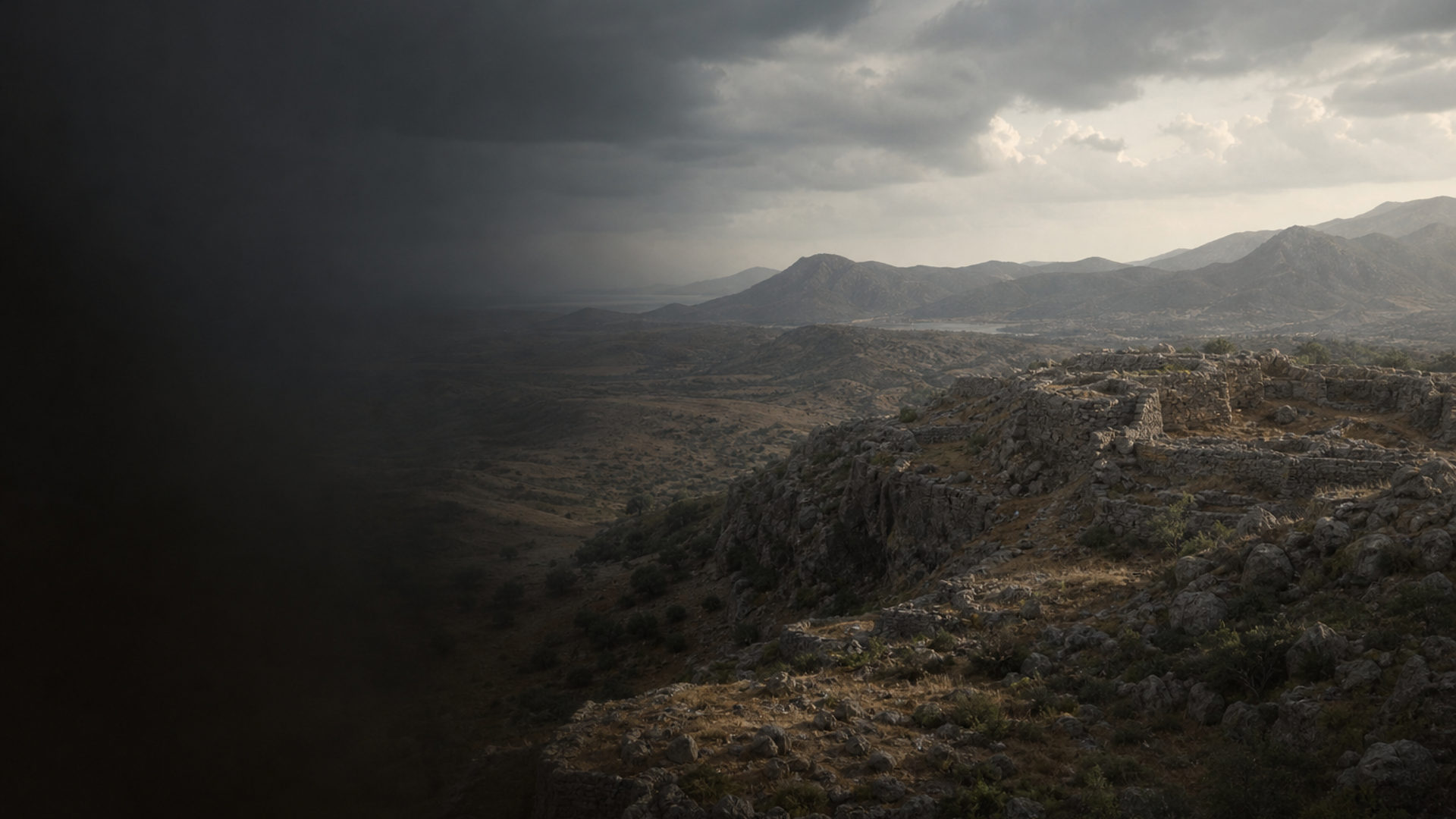
Rising from the limestone terraces of the Argolid, Tiryns shines in the archaeological record as one of the great Late Helladic palaces of mainland Greece. Excavations at Tiryns reveal monumental Cyclopean walls, megaron complexes, and workshops that speak to a site consolidated by the 15th century BCE and active through the 13th century BCE (archaeological phases broadly falling within 1440–1229 BCE). Archaeological data indicates palatial expansion and renewed building activity in the centuries after 1400 BCE, embedding Tiryns within a network of Aegean centers that communicated by sea and overland.

Material culture — fine pottery, decorated fresco fragments, metalwork and imported luxury goods — signals participation in long-distance exchange across the eastern Mediterranean. While architecture and objects map social power on the ground, aDNA offers another lens: the three ancient DNA samples from Tiryns provide a narrow, genetic glimpse into the people who lived, ruled, and worked within the palace domain. Limited evidence suggests genetic ties that reflect both longstanding Aegean ancestry and contacts reaching toward the eastern Mediterranean. Because only three samples are available, interpretations of migration, population replacement, or elite mobility remain tentative and should be treated as hypotheses rather than settled fact.

  • Monumental Cyclopean architecture and palace complexes
  • Active participation in Aegean exchange networks after 1440 BCE
  • Genetic hints of eastern Mediterranean connections — preliminary
Capítulo IV

Daily Life & Society

Tiryns would have been sensory and ceremonial: the clang of metalworkers in workshops, the bustle of port-linked trade, and the ritual pulse of palatial courts. Archaeological layers preserve evidence for craft specialization — bronze working, pottery production, and textile manufacture — often organized under palace oversight. Storerooms and craft zones suggest a redistributive economy in which agricultural produce and manufactured goods were collected, processed, and redistributed by palatial elites.

Society at Tiryns likely combined hereditary elites, specialist craftsmen, agricultural laborers, and seafaring traders. The palace complex, with its megaron and courtyards, staged political power and ritual activity; fresco fragments and luxury imports attest to elite display. While Linear B administrative tablets are best known from nearby palaces (e.g., Pylos, Mycenae), Tiryns sits clearly within that system of palatial administration and inter-palace relations. Archaeological data indicates seasonal rhythms tied to harvests and maritime calendars, and burials in the Argolid preserve traces of family and community ties alongside elite tombs that emphasize status.

Because the human remains sampled for DNA are few (three individuals), reconstructing everyday demography — kinship structures, migration of craft specialists, or the scale of foreign merchant presence — remains provisional.

  • Palatial economy with craft specialization and redistribution
  • Courtly display and integration into Mycenaean administrative networks
Capítulo V

Genetic Profile

The genetic signal from Tiryns is cautious and cinematic: out of three analyzed individuals dating between 1440 and 1229 BCE, two carried Y-chromosome haplogroup J, and one carried mitochondrial haplogroup V. Y-haplogroup J is often associated in the broader region with lineages that were common in the eastern Mediterranean and Anatolia in the later Neolithic and Bronze Age periods; its presence at Tiryns is consistent with long-standing maritime and overland connections across the Aegean and beyond. mtDNA V is less common but appears in parts of Europe and the Mediterranean, which could reflect maternal line continuity or local diversity.

Archaeogenetic studies of the Late Bronze Age Aegean more broadly indicate mixtures of local Neolithic-derived ancestry with additional elements introduced through sustained contacts with neighboring regions to the north and east. However, uniparental markers (Y and mtDNA) capture only narrow slices of ancestry and can be skewed by social practices, elite mobility, or small sample sizes. With just three samples, any inference about population-wide dynamics — migration waves, elite exogamy, or demographic replacement — is highly provisional. Expanded genome-wide sampling from Tiryns and contemporary Aegean sites would be required to robustly model ancestry components, sex-biased mobility, and the relationship between genetic variation and archaeological status.

In summary: the available aDNA hints at eastern Mediterranean connections that resonate with Tiryns’ archaeological signals, but the dataset is too small to draw firm population-level conclusions.

  • Two Y-DNA J haplogroups suggest eastern Mediterranean links
  • One mtDNA V points to maternal lineages seen in broader Europe — conclusions preliminary
Capítulo VI

Legacy & Modern Connections

Tiryns' stone walls and palatial remains have echoed through Greek cultural memory and later classical imagination. Archaeologically, Tiryns anchors our understanding of Mycenaean polities — centers of administrative control, craft production, and maritime commerce. Genetically, the site contributes to a growing, if still fragmentary, portrait of Bronze Age Aegean populations as dynamic communities shaped by local continuity and long-range contact.

Modern genetic landscapes in the Peloponnese and the wider Aegean likely reflect deep-time continuity tempered by later movements, but linking individual modern communities directly to Bronze Age Tiryns requires careful, comparative genomic sampling. The present Tiryns aDNA dataset is a tantalizing first chapter: cinematic hints of sailors, traders, and palace households crossing sea-lanes and forging alliances, yet the full population story will only emerge with broader archaeogenetic sampling and integrated archaeological study.

  • Tiryns shapes our image of Mycenaean palatial life and Aegean exchange
  • Modern genetic links are plausible but require larger comparative datasets
Con IA

Asistente de IA

Haz preguntas sobre la cultura Tiryns: Fortress of the Late Bronze Sea

Asistente de IA por DNAGENICS

Desbloquear esta función
Pregunta sobre la cultura Tiryns: Fortress of the Late Bronze Sea. El asistente con IA puede explicar hallazgos genéticos, contexto histórico, pruebas arqueológicas y conexiones modernas, con sus límites de interpretación.
Ejemplo de análisis con IA

La cultura Tiryns: Fortress of the Late Bronze Sea representa un capítulo de la historia humana...

El análisis genético permite estudiar similitudes con poblaciones anteriores y posibles adaptaciones. Las muestras de ADN antiguo aportan información para investigar patrones migratorios y relaciones entre poblaciones, con límites que dependen del estudio y del contexto arqueológico.

Esta es una vista previa del análisis con IA. Accede al asistente completo para explorar información sobre:

  • Composición y similitud genética
  • Patrones migratorios y orígenes
  • Vida cotidiana y prácticas culturales
  • Contexto genético moderno

Explora más culturas antiguas

Descubre la historia de civilizaciones de distintas partes del mundo antiguo