Preparando el informe

Cargando la información y las referencias disponibles

Consultando el registro arqueológico...

Recopilando registros antiguos

Saltar al contenido principal
Voices of Ancient Macedonia
Cultura destacada

Voices of Ancient Macedonia

Fragments of life from North Macedonia's deep past, revealed by archaeology and DNA

6000 BCE - 1100 BCE
North Macedonia (Skopje, Govrlevo, Pista Novo Selo, Vodovrati-Veles)
Desplázate para empezar
Capítulo I

La historia

Comprender la cultura Voices of Ancient Macedonia

Archaeological remains from Skopje, Govrlevo, Pista Novo Selo and Vodovrati-Veles (6000–1100 BCE) hint at a long-lived farming tradition. Limited ancient DNA (3 samples) shows haplogroups G and J, suggestive of Neolithic farmer ancestry—but conclusions are preliminary.

Time Period

6000 BCE - 1100 BCE

Region

North Macedonia (Skopje, Govrlevo, Pista Novo Selo, Vodovrati-Veles)

Common Y-DNA

G (observed, limited sample)

Common mtDNA

J (observed, limited sample)

Capítulo II

Cronología

Momentos clave de la historia de esta cultura

2500 BCE

Bronze Age transformations

Regional exchange and early metallurgy intensify; settlement patterns and material culture show greater connectivity across the central Balkans.

Capítulo III

Origins & Emergence

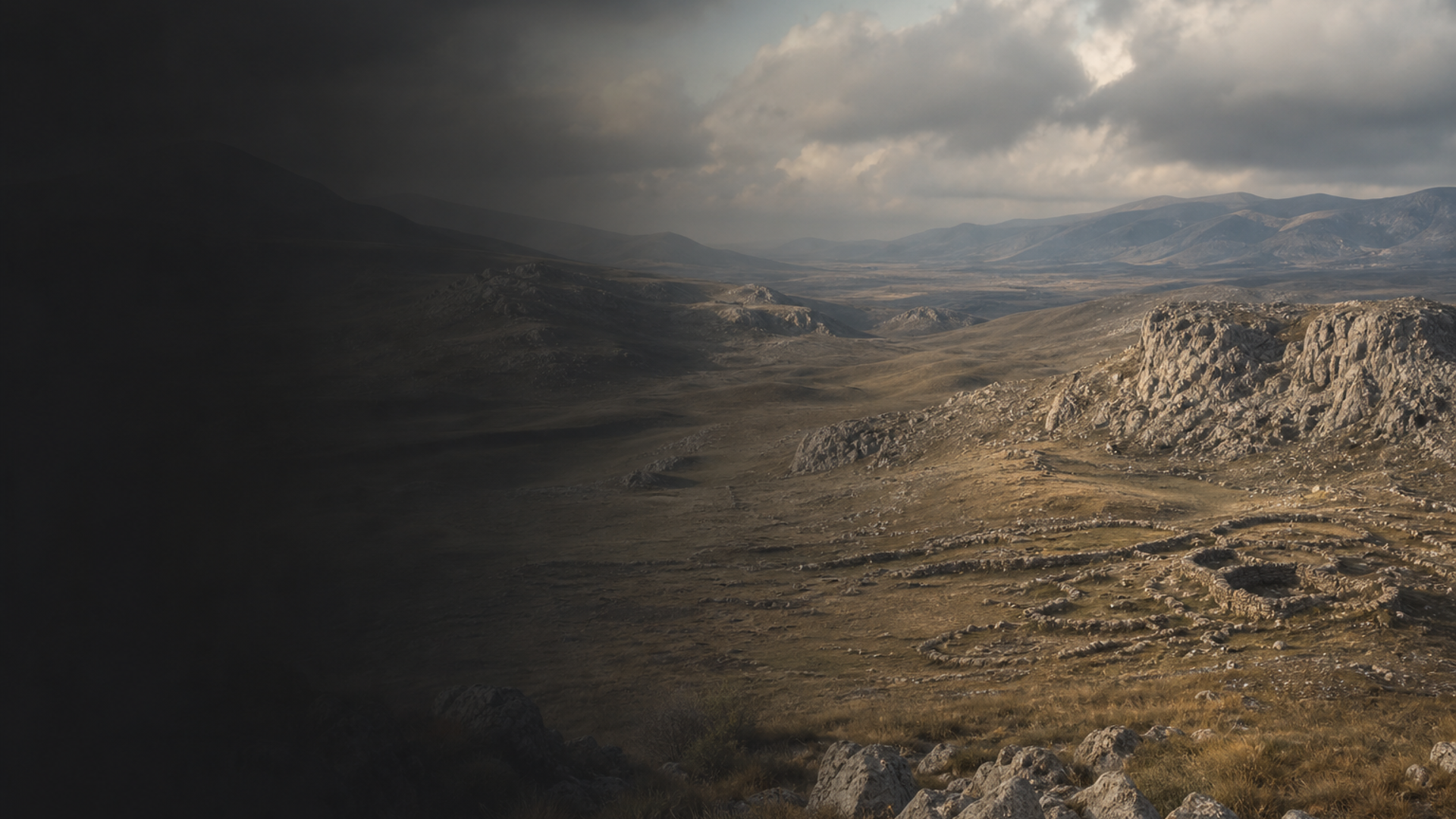
The material record in what is now North Macedonia captures a deep, layered story of settlement and transformation. From Early Neolithic villages to Late Bronze Age communities, sites such as Govrlevo (Skopje), Pista Novo Selo and Vodovrati-Veles (Gradsko) preserve pottery, house plans and burials that indicate a long history of farming, craft, and regional exchange. Archaeological data indicates that Neolithic agricultural lifeways—domesticated cereals, pulses, goats and sheep—were established here by the 6th millennium BCE, likely spreading from Anatolia and the Aegean corridors.

Over millennia, material cultures changed: pottery styles and burial rites shift, reflecting internal developments and contacts across the central Balkans. Limited evidence suggests episodes of increased connectivity in the Bronze Age, when metallurgy and intensified exchange networks reshaped lifeways. The archaeological picture in Macedonia_N is patchy but evocative: house remains and funerary deposits paint a cinematic view of households tied to fields, flocks, and rivers.

Because the genetic dataset currently consists of only three individuals spanning 6000–1100 BCE, genetic interpretations about population origins remain cautious. Nevertheless, combining the tangible traces of potsherds and hearths with DNA creates a richer, if tentative, portrait of emergence across millennia.

  • Neolithic farming established by ~6000 BCE
  • Key sites: Govrlevo, Pista Novo Selo, Vodovrati-Veles
  • Archaeology indicates long-term continuity and episodic change
Capítulo IV

Daily Life & Society

Daily life in ancient Macedonia_N likely revolved around small-scale, mixed farming households and seasonal rhythms. Archaeological remains—pottery fragments, grinding stones, storage pits, and animal bones—suggest diets based on barley, einkorn/emmer, pulses, and domesticated cattle, sheep and goats. Hearths and ceramic cooking wares conjure images of smoky interiors where stews and bread were prepared; painted and plain wares reflect household tastes and local craft traditions.

Settlement traces from Skopje's Govrlevo and other sites show compact habitation zones: timber or wattle-and-daub houses with storage features that imply food surplus and management. Funerary contexts vary, with burials sometimes accompanied by simple grave goods—beads, tools, and pottery—hinting at social distinctions that are modest yet meaningful. Evidence of local metallurgy and exchange goods in some Bronze Age layers points to craft specialization and long-distance contacts across the Balkans.

Archaeological data indicates neither large urban centers nor dramatic elite monuments in the sampled contexts; instead, the record presents a mosaic of village life shaped by environment, kin networks, and periodic exchange. These everyday traces, illuminated by excavation and scientific analysis, form the backbone of our understanding of Macedonia_N society.

  • Mixed farming economy with cereals and domesticated animals
  • Household craft and some Bronze Age specialization
Capítulo V

Genetic Profile

The genetic footprint from the Macedonia_N dataset is tantalizing but small: only three ancient individuals are available, so any population-level inference must be framed as preliminary. Within this tiny sample set, researchers observed Y-chromosome haplogroup G in one male and mitochondrial haplogroup J in one individual. Both lineages have broader associations in European prehistory—haplogroup G (notably G2a) appears frequently among early European farmers, while mtDNA J is often found in Neolithic farming contexts and has roots toward the Near East.

Taken together with archaeological indicators of early farming, these genetic markers are consistent with substantial Neolithic farmer ancestry in the region. However, the sparse sample means we cannot yet quantify admixture proportions, detect the arrival or impact of steppe-related ancestries, or chart continuity vs. replacement across millennia. Nearby regions show complex dynamics in the 3rd–2nd millennia BCE, including migrations and increasing mobility; whether those processes left a clear signature in Macedonia_N awaits larger datasets.

In sum, the limited DNA evidence aligns with an agricultural ancestry component tied to Neolithic migrations, but broader claims about demographic change, social structure, or language spread remain speculative until more samples are analyzed.

  • Y-DNA G observed — consistent with Neolithic farmer lineages
  • mtDNA J observed — suggests Near Eastern/Anatolian farmer connections; conclusions are tentative
Capítulo VI

Legacy & Modern Connections

The peoples who lived in the Macedonia_N region between 6000 and 1100 BCE contributed threads to the deep genetic and cultural tapestry of the Balkans. Archaeological continuities—farming traditions, craft skills, and settlement patterns—echo into later periods and can be seen as part of the substrate upon which subsequent societies were built.

Genetically, the limited observation of haplogroups associated with Neolithic farmers hints that some genetic legacy from these early agricultural communities persists in the region, intermixed with later arrivals and local hunter-gatherer ancestry. It is important to stress that with only three ancient genomes available, we cannot draw strong lines of descent to any modern population; instead, these samples offer snapshots that, when combined with more data, will clarify long-term connections.

As ancient DNA sampling expands, the evocative scenes suggested by potsherds and hearths will be set into sharper genetic focus—revealing how ancient lives in North Macedonia contributed to the human story of Europe.

  • Contributed to the Neolithic farmer genetic substrate in the Balkans
  • Small sample size—modern connections remain provisional
Con IA

Asistente de IA

Haz preguntas sobre la cultura Voices of Ancient Macedonia

Asistente de IA por DNAGENICS

Desbloquear esta función
Pregunta sobre la cultura Voices of Ancient Macedonia. El asistente con IA puede explicar hallazgos genéticos, contexto histórico, pruebas arqueológicas y conexiones modernas, con sus límites de interpretación.

Ejemplo de análisis con IA

La cultura Voices of Ancient Macedonia representa un capítulo de la historia humana...

El análisis genético permite estudiar similitudes con poblaciones anteriores y posibles adaptaciones. Las muestras de ADN antiguo aportan información para investigar patrones migratorios y relaciones entre poblaciones, con límites que dependen del estudio y del contexto arqueológico.

Esta es una vista previa del análisis con IA. Accede al asistente completo para explorar información sobre:

  • Composición y similitud genética
  • Patrones migratorios y orígenes
  • Vida cotidiana y prácticas culturales
  • Contexto genético moderno

Explora más culturas antiguas

Descubre la historia de civilizaciones de distintas partes del mundo antiguo