Aller au contenu principal
Profil culturel

Çatalhöyük N-Ceramic — Central Anatolia

A dense Neolithic tell where early ceramic farmers left houses, murals and genetic echoes.

7100 CE - 6000 BCE
Çatalhöyük, Konya Plain, Central Anatolia, Turkey

Le récit

Population samples from Çatalhöyük (7100–6000 BCE) reveal a Neolithic ceramic community in the Konya Plain. Archaeology and ancient DNA together illuminate farmer lifeways, maternal lineages dominated by mtDNA K, and Y-lineages including G and C.

Time Period

7100–6000 BCE

Region

Çatalhöyük, Konya Plain, Central Anatolia, Turkey

Common Y-DNA

G (n=2), C (n=2) — small counts

Common mtDNA

K (n=6), H (n=2), HV (n=2), T2e (n=1), T (n=1)

Chronologie

7100 BCE

Onset of the North Ceramic phase at Çatalhöyük

Occupation intensifies on the Konya Plain as pottery becomes common; households expand and ritual practices continue beneath house floors.

Origins & Emergence

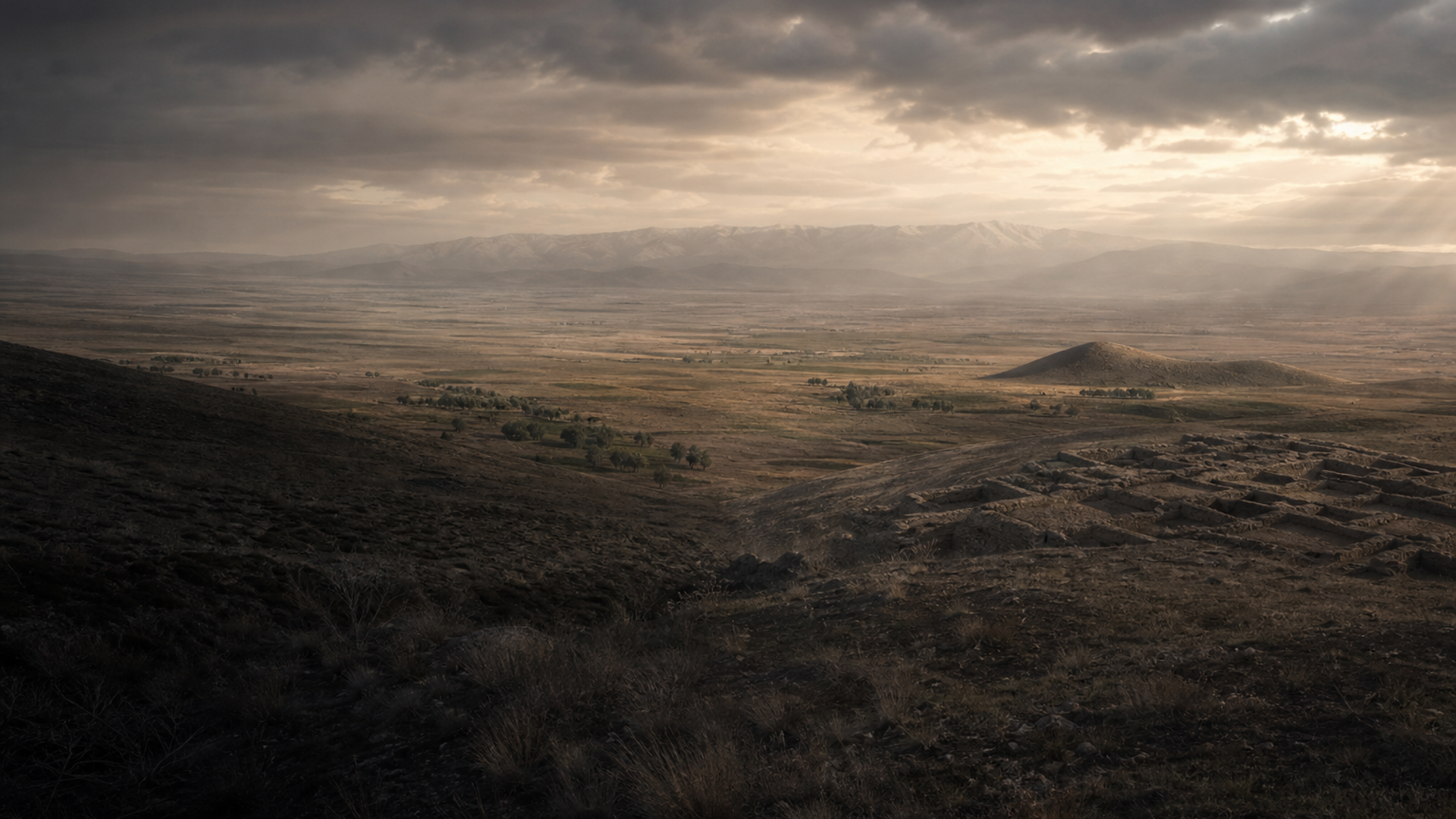
Rising from the loess of the Konya Plain, Çatalhöyük is one of the most evocative Neolithic tells in Central Anatolia. Occupation at the North Ceramic phase spans roughly 7100–6000 BCE, a moment when pottery became widespread across Neolithic Turkey (the so-called Neolithic Ceramic period). The settlement’s dense cluster of mudbrick houses, plastered interiors and painted walls speaks to an intensifying domestic life and new material expressions — ceramic vessels, figurines, and ritual paraphernalia. Archaeological data indicates long-term continuity of occupation at Çatalhöyük and local innovation rather than sudden replacement.

Material culture shows trade and communication across Anatolia: obsidian from central sources, stylistic links to other Anatolian Neolithic sites, and the rapid adoption of ceramics for cooking and storage. While the archaeological record at Çatalhöyük is rich in architecture and art, the demographic picture is best completed by genetic evidence. Ancient DNA from the North Ceramic occupation—while modest in number—ties these people into the broader story of early Anatolian farmers whose movements would shape later European and Near Eastern gene pools.

Limited evidence suggests that ceramic technologies accompanied changes in household economies and potentially in social networks. Yet many questions remain: the pace of ceramic adoption, regional diversity in craft production, and the extent of interaction with contemporaneous communities across Anatolia and the Levant.

  • Occupational phase: c. 7100–6000 BCE, North Ceramic horizon
  • Site: Çatalhöyük, Konya Plain, Central Anatolia
  • Archaeology indicates strong local continuity with expanding ceramic use

Daily Life & Society

Life in the Neolithic tell unfolded beneath low roofs and within plastered rooms where households cooked, crafted, and buried their dead beneath floor levels. Çatalhöyük’s archaeology paints cinematic scenes: women and men moving through narrow alley-roofed streets, murals and built-in platforms lined with painted plaster, and everyday items — grinding stones, hearths, and pottery — arranged for repeated, intimate use. Funerary practice often involved interment beneath house floors; plastered skulls and small figurines point to complex ancestor remembrance and ritual.

Economy relied on mixed farming: domesticated wheat, barley, pulses, sheep and goats, with hunting and foraging supplementing diets. The adoption of ceramics altered domestic routines — cooking pots and storage jars enabled new food processing and preservation strategies, leaving residues that archaeologists can trace. Socially, Çatalhöyük has been interpreted as relatively egalitarian at large scales, with households displaying variability in size and material wealth rather than stark hierarchical markers.

Archaeological traces of craft production, obsidian exchange, and painted symbolism suggest sustained links across Anatolia. Yet many aspects of social organization, including household kinship structures and the precise role of ritual imagery, remain debated; interpretations continue to evolve as archaeological and genetic data are integrated.

  • Household-focused life: burials under floors, plastered interiors, murals
  • Economy: mixed farming with increasing reliance on ceramic storage and cooking

Genetic Profile

Fourteen individuals attributed to the Turkey_Catalhoyuk_N_Ceramic group provide a moderate ancient DNA sample (n=14) for this phase. The maternal lineages are dominated by mtDNA K (6 of 14), with additional haplogroups H (2), HV (2), T2e (1) and T (1). This prevalence of mtDNA K echoes patterns seen in early Neolithic farming communities across Anatolia and the Near East, where K is commonly associated with expanding farmer populations. Maternal continuity suggests that female-mediated ancestry in Çatalhöyük aligns with the broader Anatolian farmer signal found in Europe’s Neolithic transition.

Y-chromosome haplogroups in this cohort include G (2) and C (2), with the remaining male samples either unresolved or carrying low-coverage assignments. Haplogroup G is frequently observed among early Near Eastern farmers, consistent with an Anatolian farming paternal contribution. Haplogroup C is less common in Neolithic Anatolia and may reflect either diversity within local paternal lineages or limited gene flow from neighbouring forager groups or long-distance connections; given the small Y-sample counts, this interpretation is tentative.

Autosomal genetic profiles (where available) generally reflect an Anatolian Neolithic farmer ancestry component that contributed substantially to later European farmer populations. However, with only 14 samples, conclusions about population structure, sex-biased migration, or fine-scale admixture must be cautious. Continued sampling and higher-coverage genomes will refine how Çatalhöyük’s inhabitants fit into the web of Neolithic demographic change.

  • Moderate sample (n=14): mtDNA dominated by K; common in early Anatolian farmers
  • Y-DNA includes G and C; G aligns with Near Eastern farmer lineages, C is less typical and tentative

Legacy & Modern Connections

Çatalhöyük’s North Ceramic inhabitants are part of the deep Anatolian legacy that underpins much of Eurasian Neolithic ancestry. Their material culture — early pottery, house-centered ritual, and long-lived domestic landscapes — left durable traces in the archaeological record. Genetically, their mitochondrial and autosomal signatures contribute to the Anatolian farmer ancestry observed across later Neolithic Europe and the Near East, making Çatalhöyük a key node in the story of prehistoric population movement.

Modern populations in Anatolia carry echoes of this ancient genetic tapestry, but millennia of migrations and admixture have reshaped regional genomes. Therefore, while Çatalhöyük helps illuminate one ancestral strand, it is only one piece of a complex puzzle. The artistic and domestic choices preserved in the site continue to inspire interpretations of early human social worlds, and ongoing aDNA work promises a clearer view of how these Neolithic communities were connected to their neighbors and descendants.

  • Contributes to the Anatolian farmer ancestry that spread into Europe
  • Archaeological and genetic records together show long-term cultural and biological impact

Assistant IA

Assistant IA par DNAGENICS

Débloquer cette fonction
Posez des questions sur la culture Çatalhöyük N-Ceramic — Central Anatolia. L'assistant IA peut expliquer les résultats génétiques, le contexte historique, les preuves archéologiques et les liens génétiques avec les populations actuelles, dans les limites de l'interprétation.
Exemple d'analyse IA

La culture Çatalhöyük N-Ceramic — Central Anatolia représente un chapitre fascinant de l'histoire humaine…

L'analyse génétique met en évidence des similarités avec des populations antérieures et des signes d'adaptations propres. Les échantillons d'ADN ancien éclairent les schémas migratoires et les liens entre populations, avec des limites qui dépendent de l'étude et du contexte archéologique.

Il s'agit d'un aperçu de l'analyse IA. Accédez à l'assistant complet pour explorer :

  • Composition et similarité génétique
  • Schémas migratoires et origines
  • Vie quotidienne et pratiques culturelles
  • Contexte génétique actuel