Préparation du rapport

Chargement des informations et références disponibles

Connexion au corpus archéologique…

Collecte des archives antiques

Aller au contenu principal
Jagodnjak Early Slavs
Profil culturel

Jagodnjak Early Slavs

Small DNA window into 7th–8th century Slavic life in eastern Croatia

652 CE - 775 CE
Croatia (Jagodnjak-Krčevine, Osijek-Baranja)
Faites défiler pour commencer
Chapitre I

Le récit

Comprendre la culture Jagodnjak Early Slavs

Archaeological and aDNA data from three burials at Jagodnjak-Krčevine (652–775 CE) illuminate Early Medieval Slavic presence in Croatia. Limited samples suggest a mix of local Balkan ancestry and wider Early Slavic genetic signals; conclusions remain preliminary.

Time Period

652–775 CE

Region

Croatia (Jagodnjak-Krčevine, Osijek-Baranja)

Common Y-DNA

G (1)

Common mtDNA

J (1), H9a (1), H (1)

Chapitre II

Chronologie

Moments clés de l'histoire de cette culture

600 CE

Wider Early Slavic movements in Central Europe

Period of documented Slavic expansions and settlement across the Carpathian Basin and the Balkans, setting context for later 7th-century sites in Croatia.

652 CE

Earliest dated Jagodnjak burial

One of the three sampled individuals from Jagodnjak-Krčevine is dated to 652 CE, anchoring the site in the Early Medieval era.

775 CE

Latest sampled burial

The upper bound of the Jagodnjak sample range; represents continued occupation or reuse of cemetery space into the late 8th century.

Chapitre III

Origins & Emergence

The graves at Jagodnjak-Krčevine occupy a liminal moment in the early medieval transformation of the eastern Pannonian basin. Dated by radiocarbon and associated artefacts between 652 and 775 CE, these burials sit within the material horizon archaeologists assign to the Early Slavic cultural sphere in present-day Croatia. Archaeological data indicates a continuity of local settlement patterns alongside new funerary customs that archaeologists link to Slavic-speaking groups moving into the region during the sixth–seventh centuries.

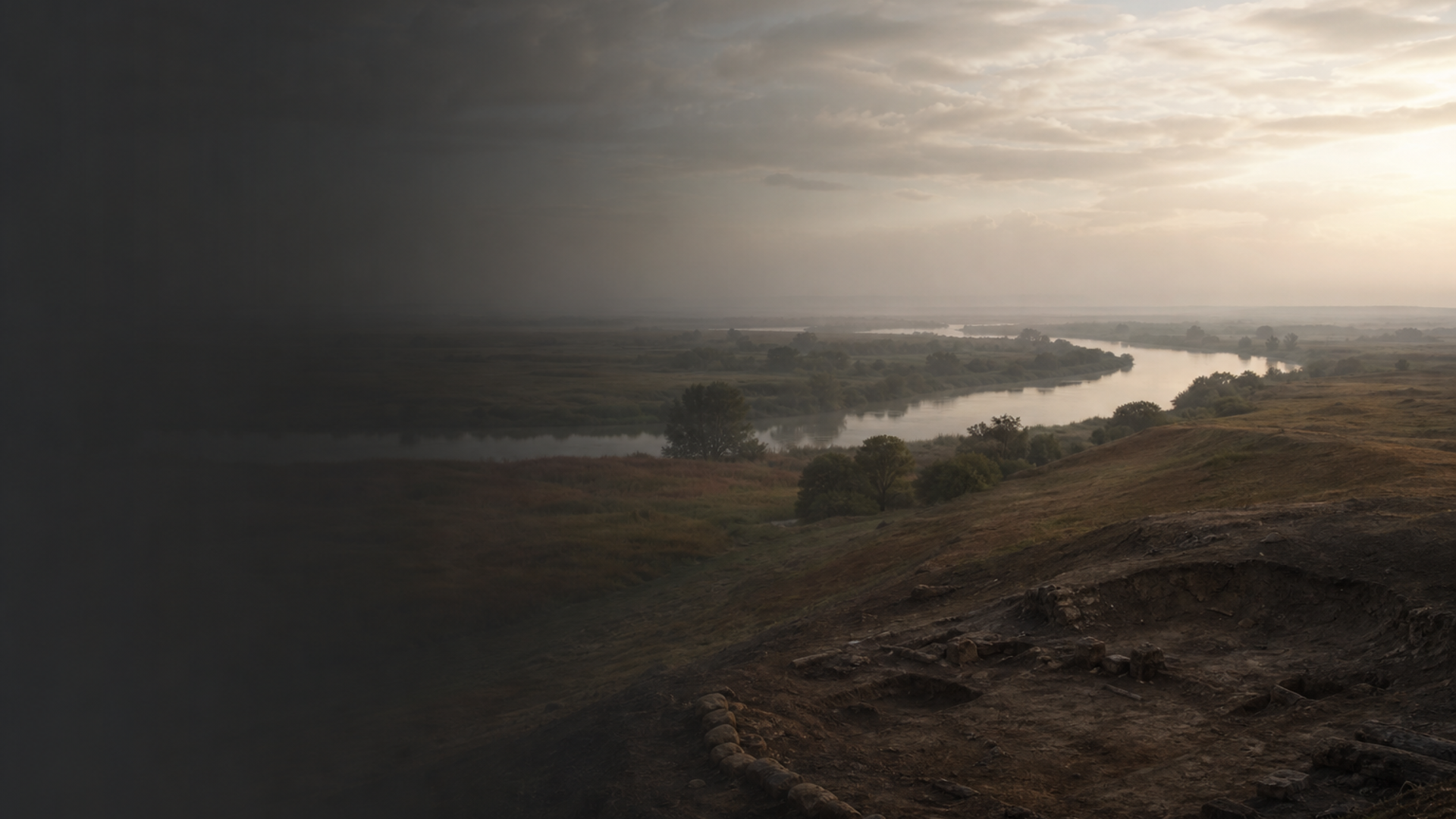
Cinematic landscapes — river plains, marshes, and wooded ridges — provided corridors for human movement. Material culture from nearby sites and burial rites suggest networks of interaction extending north into the Carpathians and south into the central Balkans. Limited evidence suggests that these Early Slavic communities were not a monolithic migrating mass but rather a mosaic: incoming groups, local inhabitants adopting new practices, and long-distance connections converged.

Genetically, aDNA from Jagodnjak is a narrow but telling window. With only three samples, we can tentatively place these individuals within the broader pattern seen in other Early Medieval Slavic contexts: admixture between local Balkan ancestries and northern or steppe-derived elements. Archaeology contextualizes this biological signal — settlement shifts, craft exchange, and burial rites — offering a narrative where movement and local adaptation are both central.

  • Site: Jagodnjak-Krčevine, Osijek-Baranja County, Croatia
  • Date range: 652–775 CE (Early Medieval, Early Slavic period)
  • Evidence shows mixture of continuity and incoming cultural traits
Chapitre IV

Daily Life & Society

Daily life in the Early Slavic horizon around Jagodnjak would have been shaped by seasonal rhythms, small-scale agriculture, animal husbandry, and riverine resources. Archaeological finds from comparable regional cemeteries and settlements indicate modest material culture: simple pottery, iron tools, and personal ornaments. Skeletal remains hint at strenuous lives — healed fractures, dental wear, and evidence of repetitive labor — consistent with agrarian and craft activities.

Households were likely organized around family units with flexible social ties: kinship networks mattered, but mobility and alliance-building through marriage and exchange also shaped communities. Burial practices at Jagodnjak reflect beliefs about identity and memory: position of the body, grave goods, and cemetery layout provide clues to status differences, age groups, and perhaps gendered roles. The landscape itself — a mix of arable plots and wetlands — encouraged mixed economies and fostered trade along waterways.

Archaeology paints an evocative picture: smoke rising from turf-roofed houses, seasonal markets where metalworkers and potters met travelers, and communal rites at cemetery edge. Yet many specifics about social hierarchy, belief systems, and daily rituals remain invisible in the record and require cautious interpretation.

  • Economy: small-scale agriculture, animal husbandry, and foraging
  • Material culture: pottery, iron tools, personal ornaments
Chapitre V

Genetic Profile

The genetic dataset from Jagodnjak-Krčevine comprises three individuals dated between 652 and 775 CE. Among them, one male carries Y-haplogroup G; mitochondrial haplogroups observed are J, H9a, and H. Because the sample count is low (<10), any population-level inference is preliminary and must be framed as provisional.

In broader surveys, Early Medieval Slavic-associated burials across Central and Eastern Europe often show mixed ancestries: components traceable to local Neolithic/Balkan farmer lineages (EEF), European hunter-gatherer input (WHG), and varying degrees of Steppe-related ancestry (Yamnaya/late Bronze Age-derived). The Jagodnjak individuals’ haplogroups fit within the diversity seen in these regions — mtDNA H and J are common across Europe, while Y-haplogroup G, though less typical among some Slavic groups, appears in multiple European contexts and may reflect local continuity or specific male-line migrations.

Genomic affinity analyses (when applied across larger datasets) can reveal admixture dates and proportions, but with only three genomes those analyses are unstable. Therefore: archaeological patterns of movement and local persistence should be integrated with these preliminary genetic signals to avoid overinterpretation. Future sampling from Jagodnjak and neighboring sites will be essential to clarify whether these three individuals represent typical community ancestry or isolated lineages.

  • Very limited sample size (n=3) — conclusions are preliminary
  • Haplogroups: Y-G (1); mtDNA J (1), H9a (1), H (1)
Chapitre VI

Legacy & Modern Connections

The echoes of the Early Slavic presence resonate in the modern populations of Croatia and the wider Balkans. Genetic legacies are complex: modern Croats inherit a tapestry woven from prehistoric Europeans, Roman and Byzantine-era contacts, later medieval movements, and the Early Medieval Slavic horizon. Archaeology situates the Jagodnjak burials as one local chapter in this long human story.

Because the Jagodnjak genetic sample is so small, it is not yet possible to draw firm lines from these three individuals to present-day communities. However, when combined with larger regional aDNA studies, such localized datasets help map the patchwork processes—migration, assimilation, and local continuity—that produced modern genetic landscapes. Each burial adds a brushstroke to a cinematic panorama of shifting frontiers, seasonal horizons, and human adaptability.

  • Contributes to a regional picture of admixture and continuity
  • Small sample limits direct links to modern populations
Propulsé par l'IA

Assistant IA

Posez des questions sur la culture Jagodnjak Early Slavs

Assistant IA par DNAGENICS

Débloquer cette fonction
Posez des questions sur la culture Jagodnjak Early Slavs. L'assistant IA peut expliquer les résultats génétiques, le contexte historique, les preuves archéologiques et les liens génétiques avec les populations actuelles, dans les limites de l'interprétation.

Exemple d'analyse IA

La culture Jagodnjak Early Slavs représente un chapitre fascinant de l'histoire humaine…

L'analyse génétique met en évidence des similarités avec des populations antérieures et des signes d'adaptations propres. Les échantillons d'ADN ancien éclairent les schémas migratoires et les liens entre populations, avec des limites qui dépendent de l'étude et du contexte archéologique.

Il s'agit d'un aperçu de l'analyse IA. Accédez à l'assistant complet pour explorer :

  • Composition et similarité génétique
  • Schémas migratoires et origines
  • Vie quotidienne et pratiques culturelles
  • Contexte génétique actuel

Explorez d'autres cultures antiques

Découvrez les récits de civilisations issues du monde antique