Préparation du rapport

Chargement des informations et références disponibles

Connexion au corpus archéologique…

Collecte des archives antiques

Aller au contenu principal
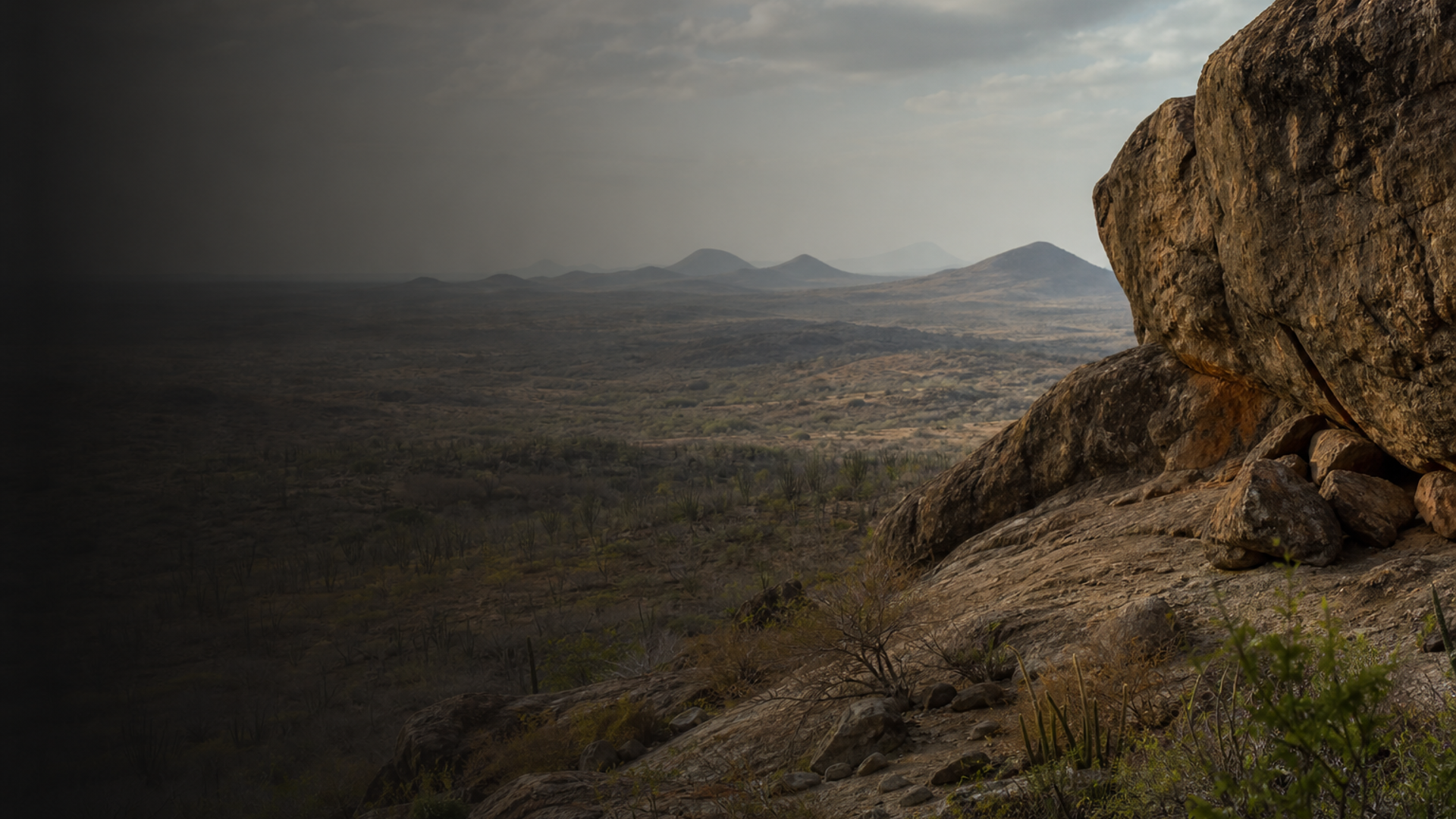
Pedra do Alexandre Hunter-Gatherer
Profil culturel

Pedra do Alexandre Hunter-Gatherer

A single ancient genome from Rio Grande do Norte that speaks to northeastern Brazil’s deep past

2900 CE - 2450 BCE
Northeastern Brazil (Rio Grande do Norte)
Faites défiler pour commencer
Chapitre I

Le récit

Comprendre la culture Pedra do Alexandre Hunter-Gatherer

Ancient DNA from Pedra do Alexandre (c. 2900–2450 BCE) links a single individual to widespread Native American lineages (Y Q, mtDNA C1b). Archaeological context suggests Archaic hunter-gatherer lifeways in northeastern Brazil; conclusions remain preliminary given one sample.

Time Period

2900–2450 BCE

Region

Northeastern Brazil (Rio Grande do Norte)

Common Y-DNA

Q (observed)

Common mtDNA

C1b (observed)

Chapitre II

Chronologie

Moments clés de l'histoire de cette culture

2500 BCE

Occupation at Pedra do Alexandre (approx.)

Archaeological and genetic evidence place human activity at Pedra do Alexandre around 2900–2450 BCE, reflecting Archaic coastal foraging lifeways; interpretation remains provisional given limited data.

Chapitre III

Origins & Emergence

The individual from Pedra do Alexandre (Carnaúba dos Dantas, Rio Grande do Norte) lived within the window 2900–2450 BCE, a time when coastal and inland wetland landscapes of northeastern Brazil hosted diverse foraging communities. Archaeological data indicates occupation of shoreline, lagoon and riverine ecotones during the Brazilian Archaic period, broadly associated here with the Lagoa de Encantada hunter-gatherer tradition. Shell middens, scattered lithics and ephemeral hearth features in comparable sites suggest a seasonal, mobile use of resource-rich littoral habitats.

Limited evidence suggests these communities emphasized fishing, mollusk gathering and the exploitation of freshwater and estuarine resources, but preservation biases and sparse excavation mean that many details remain unclear. The genetic sample is a rare direct window into personal ancestry from this era: while the archaeological record provides landscape and material context, the DNA gives a human signature that can be compared to other ancient and modern genomes. Because this dataset is a single individual, any model of population movement, interaction or continuity must be treated as provisional. Further sampling across sites and time is required to move from evocative possibility to robust narrative.

  • Sample from Pedra do Alexandre, Carnaúba dos Dantas, Rio Grande do Norte
  • Date range: 2900–2450 BCE, within the Brazilian Archaic
  • Archaeological context: coastal/lagoon ecotone occupation; limited stratigraphic detail
Chapitre IV

Daily Life & Society

Imagine a shoreline at sunrise: people moving between mangroves, shallow lagoons and dune-backed scrub to harvest shellfish, set fish traps, and gather tubers and fruits. Archaeological data from similar Archaic contexts in northeastern Brazil indicates diets rich in marine and freshwater protein, supplemented by wild plants. Material culture in the region tends toward expedient lithic tools — blades, scrapers and groundstone for processing — and personal adornment made from shell and bone, though preservation varies by site.

Social organisation for such groups is inferred rather than directly observed. Mobility and seasonality likely structured kin networks, with small group sizes and flexible territorial use. Symbolic life — ornaments, pigment use, mortuary variability — appears in related sites, suggesting identity and social ties expressed through material means. However, because this dataset represents a single individual and the broader site assemblage is limited, reconstructions of household composition, leadership and long-range exchange must remain cautious. The archaeological picture is evocative but incomplete.

  • Subsistence likely focused on fishing, mollusks, and gathered plants
  • Material culture: lithics and shell/bone ornaments inferred from regional parallels
Chapitre V

Genetic Profile

The genetic profile from Brazil_RN_ALE_MH_HG_4600BP is based on a single individual dated to the late 4th–mid 3rd millennium BCE. Reported uniparental markers are Y-chromosome haplogroup Q and mitochondrial haplogroup C1b. Both lineages are well-established components of Native American genetic diversity: haplogroup Q is a common paternal lineage across the Americas, while C1b is one branch of the founding maternal C lineages.

These assignments are consistent with deep Pan-American ancestry and with archaeological expectations for pre-agricultural hunter-gatherer populations in Brazil. Comparative ancient-DNA analyses place such haplogroups within broader patterns of early peopling and regional differentiation in South America. But with n=1, population-level inferences (timing of local continuity, degrees of admixture, or fine-scale migrations) are highly tentative. Genetic affinities to the Lagoa de Encantada tradition or to later Indigenous groups can be hypothesized, yet require additional ancient genomes from neighboring sites and periods to test.

Thus the genetic data opens powerful avenues for linking material culture to demography, even as it underscores the urgent need for more samples to turn preliminary signal into a robust picture of northeastern Brazil’s past.

  • Y-DNA: Q — a common Native American paternal lineage
  • mtDNA: C1b — one of the founding maternal lineages in the Americas; conclusions are preliminary (n=1)
Chapitre VI

Legacy & Modern Connections

The haplogroups observed at Pedra do Alexandre echo lineages still present across contemporary Indigenous and admixed populations in the Americas, hinting at deep ancestry that threads through millennia. Archaeologically, the lifeways inferred for this Archaic individual — reliance on aquatic resources, mobility across coastal landscapes, and the use of organic and stone materials — continue as cultural themes in northeastern Brazil’s ethnographic record.

Caveats are essential: genetic continuity cannot be assumed from a single ancient individual. Population turnover, localized admixture and later demographic events may have reshaped regional gene pools. Nevertheless, the specimen provides a tangible bridge between archaeology and genomes and demonstrates how each new ancient sample refines our understanding of continuity and change. Ongoing research and respectful collaboration with Indigenous communities will be crucial to contextualize biological data alongside cultural histories.

  • Shared haplogroups suggest deep Pan-American ancestry but do not prove direct continuity
  • More ancient genomes and community partnership are needed to clarify modern connections
Propulsé par l'IA

Assistant IA

Posez des questions sur la culture Pedra do Alexandre Hunter-Gatherer

Assistant IA par DNAGENICS

Débloquer cette fonction
Posez des questions sur la culture Pedra do Alexandre Hunter-Gatherer. L'assistant IA peut expliquer les résultats génétiques, le contexte historique, les preuves archéologiques et les liens génétiques avec les populations actuelles, dans les limites de l'interprétation.
Exemple d'analyse IA

La culture Pedra do Alexandre Hunter-Gatherer représente un chapitre fascinant de l'histoire humaine…

L'analyse génétique met en évidence des similarités avec des populations antérieures et des signes d'adaptations propres. Les échantillons d'ADN ancien éclairent les schémas migratoires et les liens entre populations, avec des limites qui dépendent de l'étude et du contexte archéologique.

Il s'agit d'un aperçu de l'analyse IA. Accédez à l'assistant complet pour explorer :

  • Composition et similarité génétique
  • Schémas migratoires et origines
  • Vie quotidienne et pratiques culturelles
  • Contexte génétique actuel

Explorez d'autres cultures antiques

Découvrez les récits de civilisations issues du monde antique