Aller au contenu principal
Profil culturel

Totocachi: A Late Tiwanaku Echo

Single ancient genome from Totocachi links late Tiwanaku presence on the Bolivian Altiplano to maternal lineage B2

1393 CE - 1439 CE
Totocachi, Altiplano, Bolivia

Le récit

Archaeological and genetic evidence from a single individual at Totocachi, Bolivia (1393–1439 CE) suggests a late Tiwanaku-affiliated presence on the Altiplano. The mtDNA belongs to haplogroup B2; Y-chromosome data are not reported. Conclusions are preliminary due to n=1.

Time Period

1393–1439 CE (single sample)

Region

Totocachi, Altiplano, Bolivia

Common Y-DNA

No Y-DNA reported for this sample

Common mtDNA

B2 (1 sample)

Chronologie

300 CE

Early Tiwanaku development

Regional sociopolitical formations around Lake Titicaca begin to coalesce, setting the stage for Tiwanaku cultural expansion.

500 CE

Classic Tiwanaku florescence

Tiwanaku reaches a peak in monumental architecture, ritual, and regional influence across the highlands.

1393 CE

Totocachi individual (dated)

Single sampled individual from Totocachi dated within 1393–1439 CE, providing a late Tiwanaku-affiliated genetic snapshot.

Origins & Emergence

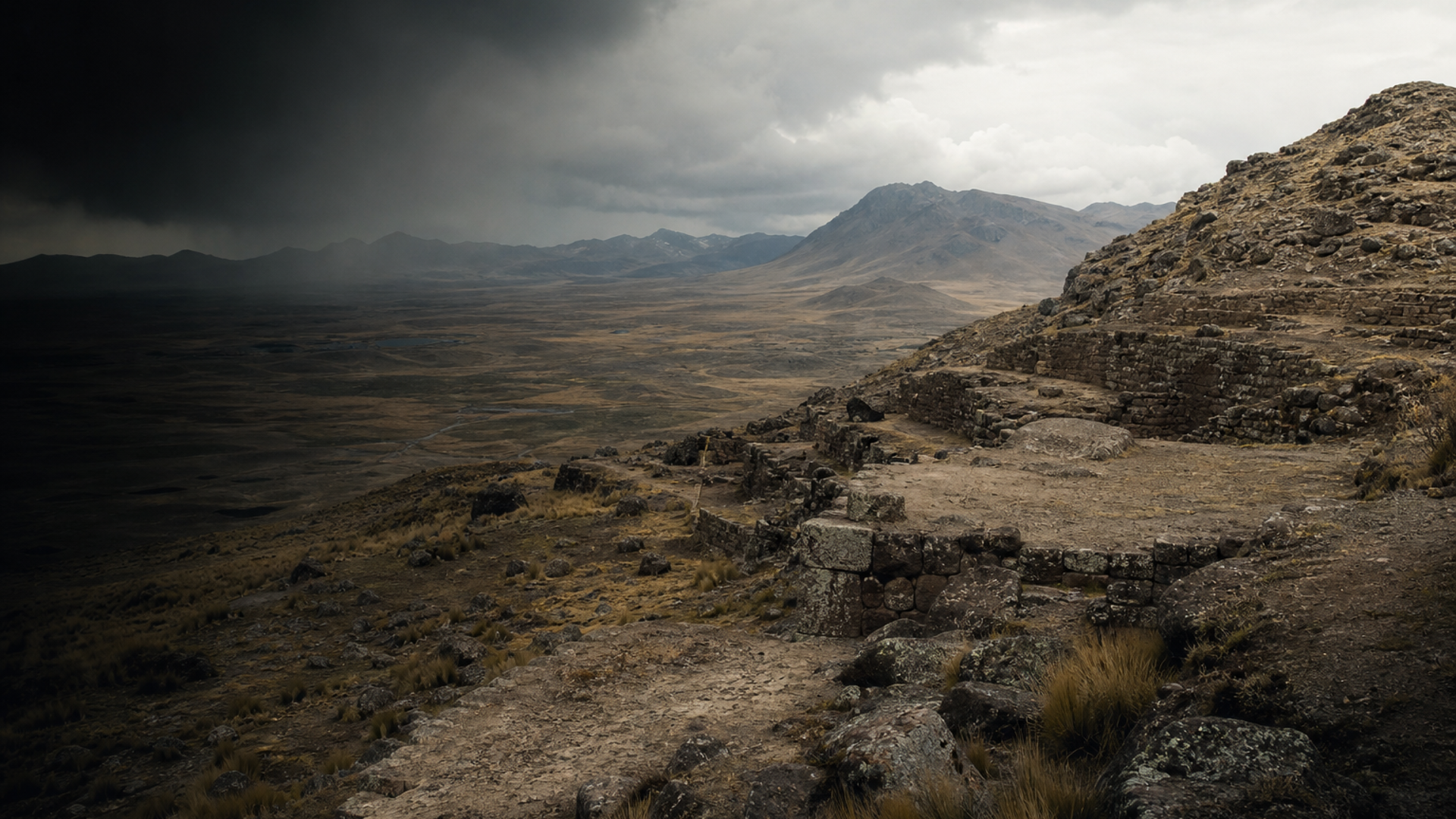
High on the tangled wind-swept plains of the Bolivian Altiplano, Totocachi sits as a quiet witness to centuries of human movement and cultural fusion. Archaeological data indicate that the occupation at Totocachi relates to the long shadow of the Tiwanaku cultural sphere — the highland polity centered at the southern shores of Lake Titicaca — whose major florescence is typically dated from c. 500 to 1000 CE. By the 14th–15th centuries CE, the broader region had undergone political and demographic shifts: local polities, residual Tiwanaku traditions, and new social networks coexisted in a mosaic.

The sole dated individual from Totocachi (1393–1439 CE) falls into this late horizon when the material record often registers continuity in ceramics, architectural motifs, and ritual markers even as political centers changed. Limited evidence suggests this period featured both local continuity and incoming influences from neighboring highland and valley communities. Because the dataset for Totocachi is a single individual, archaeological interpretation must remain cautious: the sample can illuminate possibilities but cannot, on its own, prove population-wide events.

In cinematic terms, Totocachi at the cusp of the 15th century can be imagined as a place where lingering Tiwanaku forms met local adaptations — a human landscape of continuity, transition, and regional exchange.

  • Late Tiwanaku-affiliated occupation context on the Bolivian Altiplano
  • Sample dated to 1393–1439 CE, a period of regional reorganization
  • Interpretations are preliminary given a single sampled individual

Daily Life & Society

The everyday world of Totocachi's inhabitants would have been shaped by the harsh eloquence of the high Andes: thin air, fierce sun, and a landscape carved by lakes and puna grasslands. Archaeological indicators across Tiwanaku-affiliated sites point to mixed agropastoral economies — tuber cultivation (such as potatoes and oca), quinoa, and the herding of camelids (llama and alpaca) — integrated with craft production and regional exchange. Material culture, including ceramics, lithics, and textile fragments from the broader Tiwanaku horizon, suggests skilled artisans and ritual specialists who maintained long-distance ties.

Household compounds likely centered on hearths and storage pits. Social life combined domestic labor with structured ritual: plazas, carved stone features, and portable offerings found in Tiwanaku contexts speak to communal ceremonies and ancestor veneration. Totocachi's single genetic sample cannot reconstruct the full social fabric, but when paired with archaeological indicators it offers a glimpse of an individual embedded in an economy of highland resilience and ceremonial practice.

It is important to emphasize uncertainty: without larger excavation and more dated individuals, we cannot determine how typical this person's life was within Totocachi’s population or how representative Totocachi was of broader late Tiwanaku society.

  • Economy likely agropastoral (potatoes, quinoa, camelids)
  • Domestic and ritual life informed by Tiwanaku material traditions

Genetic Profile

The genetic data from Totocachi are modest but evocative: the single sampled individual carries mitochondrial haplogroup B2. Haplogroup B2 is a well-documented maternal lineage throughout the Americas, common in many Andean and lowland populations. Its presence at Totocachi aligns with broad patterns of maternal continuity within the region but does not, by itself, reveal fine-grained demographic processes.

No Y-chromosome information is reported for this individual, so paternal affiliations remain unknown. With a single mitochondrial genome (n=1), population-level inferences are inherently tentative. Archaeological context suggests continuity with Tiwanaku-associated material culture; the mtDNA result is consistent with local maternal ancestry persisting into the late pre-contact era rather than indicating a major incoming maternal replacement.

When ancient genomes from multiple individuals and sites are compared, patterns emerge: shared maternal lineages can signal regional continuity, while distinct haplogroups or shifts in lineage frequencies can signal migration, admixture, or demographic churn. For Totocachi, the available genetic snapshot complements the archaeological record but must be framed as preliminary. Future sampling from Totocachi and surrounding highland sites would be required to test hypotheses about mobility, kinship, and the genetic legacy of Tiwanaku-era populations.

Language of uncertainty: limited sample size means these genetic interpretations are provisional and meant to motivate further, targeted ancient DNA sampling.

  • mtDNA: B2 — a widespread maternal lineage in the Americas
  • Y-DNA: not reported; conclusions provisional due to n=1

Legacy & Modern Connections

Totocachi’s single ancient genome offers a poetic bridge between past and present: the B2 maternal lineage ties this individual to a deep, continent-wide maternal heritage still found among indigenous communities. Archaeological continuities in craft, ritual forms, and landscape use suggest cultural threads that survived centuries of change on the Altiplano.

For modern descendants and researchers, the evidence at Totocachi underscores two messages. First, biological and cultural continuity are often intertwined in the Andes; many modern Andean groups retain genetic lineages and practices rooted in pre-contact societies. Second, a single sample cannot capture the full diversity of past populations. Responsible interpretation emphasizes collaboration with local communities and additional sampling to build a richer, ethically grounded narrative of ancestry and memory.

In museum galleries and digital platforms, Totocachi can be presented as a compelling case study: a single voice from the 15th century that invites us to listen for the many other voices still buried beneath the Altiplano soils.

  • mtDNA B2 connects the individual to broad indigenous maternal lineages
  • Further sampling and community engagement needed to deepen connections

Assistant IA

Assistant IA par DNAGENICS

Débloquer cette fonction
Posez des questions sur la culture Totocachi: A Late Tiwanaku Echo. L'assistant IA peut expliquer les résultats génétiques, le contexte historique, les preuves archéologiques et les liens génétiques avec les populations actuelles, dans les limites de l'interprétation.
Exemple d'analyse IA

La culture Totocachi: A Late Tiwanaku Echo représente un chapitre fascinant de l'histoire humaine…

L'analyse génétique met en évidence des similarités avec des populations antérieures et des signes d'adaptations propres. Les échantillons d'ADN ancien éclairent les schémas migratoires et les liens entre populations, avec des limites qui dépendent de l'étude et du contexte archéologique.

Il s'agit d'un aperçu de l'analyse IA. Accédez à l'assistant complet pour explorer :

  • Composition et similarité génétique
  • Schémas migratoires et origines
  • Vie quotidienne et pratiques culturelles
  • Contexte génétique actuel