Introduction
France’s ancestry is often described as a single national story, but population genetics shows something far more layered. Across mainland France, DNA reflects a long sequence of arrivals and admixture events, from Mesolithic hunter-gatherers to Neolithic farmers, Bronze Age steppe groups, Iron Age Gauls, Roman-era populations, and Germanic migrations in Late Antiquity. The result is not one genetic profile, but a regional mosaic shaped by geography, mobility, and history.
That matters for anyone interested in DNA ancestry, because modern genetic variation often preserves traces of ancient population movements. In France, those traces are especially clear when you compare regions side by side. The north-west, south, Mediterranean coast, and north-east each show distinctive patterns that line up with archaeology and historical settlement, offering a useful case study in ancient DNA, population genetics, and the deep roots of European diversity.
Key Discoveries / Main Points
- Mainland France is genetically layered, with ancestry contributions from hunter-gatherers, Anatolian farmers, and steppe herders detectable across the country.
- The Bronze Age turnover had a major impact, especially in the north and west, where Bell Beaker-related ancestry became dominant in many regions.
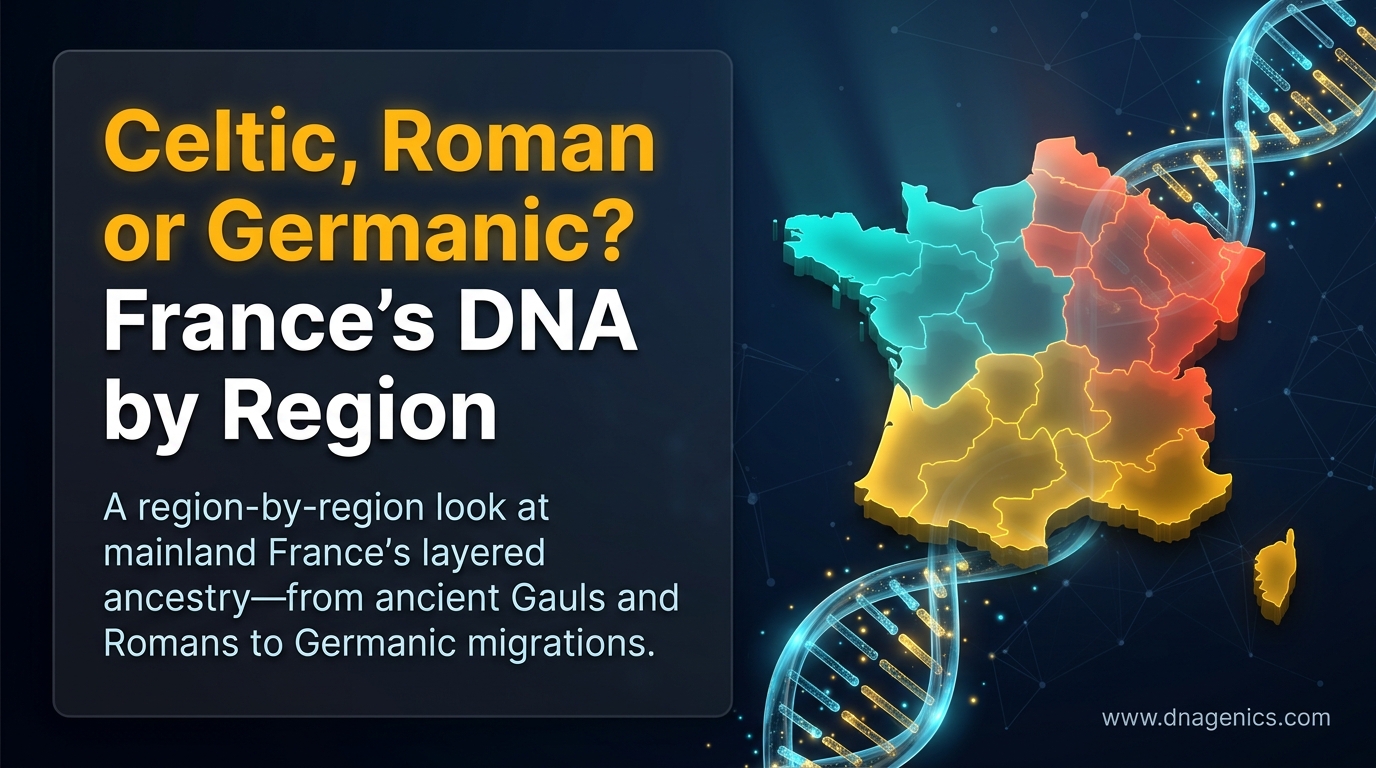
- In Late Antiquity, France shows a strong three-way regional contrast between Celtic, Roman, and Germanic-associated reference populations.
- Brittany stands out as the most Atlantic and Celtic region, while Alsace, Lorraine, and parts of Normandy show the strongest Germanic signal.
- The Mediterranean south carries more Roman-associated and older farmer-related ancestry, reflecting long-term connections across the Mediterranean world.
What This Means for Your DNA
If you have French ancestry, your results are unlikely to reflect a single historical label. A DNA test may connect you to modern France, but the ancestry behind that result can include different mixtures depending on whether your family comes from Brittany, Normandy, Alsace, Provence, Occitanie, or elsewhere. In genetic terms, France is best understood as a set of regional populations with partially shared deep ancestry and locally distinct historical influences.
For beginners, this means that a French ancestry estimate is not just “French.” It may carry stronger signals linked to Atlantic Europe, central Europe, or the Mediterranean, depending on where your ancestors lived. For more advanced users, the more interesting question is not whether a region is “Celtic” or “Germanic” in a simple identity sense, but how closely present-day genomes resemble ancient reference groups tied to those historical periods. That is a statistical comparison, not a direct label of ethnicity.
This is especially useful in genealogy when documentary records are thin. A family from northern France may show affinities that are somewhat different from one from the south-east, even if both are French on paper for centuries. Genetic ancestry can help you understand those regional differences, while also reminding you that migration, intermarriage, and cultural change have always shaped the French gene pool.
Historical and Archaeological Context
The story begins with Western Hunter-Gatherers (WHG), the people who lived in Europe before farming spread across the continent. In mainland France, Mesolithic individuals from places such as Brittany preserve that very old layer of ancestry. Then, beginning in the Neolithic, farmers with origins in Anatolia moved into France along the Mediterranean coast and through continental routes, bringing agriculture, new settlement patterns, and eventually megalithic traditions such as those associated with Carnac.
A major transformation came in the Bronze Age, when steppe ancestry associated with Bell Beaker-related populations spread across western Europe. In France, this ancestry became especially strong in the north-west and north, and it helps explain why the country’s later Iron Age populations, including the Gauls, were genetically closer to Bronze Age western Europeans than to the earliest farmers alone. Archaeology and genetics point to continuity mixed with replacement, not a clean break.
Late Antiquity added another layer. The Roman world linked southern France closely to Italy and the wider Mediterranean, while Germanic groups such as the Franks, Burgundians, Visigoths, Saxons, and later Vikings left differing regional signals. The modern pattern fits that history: the south and Mediterranean coast tend to show stronger Roman-related ancestry, while the north-east and parts of Normandy show stronger Germanic-related ancestry, and Brittany retains a particularly strong Atlantic profile.
The Science Behind It
The analysis behind this kind of regional map uses reference populations from ancient DNA and modern genotype data, then compares regional averages to those references using statistical models. In the deep-time layer, the comparison is built around three major ancestral sources common in much of Europe: hunter-gatherers, early farmers, and steppe pastoralists. A second layer uses later ancient populations, including Neolithic France, Bell Beaker groups, and Imperial Rome. A third layer focuses on Late Antiquity, when the ancestry signals are modeled as mixtures of Celtic, Roman, and Germanic-associated populations.
This approach does not mean that modern people are “purely” descended from any one ancient group. Instead, it estimates which ancient source populations a modern regional average is most similar to, given the available reference data. That is why the results should be read as population-level patterns, not as exact personal identities. Two people from the same region can still have different family histories, and any one DNA test reflects only the segments inherited through your own pedigree.
In Simple Terms: Scientists compare modern regional DNA to ancient genomes, then estimate which old populations it most resembles. It is a way to see broad ancestry patterns, not to assign a single identity to a person or a family.
At the broadest level, mainland France averages roughly 12% hunter-gatherer, 46% Anatolian farmer, and 42% steppe ancestry in the deep model. Regionally, that balance shifts. Brittany and other north-western areas have higher steppe-related ancestry, while the Mediterranean south retains more farmer-related ancestry and a stronger Roman-associated signal. Those gradients are consistent with multiple waves of migration, local continuity, and later historical movement.
Why It Matters
France is a useful example of how genetics, archaeology, and history complement one another. Written history can tell us when Romans ruled, when Franks settled, or where Britons moved in the early medieval period. Ancient DNA helps show how those events influenced real population structure, and modern regional samples reveal which signals persisted into the present. Together, they produce a more precise picture than history alone.
For the future of ancestry testing, this kind of regional analysis points toward more nuanced interpretation. As more ancient genomes become available, regional models will become sharper, especially for areas with complex settlement histories such as the Atlantic coast, the Rhine frontier, and the Mediterranean arc. For customers interested in haplogroups, migration, and deep ancestry, France shows why context matters: ancestry is not just where your family is from, but how many centuries of movement shaped that place.
References / Further Reading
- Ancient DNA studies of Neolithic, Bronze Age, Iron Age, and Roman-era Europe
- Regional population genetics datasets from mainland France
- Research on Bell Beaker expansion, Roman Gaul, and Late Antique migrations in western Europe