A preparar o relatório

A carregar as informações e as referências disponíveis

Consultando el registro arqueológico...

Recopilando registros antiguos

Saltar para o conteúdo principal
Capelinha Sambaqui — 10.4k BP
Cultura de destaque

Capelinha Sambaqui — 10.4k BP

One ancient genome from a SE Brazilian shell mound hints at coastal foragers and deep Native American roots

8547 CE - 8304104 BCE
Capelinha, Southeast Coast, Brazil
Desplázate para começar
Capítulo I

A História

Comprender la cultura Capelinha Sambaqui — 10.4k BP

Ancient DNA from a single individual at the Capelinha sambaqui (c. 8547–8304 BCE) links early coastal foragers on Brazil's southeast shore with Pan-American haplogroups Q (Y) and C (mtDNA). Limited sample size makes conclusions preliminary; archaeology and genetics together illuminate early Holocene coastal lifeways.

Time Period

c. 8547–8304 BCE (≈10.4k BP)

Region

Capelinha, Southeast Coast, Brazil

Common Y-DNA

Q

Common mtDNA

C

Capítulo II

Cronologia

Momentos-chave da história desta cultura

8400 BCE

Early sambaqui occupation at Capelinha

Radiocarbon-dated occupation and human remains in the Capelinha shell mound indicate coastal foraging around 8547–8304 BCE.

Capítulo III

Origins & Emergence

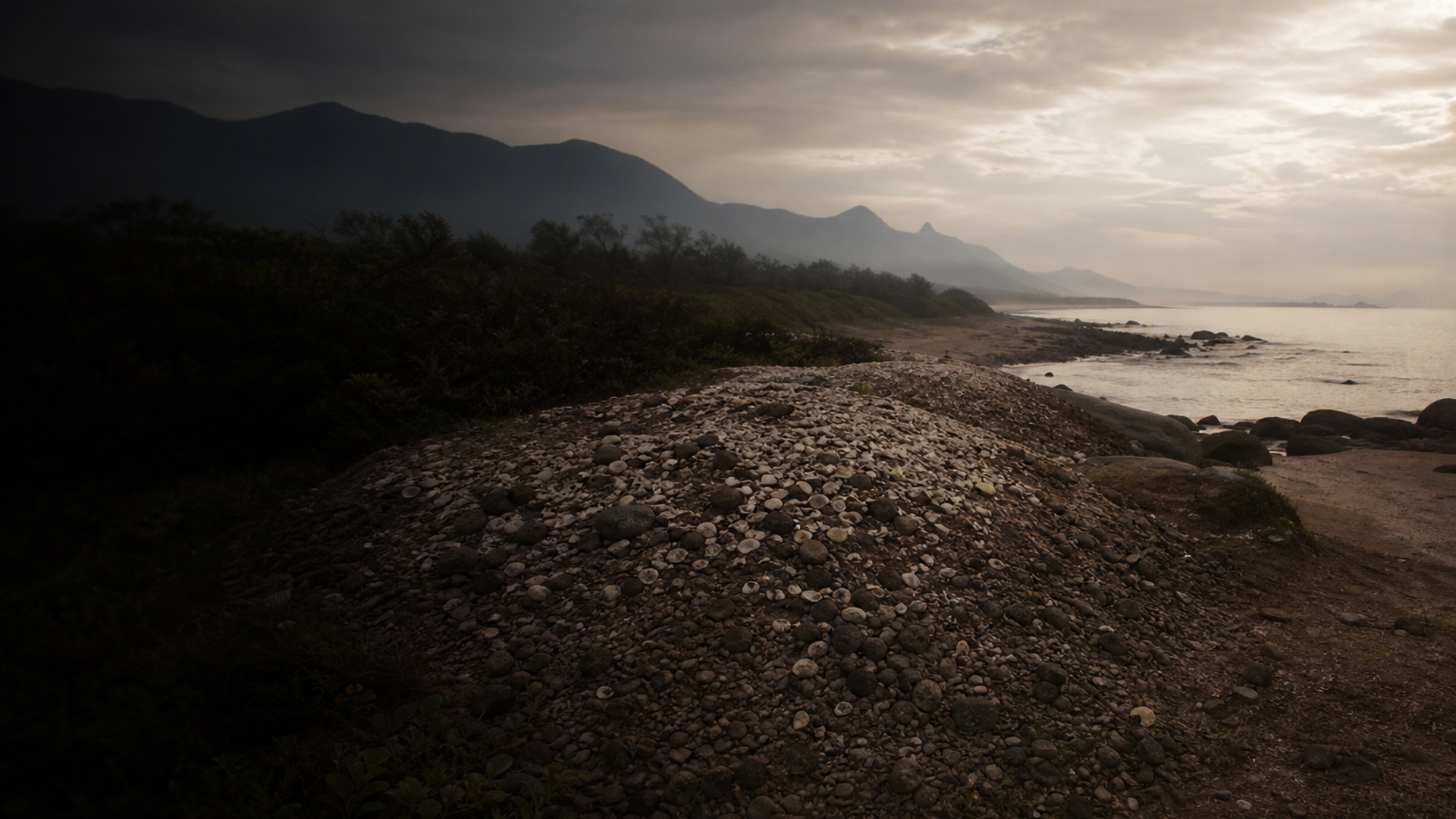
The Capelinha find sits at the edge of the early Holocene horizon on Brazil’s southeast littoral. Archaeological data indicates shell-rich mounds (sambaquis) were being constructed or used at this site around 8547–8304 BCE, a period of sea-level stabilization and ecological reorganization after the Last Glacial Maximum. Limited evidence suggests coastal foraging economies exploited estuaries, mangroves and nearshore resources, leaving layered shell deposits that preserve both material culture and human remains.

The wider region preserves an archaeological conversation with the inland Lagoa Santa complex—hunter-gatherer populations whose skeletal and cultural traces overlap in time and geography—but the coastal sambaqui world reflects a distinctive maritime adaptation. The cinematic sweep of shell middens rising above the shoreline is matched by subtle signals in stone tool assemblages and midden stratigraphy that point to repeated occupation and specialized resource use.

Caveats: this cultural portrait is built around a very small dataset. With just one securely dated genome from Capelinha, interpretations of demographic origin and cultural emergence must remain tentative. Ongoing archaeological survey and additional ancient DNA sampling are essential to test whether Capelinha represents a local early sambaqui tradition or a thread in broader coastal networks.

  • Site: Capelinha (Southeast Coast, Brazil)
  • Date range: c. 8547–8304 BCE (≈10.4k BP)
  • Context: early Holocene sambaqui / coastal forager adaptation
Capítulo IV

Daily Life & Society

The material world of Capelinha can be imagined through the layered shells and artifacts recovered from the mound. Archaeological evidence indicates diets rich in mollusks, fish and estuarine fauna, with seasonal pulses of productivity likely driving occupation intensity. Shell middens functioned as refuse, habitation platforms, and potentially ceremonial places—accumulating the detritus of everyday life into monumental, visible features along the shore.

Organic preservation in sambaquis can capture craft debris, charred plant remains, and occasional human burials. From these, we infer a finely tuned knowledge of coastal seasons, navigation of inshore waters, and the use of stone and bone tools adapted for fish processing and shell exploitation. Social life at this time was probably organized in small, mobile kin groups that aggregated periodically. Exchange of raw materials and stylistic traits with nearby inland groups such as those linked to Lagoa Santa is plausible but not yet firmly demonstrated for Capelinha.

Because only one genome is available, social or kinship structures deduced from genetics are speculative. Archaeology remains the primary lens for reconstructing daily habits, while genetics offers a complementary, if nascent, line of evidence.

  • Subsistence: marine and estuarine resources, shellfish-heavy diet
  • Settlement: repeated occupation of sambaqui middens; small kin groups
Capítulo V

Genetic Profile

The genetic signal from Capelinha is clear in its modesty: a single genome with Y-DNA haplogroup Q and mitochondrial haplogroup C. Both lineages are well-known components of the genetic diversity of Indigenous peoples across the Americas. Y-haplogroup Q is broadly associated with paternal lineages derived from the initial peopling of the Americas, while mtDNA C is one of the founding maternal clades observed in many ancient and modern Native American populations.

Archaeogenetic interpretation must stress limits. With a sample count of one, population-level inferences—such as continuity with later coastal groups, the presence of distinct migration waves, or fine-scale kinship—are highly preliminary. Nonetheless, this genome fits the broader pattern of Beringian-derived ancestry spreading throughout the Americas in the late Pleistocene and early Holocene.

Where archaeology supplies lifeways and context (sambaqui formation, coastal foraging), ancient DNA provides a genetic anchor tying an individual at Capelinha to continent-scale ancestries. Future sampling from other sambaquis and inland contemporaries (including Lagoa Santa-associated sites) will be necessary to test hypotheses about coastal population structure, sex-biased mobility, and long-term genetic continuity in eastern South America.

  • Y-DNA: Q (paternal lineage consistent with early American ancestries)
  • mtDNA: C (maternal lineage among founding Native American haplogroups)
Capítulo VI

Legacy & Modern Connections

The single Capelinha genome offers a potent, if tentative, bridge between archaeological landscapes and the deep genetic history of South America. It exemplifies how coastal shell mounds can preserve human remains that connect material culture with ancestral lineages visible in modern Indigenous populations. Archaeological continuity of sambaqui-building traditions in parts of the Brazilian coast suggests cultural persistence, but genetic continuity cannot be assumed from one sample.

For descendant communities and scholars alike, Capelinha underscores the value of collaborative research that pairs careful excavation with ethical ancient DNA sampling. The genetic markers (Q and C) resonate with pan-American ancestries, reminding us that individual sites are threads in a vast tapestry of human movement, adaptation, and survival along the Atlantic margin. Additional genomes and integrated analyses will be needed to transform this evocative single-data-point into a coherent regional narrative.

  • Connects material culture (sambaqui) with founding Native American lineages
  • Highlights need for more samples and community-engaged research
Com IA

Assistente de IA

Haz preguntas sobre la cultura Capelinha Sambaqui — 10.4k BP

Assistente de IA por DNAGENICS

Desbloquear esta função
Pregunta sobre la cultura Capelinha Sambaqui — 10.4k BP. El asistente con IA puede explicar hallazgos genéticos, contexto histórico, pruebas arqueológicas y conexiones modernas, con sus límites de interpretación.
Exemplo de análise com IA

La cultura Capelinha Sambaqui — 10.4k BP representa un capítulo de la historia humana...

A análise genética permite estudar semelhanças com populações anteriores e possíveis adaptações. As amostras de DNA antigo fornecem informações para investigar padrões migratórios e relações entre populações, com limites que dependem do estudo e do contexto arqueológico.

Esta é uma antevisão da análise com IA. Aceder ao assistente completo para explorar informações sobre:

  • Composição e similaridade genética
  • Padrões migratórios e origens
  • Vida cotidiana e práticas culturais
  • Contexto genético moderno

Explore mais culturas antigas

Descubra a história de civilizações de diferentes partes do mundo antigo