A preparar o relatório

A carregar as informações e as referências disponíveis

Consultando el registro arqueológico...

Recopilando registros antiguos

Saltar para o conteúdo principal
Coastal Echoes of Late Iron Age Scotland
Cultura de destaque

Coastal Echoes of Late Iron Age Scotland

Archaeology and ancient DNA reveal dynamic coastal communities across Scotland (197–1 BCE).

197 CE - 1 BCE
Scotland (United Kingdom)
Desplázate para começar
Capítulo I

A História

Comprender la cultura Coastal Echoes of Late Iron Age Scotland

Archaeological remains from East Lothian to the Hebrides, combined with genome-wide and uniparental data from 13 individuals, illuminate Late Iron Age coastal lifeways in Scotland and hint at connections across Atlantic Britain. Limited sample size requires cautious interpretation.

Time Period

197–1 BCE

Region

Scotland (United Kingdom)

Common Y-DNA

R (8), I (1), F (1)

Common mtDNA

H (7), U (1), HV (1), T (1), H1 (1)

Capítulo II

Cronologia

Momentos-chave da história desta cultura

197 BCE

Earliest sampled burials

The beginning of the sampled range: burials dated to c. 197 BCE provide the earliest direct genetic snapshots in the Scotland_LIA series.

Capítulo III

Origins & Emergence

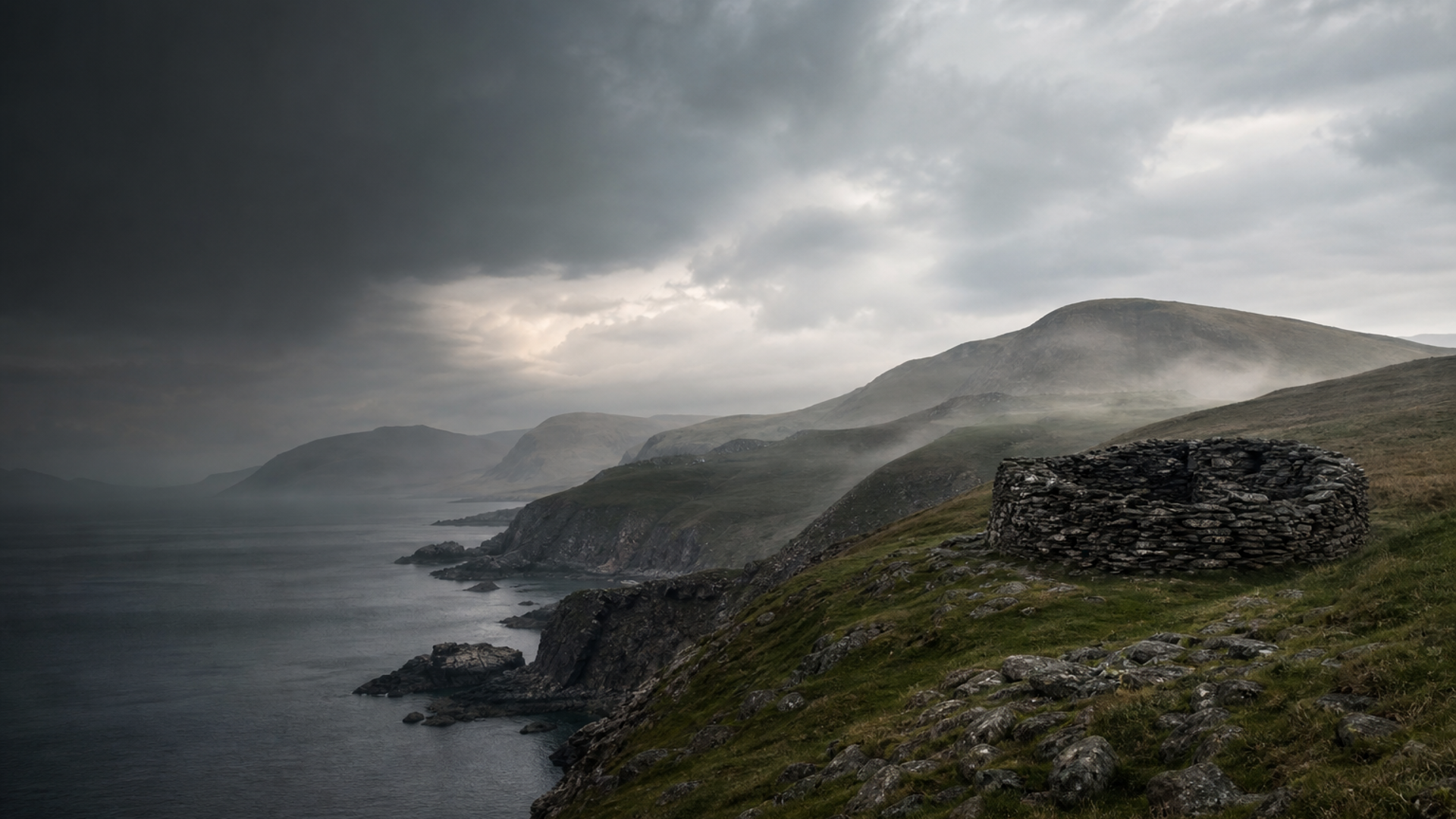
The Scotland_LIA assemblage sits at the seaward edge of Iron Age Britain. Between 197 and 1 BCE, communities from East Lothian to the Hebridean shores left a patchwork of graves, coastal settlements, and ritual deposits. Key archaeological loci include Broxmouth and Law Road (North Berwick) in East Lothian, Hornish Point on South Uist, the House of Binns in West Lothian, Howe of Howe in Orkney, Northton on Isle of Harris, Applecross in the Highlands, and Cumledge (Auchencraw Park) in the Scottish Borders.

Material culture from these sites—fragmentary ironwork, decorated brooches, and coastal funerary contexts—suggests communities tied to maritime routes and local upland–lowland interaction. Archaeological data indicates a mixture of long-established Atlantic traditions and newer continental influences in craft and burial practice, consistent with a Late Iron Age horizon across northern Britain.

Genetically, the sampled individuals span this narrow late Iron Age window. The presence of predominantly R-lineage Y-chromosomes alongside diverse maternal haplogroups hints at patrilineal continuity with incoming or mobile maternal lines, though the small sample size and uneven geographic coverage mean such interpretations remain tentative. Limited evidence suggests population continuity from earlier Iron Age groups with episodic connections to wider Atlantic networks rather than wholesale population replacement.

  • Sites from East Lothian to the Hebrides anchor coastal networks.
  • Material culture combines Atlantic traditions and continental influences.
  • Genetic and archaeological signals point to continuity with regional connectivity.
Capítulo IV

Daily Life & Society

Life in Late Iron Age Scottish communities would have been shaped by the rhythm of sea and season. Excavations at coastal and island sites such as Hornish Point and Northton reveal diets rich in marine protein alongside domesticated cereals and livestock. Archaeobotanical and faunal remains from comparable Late Iron Age sites in Scotland indicate mixed farming, sea fishing, and specialized craft production—bone, antler, and ironworking appear intermittently in the record.

Settlement evidence is often fragmentary: huts, middens, and enclosures hint at small kin-based hamlets rather than dense urban centers. Social life likely revolved around kinship groups, control of local resources, and seasonal exchange. Broxmouth and the House of Binns yielded funerary deposits that suggest differential burial treatments, which might reflect status, age, or kin identity.

Burial contexts provide the human faces to genetic data: skeletal remains sampled for DNA were recovered from varied contexts across mainland and island sites, giving a cross-section of coastal society. However, archaeological preservation biases—coastal erosion, later ploughing, and selective excavation—mean that our view is partial. Archaeological data indicates resilient communities adapted to both terrestrial and marine economies, embedded in long-distance coastal networks.

  • Mixed farming and marine resources shaped subsistence.
  • Small kin-based settlements with craft and exchange networks.
Capítulo V

Genetic Profile

Thirteen individuals from eight Scottish locations provide the genetic backbone of the Scotland_LIA profile. Uniparental markers show a predominance of Y-haplogroup R (8/10 assigned Y-chromosomes), with single observations of I and F lineages; mitochondrial diversity is dominated by H-lineages (7 individuals, including at least one H1), alongside U, HV, and T. These uniparental patterns suggest a population where R-lineage paternal ancestry was common, while maternal lineages retained diverse western Eurasian types frequent across Iron Age and earlier British contexts.

Genome-wide data, where available, tend to align these individuals with broader Late Iron Age and Romano-British clusters from Britain—showing continuity with earlier British Neolithic and Bronze Age ancestries mixed with steppe-derived components characteristic of later European populations. The concentration of R on the Y-chromosome is consistent with patterns seen elsewhere in later prehistoric Britain, but the small sample and uneven site distribution mean that any claim about population structure or migration must be cautious.

Limited sample sizes (n=13) constrain fine-scale demographic modelling; comparisons to larger regional datasets may reveal whether observed patterns reflect local continuity, patrilocal residence, or selective burial practices. Archaeogenetic results therefore illuminate likely scenarios rather than definitive narratives.

  • Predominant Y-haplogroup R with diverse maternal H, U, HV, T lineages.
  • Genome-wide affinities align with late prehistoric British ancestry; conclusions are provisional.
Capítulo VI

Legacy & Modern Connections

The Scotland_LIA assemblage bridges archaeology and genetics to trace echoes into later centuries. Many modern populations of Scotland and Atlantic Britain carry genetic legacies that reflect millennia of local continuity layered with mobility; the uniparental signals seen here—especially common R-lineage paternal markers and abundant mtDNA H—are widespread in present-day British and Irish populations.

Archaeological continuities in coastal economies, craft traditions, and monument reuse suggest cultural persistence even as networks shifted under Roman and later influences. However, the dataset is small and geographically patchy: while these individuals offer direct windows into Late Iron Age lifeways, they cannot alone define the genetic landscape of all of Iron Age Scotland. Future sampling across upland and inland sites, combined with isotope and radiometric data, will be essential to refine links between these ancient coastal communities and modern populations.

  • Genetic patterns echo in modern British and Atlantic populations, but links are complex.
  • More samples and isotopic work needed to clarify migration versus local continuity.
Com IA

Assistente de IA

Haz preguntas sobre la cultura Coastal Echoes of Late Iron Age Scotland

Assistente de IA por DNAGENICS

Desbloquear esta função
Pregunta sobre la cultura Coastal Echoes of Late Iron Age Scotland. El asistente con IA puede explicar hallazgos genéticos, contexto histórico, pruebas arqueológicas y conexiones modernas, con sus límites de interpretación.
Exemplo de análise com IA

La cultura Coastal Echoes of Late Iron Age Scotland representa un capítulo de la historia humana...

A análise genética permite estudar semelhanças com populações anteriores e possíveis adaptações. As amostras de DNA antigo fornecem informações para investigar padrões migratórios e relações entre populações, com limites que dependem do estudo e do contexto arqueológico.

Esta é uma antevisão da análise com IA. Aceder ao assistente completo para explorar informações sobre:

  • Composição e similaridade genética
  • Padrões migratórios e origens
  • Vida cotidiana e práticas culturais
  • Contexto genético moderno

Explore mais culturas antigas

Descubra a história de civilizações de diferentes partes do mundo antigo