A preparar o relatório

A carregar as informações e as referências disponíveis

Consultando el registro arqueológico...

Recopilando registros antiguos

Saltar para o conteúdo principal
Didnauri LBA: Voices from the Kura
Cultura de destaque

Didnauri LBA: Voices from the Kura

Late Bronze Age community at Didnauri (Samreklo), Georgia — a fragile genetic window into a turbulent era

1260 CE - 839 BCE
Didnauri (Samreklo), Georgia — Kura basin
Desplázate para começar
Capítulo I

A História

Comprender la cultura Didnauri LBA: Voices from the Kura

Didnauri_LBA (1260–839 BCE) comes from three samples from Didnauri (Samreklo), Georgia. Archaeology and ancient DNA hint at local Caucasian roots with possible Steppe links (Y-DNA R in all three). Small sample size makes conclusions preliminary.

Time Period

1260–839 BCE

Region

Didnauri (Samreklo), Georgia — Kura basin

Common Y-DNA

R (3 — all sampled males)

Common mtDNA

U7b (1), X2 (1), I5c (1)

Capítulo II

Cronologia

Momentos-chave da história desta cultura

2500 BCE

Early Bronze cultural foundations in the South Caucasus

Regional Bronze Age developments establish the long-term cultural foundations that later shape Late Bronze Age communities like Didnauri.

Capítulo III

Origins & Emergence

In the waning centuries of the second millennium BCE, Didnauri (also recorded as Samreklo) sits at a crossroads—where the green terraces of the Kura River meet the routes that climb toward the Greater Caucasus. Archaeological data indicates that the local Didnauri cultural horizon belongs to a broader mosaic of Late Bronze Age communities in eastern Georgia. Material traces from the region—ceramic styles, mortuary practices, and settlement patterns—suggest continuity with earlier Bronze Age traditions while also showing adaptation to changing economic and social pressures across the South Caucasus.

The three dated samples from Didnauri range from 1260 to 839 BCE, a span that captures late regional transformations: intensification of herding, local metallurgy, and shifting exchange networks. Limited evidence suggests these communities maintained strong local identities even as long-distance contacts—by trade or movement of people—introduced new objects and possibly new genes. Because the sample set is very small, archaeological interpretations must remain cautious: observed patterns may reflect local variability rather than broad population replacement.

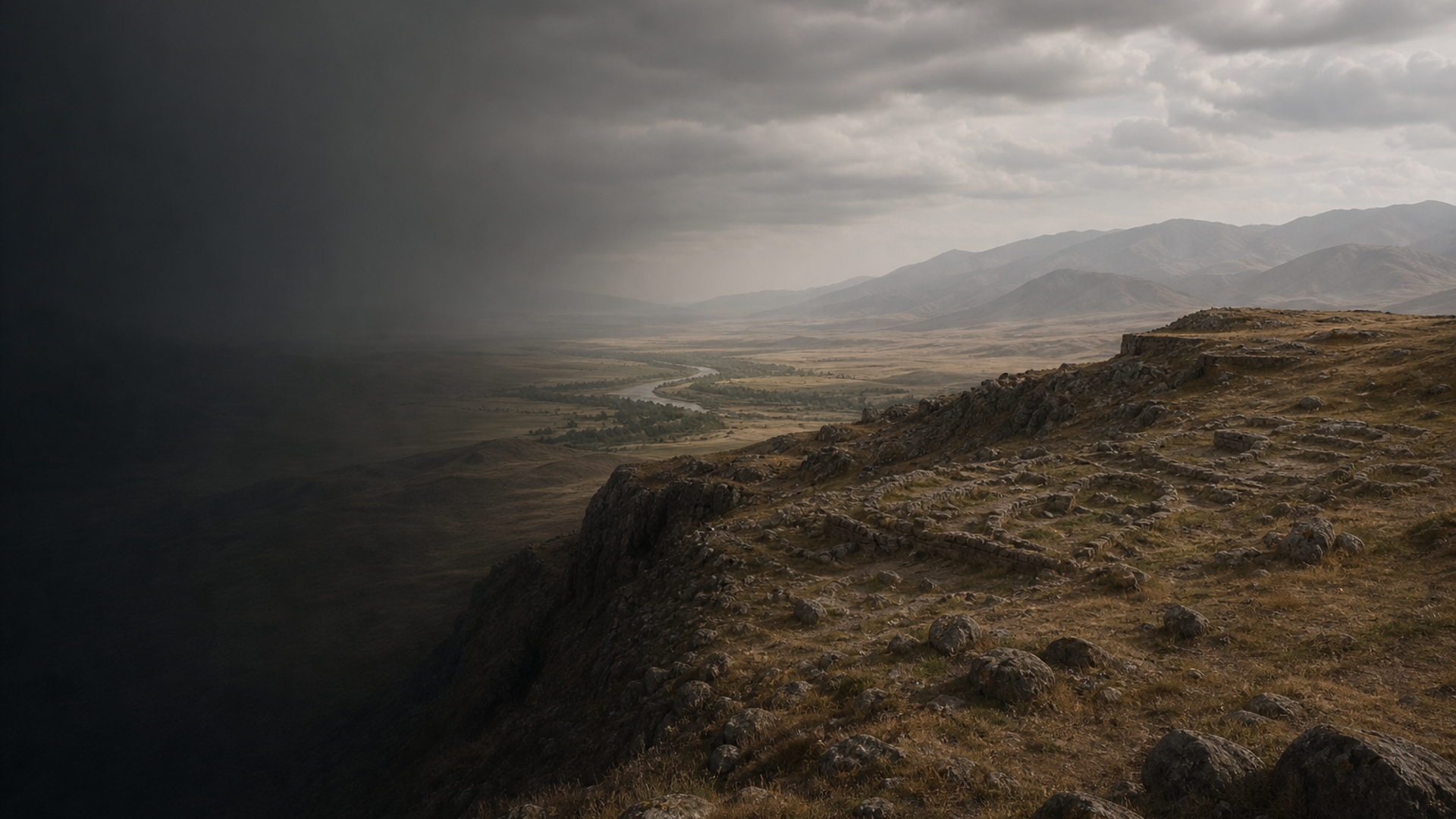
Seen against the cinematic backdrop of mountain ridgelines and river fog, Didnauri emerges as a place of both persistence and encounter—a Late Bronze Age node where long-standing Caucasian lifeways met broader currents in the ancient Near East and steppe margins.

  • Didnauri samples dated 1260–839 BCE, Late Bronze Age, eastern Georgia
  • Archaeological data indicates continuity with earlier Kura basin traditions
  • Site sits on routes connecting the Kura valley and northern Caucasus
Capítulo IV

Daily Life & Society

Archaeological remains around Didnauri evoke a world of terraced fields, herded flocks, and workshops glowing with bronze. Pottery fragments, hearths, and burial deposits suggest households organized around mixed farming and pastoralism, with seasonal movements up valleys and down to river plains. Buckets of grain, ceramic bowls, and occupational debris speak to daily rhythms: food preparation, craft production, and communal rites.

Burials found in the region frequently contain grave goods—tools, ornaments, and occasional metal items—that hint at social differentiation but not extreme hierarchy. The material record indicates networks of exchange: raw metals and exotic forms moved into the Kura basin, while local products circulated outward. Settlement patterns imply small communities, probably kin-based, with social life organized around clan or lineage ties rather than large urban polities.

Archaeological data indicates a resilient rural lifeway adapted to fluctuating climates and shifting trade. The impression is cinematic—smoke rising over corrugated roofs, shepherds threading high pastures, craftworkers hammering bronze—with everyday resilience framing occasional long-distance connections.

  • Economy centered on mixed farming, pastoralism, and local metallurgy
  • Burial goods suggest modest social differentiation and regional exchange
Capítulo V

Genetic Profile

The genetic snapshot from Didnauri_LBA is both tantalizing and provisional. All three sampled males carry Y-DNA haplogroup R, a broad West Eurasian lineage that includes diverse sub-branches associated in different contexts with both Steppe-derived populations and long-established Eurasian groups. The presence of R in all three men could reflect local prevalence of this lineage or reflect incoming male-mediated gene flow; with only three Y-chromosomes, distinguishing these scenarios is not yet possible.

Mitochondrial diversity among the three individuals—U7b, X2, and I5c—hints at mixed maternal ancestries. U7b is often seen in Near Eastern and Caucasian contexts, X2 has a wide Eurasian distribution, and I5c is less common but attested in Europe and adjacent regions. Together, these mtDNA lineages paint a picture of maternal inputs from both local Caucasian and wider West Eurasian reservoirs.

Crucially, the sample count is only three. When sample number is below 10, genetic patterns must be treated as preliminary: they can suggest possible connections but cannot robustly characterize population structure, admixture proportions, or demographic processes. Archaeogenetic interpretation therefore couples these DNA hints with archaeology: the Y-R signal aligns with known corridors of male mobility across the steppe and Caucasus, while mtDNA diversity resonates with a region long engaged in exchange with the Near East and Anatolia. Larger, better-contextualized datasets from Didnauri and neighboring sites are needed to confirm whether these patterns represent local norms or chance sampling.

  • All three males carry Y-DNA haplogroup R, suggesting potential Steppe or West Eurasian links
  • mtDNA (U7b, X2, I5c) indicates diverse maternal origins; conclusions remain preliminary due to N=3
Capítulo VI

Legacy & Modern Connections

The Didnauri_LBA assemblage offers a slender but evocative bridge to the deep past of Georgia. Genetic signals—Y-DNA R and a mix of maternal lineages—mirror the archaeological impression of a region both rooted in local Caucasian traditions and receptive to long-distance interactions. For modern populations in Georgia and the Caucasus, these data underscore continuity punctuated by episodes of contact rather than simple replacement.

Because the dataset is small, statements about direct ancestry to modern groups must remain cautious. Instead, Didnauri_LBA contributes to a growing tapestry of regional ancient DNA: when combined with larger series from the Kura basin and adjacent regions, it will help trace how Bronze Age communities shaped the genetic landscape of the South Caucasus and how networks of trade, migration, and kinship forged the cultural contours that echo into the present.

  • Points to continuity with regional Caucasian ancestry alongside external contacts
  • Small sample size limits direct claims of ancestry to modern populations
Com IA

Assistente de IA

Haz preguntas sobre la cultura Didnauri LBA: Voices from the Kura

Assistente de IA por DNAGENICS

Desbloquear esta função
Pregunta sobre la cultura Didnauri LBA: Voices from the Kura. El asistente con IA puede explicar hallazgos genéticos, contexto histórico, pruebas arqueológicas y conexiones modernas, con sus límites de interpretación.
Exemplo de análise com IA

La cultura Didnauri LBA: Voices from the Kura representa un capítulo de la historia humana...

A análise genética permite estudar semelhanças com populações anteriores e possíveis adaptações. As amostras de DNA antigo fornecem informações para investigar padrões migratórios e relações entre populações, com limites que dependem do estudo e do contexto arqueológico.

Esta é uma antevisão da análise com IA. Aceder ao assistente completo para explorar informações sobre:

  • Composição e similaridade genética
  • Padrões migratórios e origens
  • Vida cotidiana e práticas culturais
  • Contexto genético moderno

Explore mais culturas antigas

Descubra a história de civilizações de diferentes partes do mundo antigo