Saltar para o conteúdo principal
Cultura de destaque

Echoes from Albanian Highlands

Five early modern genomes connect village burials in Kukës and central Albania to wider Balkan threads

1400 CE - 1700 CE
Albania (Kukës District; Pazhok)

A História

Archaeological remains dated 1400–1700 CE from Bardhoc and Pazhok (Albania) yield five mtDNA profiles (H, U, T, J). Limited samples hint at maternal continuity with broader European and Near Eastern lineages; interpretations remain preliminary pending larger datasets.

Time Period

1400–1700 CE

Region

Albania (Kukës District; Pazhok)

Common Y-DNA

Not resolved (insufficient data)

Common mtDNA

H (2), U (1), T (1), J (1)

Cronologia

1400 CE

Early Ottoman presence in Albania

Ottoman expansion reshapes political control in the Balkans; rural communities adapt amid new administrative and military structures.

1444 CE

League of Lezhë

Local Albanian polities form an alliance under Skanderbeg; a notable episode in regional resistance to Ottoman rule.

1700 CE

Early modern rural continuity

Villages in northeastern and central Albania continue traditional agro-pastoral lifeways under shifting imperial contexts.

Origins & Emergence

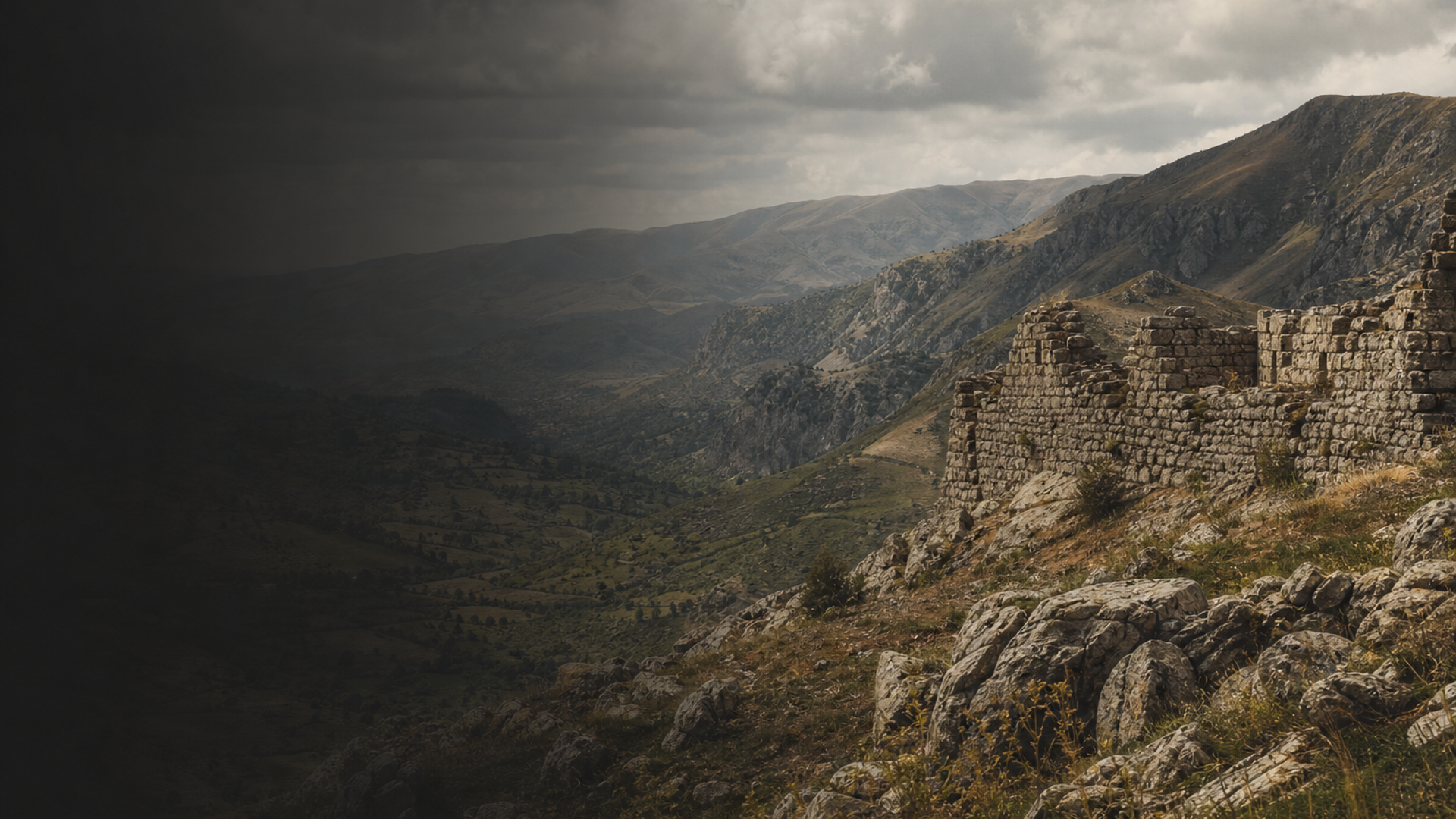
Set against the dramatic ridges of northeastern Albania and the rolling central valleys, the human remains sampled from Bardhoc (Kukës District) and Pazhok date to the long early-modern span from 1400 to 1700 CE. Archaeological data indicates these were rural communities that persisted through the upheavals of late medieval and Ottoman eras. Limited evidence suggests continuity of local settlement patterns rather than wholesale population replacement during this period.

The material record for this era in northern and central Albania is patchy: churchyards, small hamlet burials, and incidental finds dominate the archive. The five genomic samples analysed here were recovered from fieldwork contexts tied to local cemeteries and small-scale excavations; their radiocarbon and stratigraphic associations place them firmly within the 15th–17th centuries CE. While cinematic in their silence, these bones speak to slow processes — household continuity, episodic mobility, and connections to wider Balkan networks of trade and marriage.

Because the sample size is very small, any reconstruction of population processes must be cautious. Limited genetic snapshots can highlight possible links to broader European maternal lineages while leaving open many alternative histories until more samples and comparative datasets are available.

  • Samples dated 1400–1700 CE from Bardhoc and Pazhok
  • Archaeological contexts suggest small rural cemeteries and household continuity
  • Conclusions are preliminary given the small sample size

Daily Life & Society

The villages represented by Bardhoc and Pazhok were part of a landscape of mountain pastures, terraced fields, and narrow valley tracks. Archaeological traces from comparable Albanian villages of this period point to mixed agro-pastoral economies: cereal cultivation on low terraces, seasonal shepherding in upland pastures, and household crafts such as wool processing and small-scale metalworking.

Material culture from the region often incorporates long-lived local traditions alongside imported goods — Ottoman ceramics, coins, or glass that reached even remote hamlets through trade and military movements. Local burial practices retained strong community signatures: small, often clustered graves with modest personal items. Such patterns imply kin-based households and tight social networks where marriages, alliances, and mobility were regulated at the village and regional level.

Archaeology indicates resilience: despite political changes in the 15th–17th centuries, many communities show continuity in settlement organization and subsistence strategies. At the same time, periodic population movement — seasonal migration, trade-linked travel, and the forced movements that accompanied military campaigns — likely introduced new cultural and biological inputs into these rural gene pools.

  • Mixed agro-pastoral economy with seasonal transhumance
  • Material culture shows local continuity with occasional imported goods

Genetic Profile

Genetic analysis of the five samples reveals maternal lineages dominated by mtDNA haplogroup H (2 individuals), with single occurrences of U, T, and J. Haplogroup H is the most common maternal lineage across much of Europe and its presence here aligns with broad Eurasian maternal continuity from earlier Neolithic and post-Neolithic populations. Haplogroup U (often deeper Paleolithic/Neolithic substrata) and T and J (frequent in Neolithic and later Near Eastern-associated dispersals) point to a mosaic of maternal ancestries consistent with long-term connections across the Balkans and Mediterranean.

No consistent Y-chromosome pattern could be reported from this dataset (common Y-DNA fields are unresolved), either because male-specific data were not retrieved or because the sample size is insufficient. With only five genomes, statistical power is low: the observation of H twice may reflect local frequency, sampling bias, or chance. Archaeogenetic interpretation must therefore remain conservative.

Taken together with archaeological context, these maternal profiles suggest continuity with wider European maternal lineages while leaving room for gene flow from neighboring Balkan and Anatolian populations. Future work with larger sample sizes and genome-wide data is required to test hypotheses about admixture, sex-biased migration, or continuity with modern Albanian populations.

  • mtDNA: H (2), U (1), T (1), J (1) — suggests mixed European and Near Eastern maternal inputs
  • Sample size (n=5) is below 10 — genetic conclusions are preliminary

Legacy & Modern Connections

These five early-modern genomes act as careful, low-light beacons for understanding ancestral threads in Albania. Archaeological patterns of continuity in rural settlement and the presence of broadly European and Near Eastern maternal haplogroups align with a picture of the Balkans as a palimpsest of long-term local residence punctuated by episodic influxes.

While modern genetic studies of Albanians indicate complex ancestry shaped over millennia, the limited data here neither confirm nor refute continuity between 15th–17th-century villagers and present-day populations. Instead, these samples emphasize the need for broader regional sampling and paired archaeological context. Each additional genome will sharpen our picture: revealing whether observed mtDNA lineages reflect persistent maternal lines in local communities or the cumulative effects of mobility in a dynamic frontier zone.

  • Findings hint at maternal ties to wider European and Near Eastern pools
  • Greater sampling and genome-wide data needed to clarify links to modern Albanians

Assistente de IA

Assistente de IA por DNAGENICS

Desbloquear esta função
Pregunta sobre la cultura Echoes from Albanian Highlands. El asistente con IA puede explicar hallazgos genéticos, contexto histórico, pruebas arqueológicas y conexiones modernas, con sus límites de interpretación.
Exemplo de análise com IA

La cultura Echoes from Albanian Highlands representa un capítulo de la historia humana...

A análise genética permite estudar semelhanças com populações anteriores e possíveis adaptações. As amostras de DNA antigo fornecem informações para investigar padrões migratórios e relações entre populações, com limites que dependem do estudo e do contexto arqueológico.

Esta é uma antevisão da análise com IA. Aceder ao assistente completo para explorar informações sobre:

  • Composição e similaridade genética
  • Padrões migratórios e origens
  • Vida cotidiana e práticas culturais
  • Contexto genético moderno