A preparar o relatório

A carregar as informações e as referências disponíveis

Consultando el registro arqueológico...

Recopilando registros antiguos

Saltar para o conteúdo principal
Echoes from Cueva del Perico
Cultura de destaque

Echoes from Cueva del Perico

Archaeological and genetic traces of Archaic Cuba, Cueva del Perico I (Artemisa)

803 BCE - 800 CE
Artemisa province, Cuba (Cueva del Perico I)
Desplázate para começar
Capítulo I

A História

Comprender la cultura Echoes from Cueva del Perico

Archaic-period burials from Cueva del Perico I (Artemisa, Cuba; 803 BCE–800 CE) link archaeological context and ancient DNA. Eight samples show primarily Native American maternal lineages (D1, C, A2) and Y haplogroup Q—preliminary but evocative evidence of deep Caribbean ancestry.

Time Period

803 BCE – 800 CE

Region

Artemisa province, Cuba (Cueva del Perico I)

Common Y-DNA

Q (3), Q1b (1) — limited sample

Common mtDNA

D1 (5), C (2), A2 (1)

Capítulo II

Cronologia

Momentos-chave da história desta cultura

803 BCE

Earliest dated activity at Cueva del Perico I

Radiocarbon and stratigraphy place human presence and burials at Cueva del Perico I beginning around 803 BCE, marking part of the Archaic coastal occupation sequence.

Capítulo III

Origins & Emergence

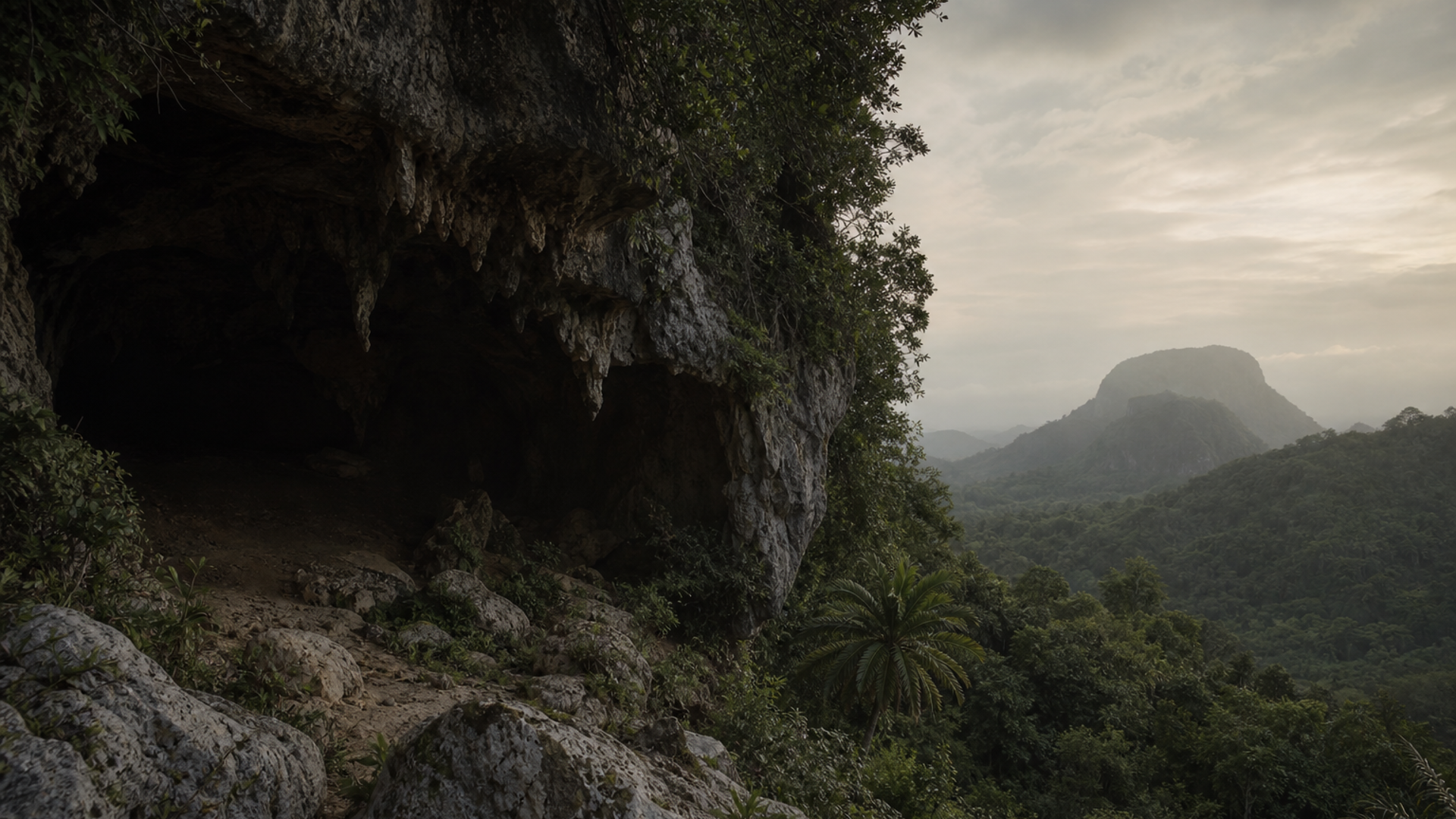
Beneath the limestone overhang of Cueva del Perico I, archaeologists uncovered a subtle archive of lives lived along Cuba's southwestern coast. Radiocarbon and stratigraphic indicators place human activity and burials within a broad Archaic span (approximately 803 BCE to 800 CE in these deposits). The material record is modest — shell middens, charred hearth lenses, simple flaked stone tools, and inhumations — but it points to a long-standing coastal lifeway.

These deposits evoke a maritime-foraging adaptation: people who navigated nearshore waters, harvested shellfish and fish, and moved seasonally within a mosaic of coastal habitats. The assemblage fits regional patterns of the Caribbean Archaic, where low-density populations left dispersed camps and burial hollows rather than large monumental sites. Archaeological data indicates continuity in tool forms and subsistence practices across centuries at Perico, suggesting local persistence rather than abrupt replacement.

From a cinematic vantage, Cueva del Perico shelters the faint soundscape of waves and firelight; scientifically, it preserves discrete episodes of occupation that allow direct sampling of ancient DNA. Limited sample numbers (eight individuals) mean that any reconstruction of origins remains provisional — these individuals offer a whispered, not yet full-throated, genetic chorus of early Cuban populations.

  • Occupations dated to c. 803 BCE–800 CE in Cueva del Perico I
  • Coastal-forager material culture: shell middens, hearths, flaked stone tools
  • Evidence suggests local continuity in Archaic coastal lifeways
Capítulo IV

Daily Life & Society

Life at Cueva del Perico would have been organized around the rhythm of the sea. People exploited mangroves, reefs, and nearshore shoals, processing shellfish and fish over open hearths and using lightweight stone tools and perforators for working shell and plant fiber. Burials found within the cave suggest small social groups with localized burial practices; grave placements and associated offerings are modest, reflecting egalitarian social structures typical of Archaic hunter-fisher communities.

Material traces convey a tactile world: shells piled in middens, scorched bone fragments, and wear patterns on stone tools. Seasonal mobility is likely — groups moving between coastal foraging stations and interior resources — but sedentism around rich estuarine locales is also possible. The archaeological record at Perico lacks large ceremonial architecture, which aligns with ethnographic and regional archaeological expectations for Archaic Caribbean societies where ritual life often left ephemeral or perishable signatures.

Skeletal data, while limited, provides glimpses of diet and health through isotopic and osteological indicators (where analyses have been conducted elsewhere in the region). Combined with DNA, these lines of evidence help reconstruct lifeways: what people ate, how they moved on the landscape, and how small communities formed social bonds through shared ancestry and mortuary practice.

  • Marine-focused subsistence with shell middens and hearths
  • Small-group burial practice suggesting egalitarian social organization
Capítulo V

Genetic Profile

Ancient DNA from eight individuals at Cueva del Perico I offers a rare genetic window into Archaic Cuba, but the sample size requires careful restraint. Maternal lineages are dominated by mtDNA haplogroup D1 (5 individuals), with two C lineages and one A2 — all matrilineal haplogroups widely recognized as founding Native American branches. On the paternal side, Y-chromosome data are represented primarily by haplogroup Q (three samples) and a single Q1b — again consistent with Indigenous American paternal ancestry.

These haplogroups align broadly with expectations from mainland and Caribbean ancient DNA: founding maternal lineages (A, B, C, D, X in the Americas) and Q-series patrilineages reflect early waves of peopling and subsequent regional diversification. At Perico, the dominance of D1 and presence of C and A2 may reflect local founder effects or drift in a small island population. The presence of Q and Q1b in the Y-chromosome record supports continuity with broader Native American paternal ancestry, though resolution beyond broad haplogroup assignment is limited by current data.

Genetic affinities implied by these markers suggest connection to pan-American founding ancestries rather than recent external inputs. However, with only eight individuals, population-level inferences — about migration routes, admixture events, or continuity into later Caribbean populations — remain preliminary. Additional sampling across sites and dense genome-wide data would be required to resolve finer-scale demographic history.

  • mtDNA dominated by D1 (5), with C (2) and A2 (1) — founding Native American maternal lineages
  • Y-DNA primarily Q (3) and Q1b (1), consistent with Indigenous American patrilines
Capítulo VI

Legacy & Modern Connections

Cueva del Perico's genetic and archaeological traces form a bridge between deep Caribbean prehistory and the living peoples of the region. The mtDNA and Y-DNA profiles recovered echo lineages found across the Americas, pointing to ancient shared ancestry that predates later historical movements. While direct descent lines between these particular eight individuals and modern Cuban communities cannot be asserted with certainty, the genetic signatures contribute to a broader story of continuity: the island was part of a network of early human settlement and movement across the Caribbean and adjacent mainland.

These findings also have cultural resonance. For modern communities seeking to reconnect with deep pasts, genetic data must be integrated respectfully with archaeological evidence and oral histories. Scientifically, Perico underscores the value of small caves and coastal shelters as repositories of human history, while genetically it highlights how founder effects and island demography can shape lineage frequencies over centuries. More extensive sampling and collaboration with descendant communities will strengthen the threads that tie ancient genomes to living heritage.

  • Genetic lineages at Perico resonate with pan-American founding ancestries
  • Findings are preliminary; continued sampling and community collaboration are essential
Com IA

Assistente de IA

Haz preguntas sobre la cultura Echoes from Cueva del Perico

Assistente de IA por DNAGENICS

Desbloquear esta função
Pregunta sobre la cultura Echoes from Cueva del Perico. El asistente con IA puede explicar hallazgos genéticos, contexto histórico, pruebas arqueológicas y conexiones modernas, con sus límites de interpretación.
Exemplo de análise com IA

La cultura Echoes from Cueva del Perico representa un capítulo de la historia humana...

A análise genética permite estudar semelhanças com populações anteriores e possíveis adaptações. As amostras de DNA antigo fornecem informações para investigar padrões migratórios e relações entre populações, com limites que dependem do estudo e do contexto arqueológico.

Esta é uma antevisão da análise com IA. Aceder ao assistente completo para explorar informações sobre:

  • Composição e similaridade genética
  • Padrões migratórios e origens
  • Vida cotidiana e práticas culturais
  • Contexto genético moderno

Explore mais culturas antigas

Descubra a história de civilizações de diferentes partes do mundo antigo