A preparar o relatório

A carregar as informações e as referências disponíveis

Consultando el registro arqueológico...

Recopilando registros antiguos

Saltar para o conteúdo principal
Echoes of Saudeleur: Man Nadol
Cultura de destaque

Echoes of Saudeleur: Man Nadol

Megalithic city-states on Pohnpei and mitochondrial traces of Pacific voyaging

1400 CE - 1797 CE
Pohnpei, Federated States of Micronesia (Temwen Island, Man Nadol)
Desplázate para começar
Capítulo I

A História

Comprender la cultura Echoes of Saudeleur: Man Nadol

Archaeological and genetic glimpses from Temwen Island (Man Nadol) link Saudeleur-era megaliths to Austronesian mitochondrial lineages. Eight samples (1400–1797 CE) show mtDNA B, suggesting regional continuity but limited sample size makes conclusions preliminary.

Time Period

1400–1797 CE

Region

Pohnpei, Federated States of Micronesia (Temwen Island, Man Nadol)

Common Y-DNA

Undetermined (insufficient male data)

Common mtDNA

B (8 samples)

Capítulo II

Cronologia

Momentos-chave da história desta cultura

1400 CE

Regional consolidation of Saudeleur power

Archaeological phases at Man Nadol align with intensified construction and centralized ritual architecture during the Saudeleur era.

1628 CE

Traditional overthrow of the Saudeleur

Oral histories record the overthrow of Saudeleur rulers and political reorganization; archaeological layers indicate shifts in site use.

1797 CE

Late Saudeleur-era contexts sampled

Sampled human remains date through the late 18th century, capturing final centuries of Saudeleur-era material culture.

Capítulo III

Origins & Emergence

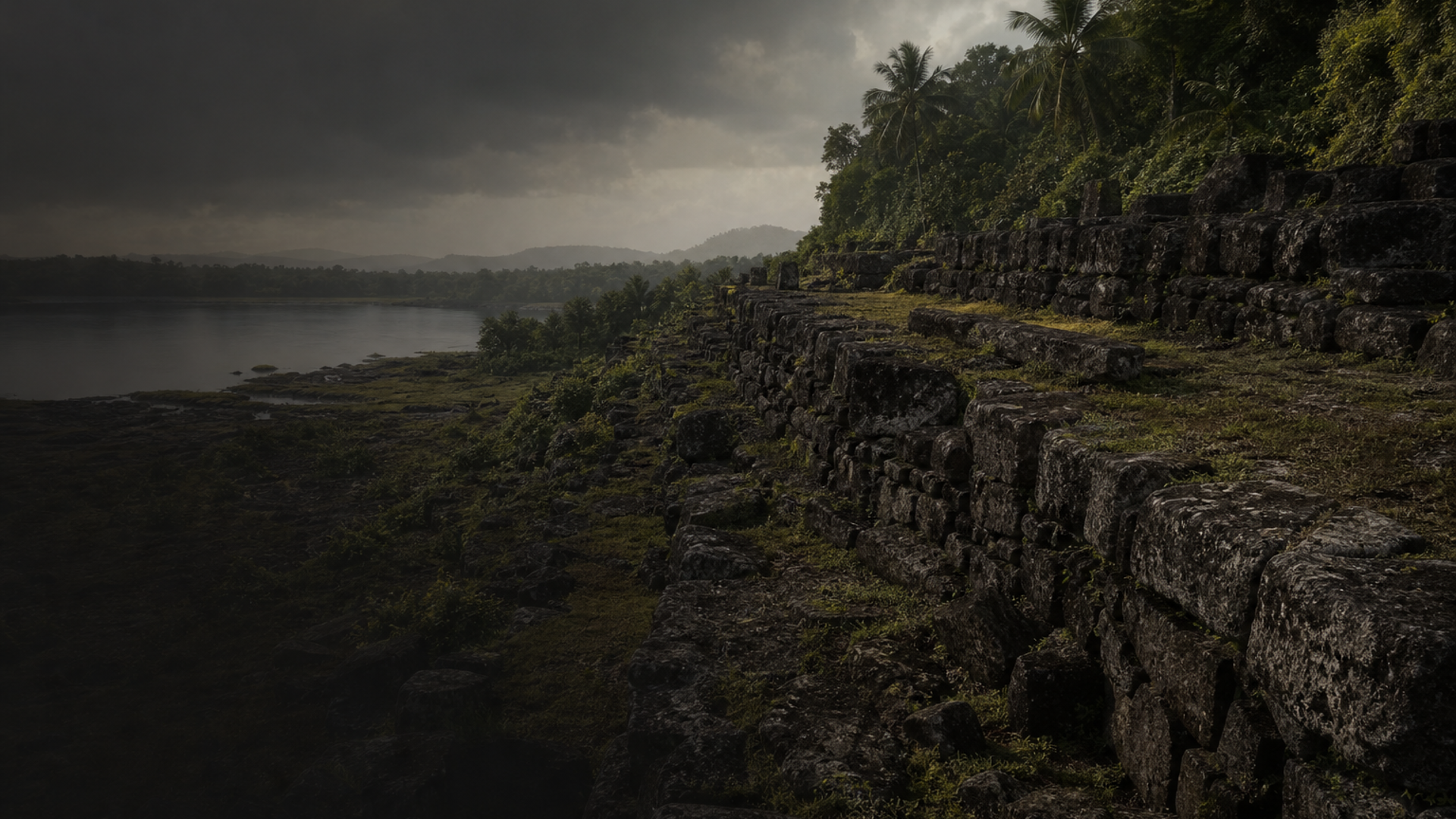
Rising like a city of basalt from a lagoon, the Saudeleur polity radiated authority across Pohnpei during the late first millennium CE into the second millennium. Archaeological excavation at Temwen Island — the complex often recorded here as Man Nadol — reveals a carefully engineered grid of islets, canals and stone platforms whose construction involved transported coral basalt and organized labor. Radiocarbon dates from associated domestic and ceremonial contexts fall within the broad range recorded here (1400–1797 CE), although earlier phases of monumental construction on Pohnpei may reach back several centuries before the Saudeleur consolidation.

Material culture from Man Nadol, including pottery styles, adzes, shell ornaments and the patterning of dwelling foundations, aligns with broader Central Pacific Austronesian maritime traditions. These features indicate sustained long-distance voyaging and exchange networks across Micronesia and into Island Melanesia and Polynesia. Archaeological data indicates centralized control over tribute and labor under the Saudeleur rulers, reflected in the scale of the monumentality. Limited evidence suggests that this centralization was superimposed on pre-existing local settlement patterns rather than entirely replacing them.

Because many site contexts have been disturbed and because the genetic sample set here is small, origins narratives remain partly conjectural; interdisciplinary work combining stratigraphy, radiocarbon dating and ancient DNA will sharpen timelines and the story of emergence.

  • Man Nadol (Temwen Island) is the principal megalithic center associated with the Saudeleur
  • Construction used imported basalt and coordinated labor, implying political centralization
  • Material culture ties to wider Austronesian maritime networks
Capítulo IV

Daily Life & Society

Life within and around the stone city would have been both ritualized and intensely maritime. Archaeological remains at Pahndauwas, Lemenkau and Peinioar within the Man Nadol complex point to dwellings clustered on raised platforms, fish-processing areas along tidal edges, and storage pits for taro and breadfruit — staples of Pohnpeian subsistence. Shell ornaments, carved wooden objects and worked basalt tools reflect skilled craft traditions and social differentiation.

Ethnohistoric accounts and archaeological patterns indicate a stratified society in which elite Saudeleur chiefs exercised control over tribute and labor, while kin-based fishing and farming groups managed day-to-day subsistence. Ceremonial platforms and tombs within the complex likely hosted rites that reinforced elite authority and cosmological orders. Ceramic sherds and botanical remains recovered in excavations show routine exchange of foodstuffs and objects with neighboring islands, consistent with long-distance canoe voyaging.

Archaeological data indicates coastal modification for canoe landing and fish traps, while midden assemblages document diet and seasonality. However, preservation biases — tropical soils and sea-level changes — limit direct visibility into domestic life. Where funerary contexts are preserved, they offer windows into social status, diet and mobility, but surviving samples are few, so reconstructions of daily life remain provisional and benefit from continued, careful excavation.

  • Raised platforms, fish-processing zones and storage pits indicate mixed farming and fishing
  • Evidence for social stratification and ritual architecture within the megalithic complex
Capítulo V

Genetic Profile

Genetic sampling from three loci within the Man Nadol complex (Pahndauwas, Lemenkau, Peinioar) yielded eight mitochondrial genomes, all assigned to mtDNA haplogroup B. Haplogroup B is widespread among Austronesian-speaking populations across Island Southeast Asia and the Pacific and is commonly interpreted as a genetic signature of past maritime dispersals. The uniform presence of mtDNA B in these eight samples suggests maternal continuity with broader Pacific populations during the Saudeleur era.

However, the sample count is small (n=8), and all reported markers are mitochondrial; no robust Y-chromosome patterns can be inferred from the present data set. This limits conclusions about paternal ancestry, sex-biased migration, or the genetic structure of elite versus non-elite groups. Archaeological contexts for sampled individuals vary, and post-depositional disturbance can bias which burials remain available for analysis.

Interpreting mtDNA B in this context should be cautious: while it points to links with Austronesian voyaging networks, mtDNA alone cannot resolve the timing or directionality of migrations. Future work combining genome-wide ancient DNA, more samples (especially male individuals for Y-DNA), and direct radiocarbon dates will be essential to test whether the Saudeleur polity represents local continuity, admixture with incoming groups, or a combination of both. For now, the genetic signal is evocative but preliminary.

  • All eight samples show mtDNA haplogroup B, aligning with Austronesian maternal lineages
  • No reliable Y-DNA pattern available; sample size (n=8) is small and conclusions are provisional
Capítulo VI

Legacy & Modern Connections

The stone city of Man Nadol remains a powerful cultural landmark for modern Pohnpeians and a touchstone for Pacific identity. Archaeological structures preserve memory-scapes of political power, ritual life and maritime connectivity that shaped the Saudeleur era. The genetic traces — notably mtDNA B in the sampled individuals — echo living maternal lineages carried in contemporary Micronesian communities, suggesting threads of continuity in maternal ancestry despite centuries of change.

These connections are locally significant: modern Pohnpeian oral histories, place names and customary practices resonate with the archaeological record, and community collaboration in research is essential. Given the limited genetic dataset, however, any claims about direct descent or replacement must be framed cautiously. Expanded sampling, respectful engagement with descendant communities, and integrated archaeological science will deepen understanding of how ancient Saudeleur society connects to present-day Pohnpei.

  • Man Nadol remains central to Pohnpeian heritage and identity
  • Preliminary genetic continuity (mtDNA B) links ancient maternal lines to broader Pacific populations
Com IA

Assistente de IA

Haz preguntas sobre la cultura Echoes of Saudeleur: Man Nadol

Assistente de IA por DNAGENICS

Desbloquear esta função
Pregunta sobre la cultura Echoes of Saudeleur: Man Nadol. El asistente con IA puede explicar hallazgos genéticos, contexto histórico, pruebas arqueológicas y conexiones modernas, con sus límites de interpretación.
Exemplo de análise com IA

La cultura Echoes of Saudeleur: Man Nadol representa un capítulo de la historia humana...

A análise genética permite estudar semelhanças com populações anteriores e possíveis adaptações. As amostras de DNA antigo fornecem informações para investigar padrões migratórios e relações entre populações, com limites que dependem do estudo e do contexto arqueológico.

Esta é uma antevisão da análise com IA. Aceder ao assistente completo para explorar informações sobre:

  • Composição e similaridade genética
  • Padrões migratórios e origens
  • Vida cotidiana e práticas culturais
  • Contexto genético moderno

Explore mais culturas antigas

Descubra a história de civilizações de diferentes partes do mundo antigo