A preparar o relatório

A carregar as informações e as referências disponíveis

Consultando el registro arqueológico...

Recopilando registros antiguos

Saltar para o conteúdo principal
Marmara Roman Communities
Cultura de destaque

Marmara Roman Communities

Lives at Iznik (Nicaea) and Apollonia seen through archaeology and maternal DNA

100 BCE - 400 CE
Marmara region, modern Turkey (Iznik, Gölyazı)
Desplázate para começar
Capítulo I

A História

Comprender la cultura Marmara Roman Communities

Archaeological remains from Iznik (Basilica) and Apollonia (Gölyazı) dated 100 BCE–400 CE reveal cosmopolitan Roman-period communities in the Marmara. Four maternal genomes hint at mixed Anatolian–Mediterranean ancestries; conclusions remain preliminary.

Time Period

100 BCE – 400 CE

Region

Marmara region, modern Turkey (Iznik, Gölyazı)

Common Y-DNA

Not reported / limited data

Common mtDNA

I (I1), N, H, H5 (each observed once; n=4)

Capítulo II

Cronologia

Momentos-chave da história desta cultura

325 CE

First Council of Nicaea (historic proximity to Iznik)

The 325 CE council convened in Nicaea (modern Iznik), reflecting the region's religious and administrative importance in Late Antiquity.

Capítulo III

Origins & Emergence

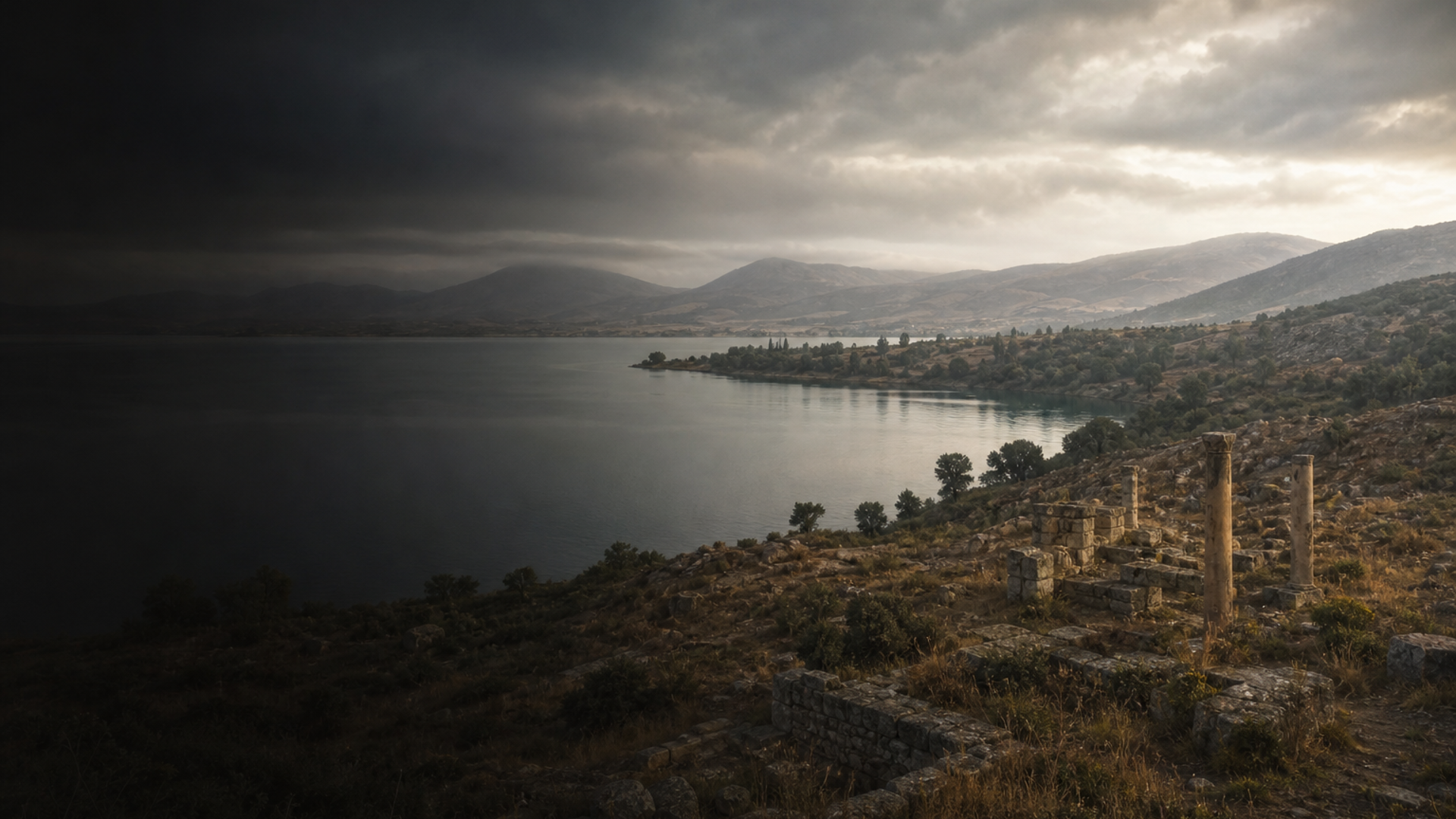
The sites represented by the Turkey_Roman_2 assemblage—Basilica at Iznik (ancient Nicaea) and Apollonia at Gölyazı—sit on the gently rimmed inland sea of the Marmara, a landscape of lakes, rivers and trade routes that linked Anatolia to the Aegean and Black Seas. Archaeological data indicates continuous habitation layered over Hellenistic and earlier Anatolian occupation, with urban rebuilding, civic architecture and Christian basilicas visible in the archaeological record between the late Republic and Late Antiquity (circa 100 BCE–400 CE).

Material remains from this period in Bithynia and adjacent provinces commonly show re-used classical masonry, new public buildings, and harbor installations that served both inland commerce and long-distance maritime networks. Epigraphic and architectural evidence across the region point to a mosaic of local Anatolian traditions and imported Roman institutions: provincial administration, new cultic spaces, and Christian congregational architecture by the fourth century. Limited evidence from the four sampled individuals suggests they lived within these dynamic, multiethnic towns—communities shaped by local continuity and incoming peoples, merchants and officials whose movements were propelled by trade, military service and religious change.

Archaeological interpretation must remain cautious: the material landscape is rich, but genetic sampling here is small, so any narrative of origin and emergence must be framed as provisional and open to revision as more data accrue.

  • Sites: Basilica (Iznik/Nicaea) and Apollonia (Gölyazı) in the Marmara region
  • Timeframe: Roman Period 2 (100 BCE–400 CE), provincially Bithynia and surrounding areas
  • Evidence shows urban continuity with Hellenistic roots and Roman-era rebuilding
Capítulo IV

Daily Life & Society

Life in the Marmara towns of the Roman era unfolded at the meeting point of inland agriculture and maritime exchange. Archaeological deposits from urban quarters and harbor margins show ceramics from local Anatolian workshops alongside amphorae and fine wares that arrived from the Aegean, eastern Mediterranean and Black Sea—evidence of a diet and economy shaped by both local produce and imported staples. The presence of basilica architecture at Iznik implies organized Christian communities and public liturgical life by the fourth century.

Craft production, small-scale industry, and boat traffic shaped daily rhythms. Body stands of stone, reused column fragments, and the stratigraphy of domestic floors indicate neighborhoods rebuilt over generations. Tombs and burial practices occasionally reveal mixtures of Roman funerary forms and earlier Anatolian rites; however, many funerary contexts are under-sampled at the sites in question. Archaeobotanical and zooarchaeological studies across Bithynia show mixed farming—cereals, olives, grapes—and animal husbandry that underpinned urban provisioning.

Mobility was a defining feature: merchants, sailors, soldiers and pilgrims traversed these waterways. Such movement left imprints in trade goods and, potentially, in the genetic record—maternal lineages can reflect networks of women who moved with families, markets and religious communities.

Bulleted glimpses of urban life:

  • Economy combined local farming with maritime trade and craft production
  • Religious life included early Christian congregations alongside traditional cults
Capítulo V

Genetic Profile

DNA data from Turkey_Roman_2 comprise four mitochondrial genomes (mtDNA) sampled from Iznik and Apollonia, dated to roughly 100 BCE–400 CE. The observed mtDNA haplogroups are I (reported as I1 in the dataset), N, H and H5 — each represented once. These maternal lineages paint a picture of diversity consistent with a frontier of interaction between Anatolian, Mediterranean and broader European maternal ancestries.

Haplogroup H and its subclade H5 are widespread across Europe and the Near East in antiquity and the present day; their presence here is compatible with long-standing Anatolian and Mediterranean connections. Haplogroup N is an older West Eurasian basal lineage that appears intermittently in Near Eastern and European contexts and may reflect deeper local ancestry components. The mtDNA I lineage (not to be confused with Y-DNA I) is less common but documented across Eurasia and can signal northern/European links or local Anatolian variants—interpretation depends on subclade resolution not available in summary counts.

Crucially, no common Y-DNA pattern is reported for these samples, so paternal lineages and sex-biased mobility remain unresolved. With n=4, sample size is very small: limited evidence suggests mixed maternal origins, but conclusions about population structure, migration magnitudes, or continuity with earlier/modern populations are preliminary. Broader conclusions require larger, geographically and temporally distributed genomic datasets, Y-chromosome data and autosomal analyses to quantify ancestry components and detect sex-biased demographic processes.

  • mtDNA diversity (I, N, H, H5) suggests mixed Anatolian–Mediterranean maternal ancestries
  • Small sample size (n=4) and lack of Y-DNA cautions against strong population-level claims
Capítulo VI

Legacy & Modern Connections

The archaeological and preliminary genetic signals from Iznik and Apollonia speak to a lasting legacy: the Marmara corridor remained a conduit of people and ideas, shaping cultural and biological landscapes over centuries. Modern populations of northwestern Anatolia carry layered ancestries from Neolithic farmers, Bronze Age peoples, Greek colonial presence, Roman provincial integration and later migrations. The mtDNA snapshot from Roman-period Marmara aligns with this palimpsest—maternal lineages that are both locally rooted and regionally connected.

However, given the tiny sample set, these four mitochondrial genomes should be read as hints rather than answers. They illuminate how Roman-era mobility may have left maternal traces in coastal and inland communities, but do not yet reveal the full tapestry of ancestry or the degree of continuity into the medieval and modern eras. Future comparative studies—integrating more ancient genomes, Y-chromosome data and autosomal profiles—will clarify how these Roman-period towns contributed to the genetic mosaic of Anatolia today.

  • Marmara remained a long-term crossroads influencing modern northwestern Anatolian ancestry
  • Current genetic inferences are provisional; more ancient genomes are needed for robust links
Com IA

Assistente de IA

Haz preguntas sobre la cultura Marmara Roman Communities

Assistente de IA por DNAGENICS

Desbloquear esta função
Pregunta sobre la cultura Marmara Roman Communities. El asistente con IA puede explicar hallazgos genéticos, contexto histórico, pruebas arqueológicas y conexiones modernas, con sus límites de interpretación.
Exemplo de análise com IA

La cultura Marmara Roman Communities representa un capítulo de la historia humana...

A análise genética permite estudar semelhanças com populações anteriores e possíveis adaptações. As amostras de DNA antigo fornecem informações para investigar padrões migratórios e relações entre populações, com limites que dependem do estudo e do contexto arqueológico.

Esta é uma antevisão da análise com IA. Aceder ao assistente completo para explorar informações sobre:

  • Composição e similaridade genética
  • Padrões migratórios e origens
  • Vida cotidiana e práticas culturais
  • Contexto genético moderno

Explore mais culturas antigas

Descubra a história de civilizações de diferentes partes do mundo antigo